Calcium Carbonate Knowledge Hub
Calcium Carbonate Properties: Purity, Whiteness, Density and Hardness
2026-09-03 16:36:56
We are Liming Heavy Industry, a manufacturer of various types of industrial crushers, such as Raymond Mill, Trapezoidal Mill, Vertical Mill, Ultrafine Mill, Ball Mill, etc.
Our mills can process the following minerals:
limestone, quicklime, kaolin, talc, barite, bentonite, calcium carbonate, dolomite, coal, gypsum, clay, carbon black, slag, cement raw materials, cement clinker, etc.
If you need a mill to process stone or minerals into powder, please feel free to contact me (WhatsApp: +8615333807511). Thank you.
Calcium carbonate properties determine whether a powder is suitable for plastics, PVC, paper, paint, rubber, sealants, adhesives, construction materials, and other industrial applications. Although calcium carbonate is commonly identified by the formula CaCO3, industrial performance depends on much more than chemical composition.
Purity, whiteness, density, hardness, particle size, moisture, impurity level, and surface treatment all influence how calcium carbonate behaves during processing and in the finished product. Understanding these properties helps manufacturers select a calcium carbonate grade that balances cost, processing efficiency, appearance, and performance.
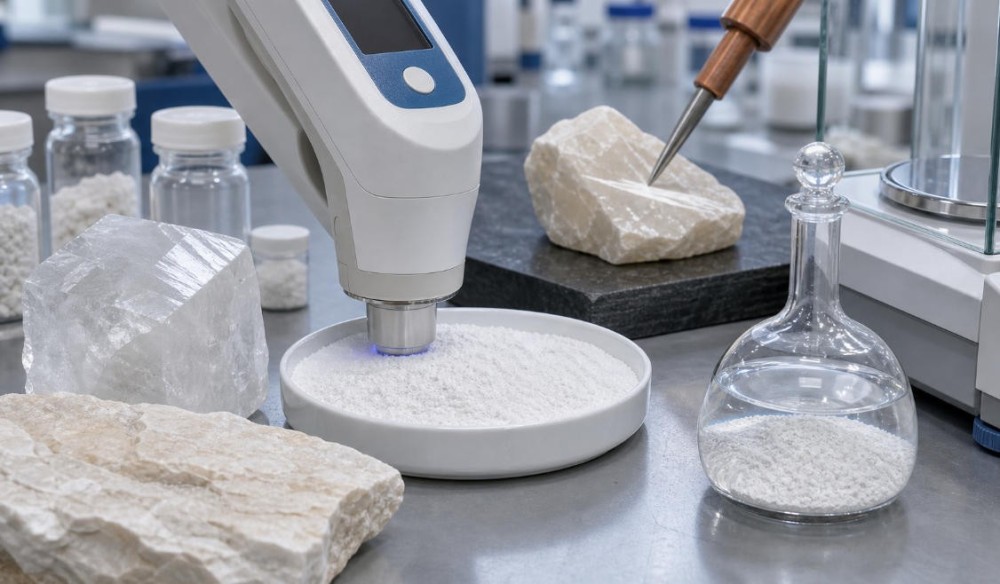
Calcium Carbonate Property Overview
| Property | Why It Matters | Typical Industrial Relevance |
|---|---|---|
| CaCO3 purity | Indicates mineral quality and impurity level | Whiteness, processing stability, suitability for premium applications |
| Whiteness | Measures visual brightness and color quality | Paint, paper, coatings, plastics, artificial stone |
| True density | Describes the density of the mineral itself | Formulation calculations, material characterization |
| Bulk density | Describes powder density after packing or handling | Storage, conveying, packing, dosing, transport |
| Mohs hardness | Indicates scratch resistance and relative softness | Grinding energy, equipment wear, processing behavior |
| Particle size | Controls surface area and powder performance | Dispersion, viscosity, gloss, stiffness, smoothness |
| Moisture | Affects storage and processing stability | PVC, masterbatch, rubber, coatings, sealants |
What Determines Calcium Carbonate Quality?
Calcium carbonate quality begins with the mineral deposit. Limestone, marble, chalk, and calcite can all contain calcium carbonate, but they do not have the same chemical composition, whiteness, mineral structure, or impurity content.
For example, two calcium carbonate powders may both be described as 800-mesh powder, yet they can perform very differently in a PVC pipe, paint formulation, or silicone sealant. One may have higher CaCO3 purity and better whiteness, while another may contain more silica, iron, clay, dolomite, or other impurities. One may have a controlled particle-size distribution, while another may include too many coarse particles.
For this reason, industrial buyers should evaluate a calcium carbonate grade as a complete specification rather than relying only on mesh size or price.
Calcium Carbonate Purity
Purity usually refers to the percentage of calcium carbonate in the material. A higher CaCO3 content generally indicates that the mineral contains fewer non-carbonate components, although the full chemical analysis remains important.
Pure calcium carbonate has a molecular weight of approximately 100.09 g/mol. In theoretical composition, it contains about 40.04% calcium, 12.00% carbon, and 47.96% oxygen by mass.
Why Purity Matters
High purity is often important because impurities can affect powder color, processing behavior, final-product consistency, equipment wear, and application suitability. The most common impurities in natural calcium carbonate raw materials may include:
Silica: Can increase abrasiveness and may affect product smoothness, whiteness, and equipment wear.
Iron-bearing minerals: Can reduce whiteness and introduce yellow, gray, or reddish tones.
Magnesium-bearing minerals: May indicate dolomite or other carbonate minerals rather than pure calcite.
Clay and aluminosilicate minerals: Can lower brightness, alter rheology, and affect dispersion.
Organic matter: Can influence color, odor, moisture behavior, and thermal performance.
How Is Purity Reported?
Suppliers commonly report CaCO3 content as a percentage, together with chemical-analysis values for SiO2, MgO, Fe2O3, Al2O3, moisture, and acid-insoluble residue. The exact reporting format varies by producer and end-use industry.
For general fillers, a grade with consistent quality and acceptable impurity levels may be sufficient. For high-whiteness coatings, premium paper, fine plastics, specialty sealants, food-related products, pharmaceutical products, or engineered materials, stricter purity and contaminant control may be required.
Calcium Carbonate Whiteness
Whiteness refers to how white a calcium carbonate powder appears under defined testing conditions. It is one of the most important visual properties for products where color, brightness, opacity, or surface appearance matters.
High whiteness is particularly valuable in white PVC products, paint, paper, coatings, artificial stone, wall putty, sealants, cable compounds, masterbatch, and consumer-facing plastic products.
What Affects Whiteness?
Whiteness is influenced by both the original mineral and the production process. Key factors include:
Raw-material quality: High-purity calcite and white marble can provide better starting whiteness than impure limestone.
Iron content: Iron-bearing minerals can create yellow, brown, gray, or reddish discoloration.
Clay and silica impurities: These can reduce brightness and produce a duller appearance.
Particle size: Fine particles may scatter light differently from coarse particles, affecting apparent whiteness and brightness.
Processing cleanliness: Contamination from handling, grinding media, dust, or poor storage can affect final powder color.
Moisture and storage conditions: Moisture, contamination, and poor warehouse conditions can reduce product appearance over time.
Whiteness vs. Brightness
Whiteness and brightness are related but not always identical values. Whiteness broadly describes the visual perception of a material’s white appearance, while brightness may refer to reflected light measured at a specific wavelength or under a specified optical standard.
For purchasing and quality control, the test method matters. A reported whiteness value should always be reviewed together with the instrument, sample-preparation method, test standard, and measurement conditions. Comparing values from different laboratories without confirming the method can be misleading.
Calcium Carbonate Density
Density is an important calcium carbonate property, but the term can refer to more than one measurement. The most common distinction is between true density and bulk density.
True Density
True density, also called specific gravity or particle density, refers to the density of the solid mineral itself, excluding air spaces between powder particles. For calcite, the most common mineral form of calcium carbonate, the density is approximately 2.71 g/cm3.
True density is mainly useful for material characterization, formulation design, volume calculations, and comparison with other mineral fillers such as talc, kaolin, barite, silica, or titanium dioxide.
Bulk Density
Bulk density refers to the mass of powder contained in a given volume, including the air gaps between particles. It is not a fixed mineral constant. Bulk density can vary significantly depending on particle size, particle shape, particle-size distribution, moisture content, compaction, surface coating, and handling method.
For example, a loosely filled ultrafine powder may occupy a large volume and show relatively low bulk density. The same powder may have a higher bulk density after vibration, transportation, storage, or mechanical compaction. PCC often has a lower bulk density than GCC because of its engineered particle morphology and more open powder structure.
Why Density Matters in Production
Bulk density affects practical operations throughout a calcium carbonate plant and downstream manufacturing line:
Silo capacity and storage planning.
Bagging weight and packaging volume.
Truck and container loading efficiency.
Screw feeder and pneumatic-conveying design.
Volumetric dosing accuracy in plastic, paint, rubber, and sealant production.
Material flow through hoppers, bins, mixers, and extruders.
When comparing calcium carbonate quotations, a buyer should distinguish between true density and bulk density. A supplier may quote one value while the manufacturing process requires the other.
Calcium Carbonate Hardness
Hardness indicates a material’s resistance to scratching or abrasion. Most industrial calcium carbonate is based on calcite, which has a Mohs hardness of approximately 3. Calcite is therefore relatively soft compared with quartz, which has a Mohs hardness of 7.
This relatively low hardness is one reason calcium carbonate is widely used as a mineral filler. Compared with harder minerals, it can be ground efficiently and may cause less wear in processing equipment, depending on the impurity level and the full mineral composition.
Why Hardness Matters for Grinding
Hardness affects grinding energy, mill selection, grinding-media wear, classifier performance, and the achievable powder fineness. Calcite-rich calcium carbonate is generally easier to grind than high-silica materials, but the actual performance of a feedstock depends on more than the Mohs hardness of calcite alone.
A limestone deposit with high silica content may behave more abrasively than a high-purity calcite deposit, even if both are described as calcium carbonate raw materials. Therefore, mineralogical testing and chemical analysis are important before selecting a grinding mill, classifier, wear protection system, or ultrafine powder-production line.
Why Hardness Matters for End Users
For plastics, paper, paint, rubber, and sealants, calcium carbonate’s relatively low hardness can be beneficial because it is generally less abrasive than harder fillers. This may help reduce wear in extruders, mixers, pumps, dies, and other processing components.
However, performance still depends on the actual grade. A calcium carbonate powder with contamination from quartz or other abrasive minerals may create more wear than expected. Buyers should review silica content, acid-insoluble residue, and mineralogical data when equipment wear is a critical concern.
Other Important Calcium Carbonate Properties
Particle Size and Particle-Size Distribution
Particle size is one of the most influential calcium carbonate parameters. It affects surface area, dispersion, viscosity, smoothness, gloss, stiffness, opacity, mechanical properties, and loading level in the final product.
Industrial grades may be described by mesh size, microns, D50, D97, residue, or specific surface area. These specifications should not be treated as interchangeable. For example, a mesh number gives a sieve-related description, while D50 and D97 describe points on a particle-size distribution curve.
Moisture Content
Moisture is especially important for plastic compounding, PVC processing, masterbatch, rubber, coatings, adhesives, and sealants. Excess moisture can affect powder flow, storage stability, dispersion, processing consistency, and final-product appearance.
Low moisture alone does not guarantee good performance. The powder must also be protected from humidity during storage, transport, and handling, particularly in humid climates or long-distance export shipments.
Oil Absorption
Oil absorption is commonly evaluated for calcium carbonate used in paints, coatings, inks, rubber, adhesives, and sealants. It indicates how much oil or binder a powder may require to achieve a workable formulation.
Finer particles and powders with higher surface area generally require more binder or liquid components. This can affect formulation viscosity, raw-material cost, and final performance.
Surface Treatment
Surface treatment is especially relevant for calcium carbonate used in hydrophobic systems such as PVC, polyethylene, polypropylene, rubber, and many sealant formulations. A coated calcium carbonate grade may disperse more effectively in these systems than an untreated grade.
Surface treatment should be evaluated together with coating amount, moisture level, particle size, oil absorption, resin type, processing temperature, and the complete compound formulation.
How to Evaluate a Calcium Carbonate Specification Sheet
A calcium carbonate technical data sheet should provide enough information to assess whether a grade matches the final application. At minimum, industrial users should review the following items:
CaCO3 content or assay.
Whiteness or brightness, including the test method where available.
Particle-size data, such as D50, D97, residue, or mesh specification.
True density and bulk density, clearly identified as separate parameters.
Moisture content.
Oil absorption, if relevant to the application.
Surface-treatment type and coating level for coated grades.
Silica, iron, magnesium, acid-insoluble residue, and other impurity data.
Packaging format, storage conditions, and batch consistency controls.
For critical applications, laboratory testing in the actual production formulation is still necessary. A technical data sheet can help shortlist suitable grades, but it cannot fully predict performance in every polymer resin, paint system, rubber compound, paper process, adhesive formulation, or production line.
Frequently Asked Questions
What is the purity of calcium carbonate?
Purity refers to the percentage of CaCO3 in a calcium carbonate material. The suitable purity level depends on the application. High-value white products, premium coatings, paper, plastics, pharmaceutical products, and regulated applications generally require stricter impurity control than basic construction fillers.
What is the density of calcium carbonate?
The true density of calcite, the most common mineral form of calcium carbonate, is approximately 2.71 g/cm3. Bulk density varies by powder grade, particle shape, fineness, moisture, packing, and handling conditions.
What is the Mohs hardness of calcium carbonate?
Calcite-based calcium carbonate has a Mohs hardness of about 3. It is relatively soft compared with quartz, which has a Mohs hardness of 7.
Why is high whiteness important in calcium carbonate?
High whiteness is important for applications where final-product color and appearance matter, including white PVC, paper, paint, coatings, artificial stone, wall putty, cable compounds, and premium plastic products.
Does a higher CaCO3 content always mean better calcium carbonate?
Not always. High purity is valuable, but the best grade also depends on particle size, whiteness, moisture, surface treatment, bulk density, oil absorption, impurity type, dispersion, and the requirements of the final application.
Conclusion
Purity, whiteness, density, and hardness are essential calcium carbonate properties, but they should be evaluated together rather than in isolation. A high-quality calcium carbonate powder should match the performance requirements of the target product and the realities of the manufacturing process.
For industrial users, the right calcium carbonate grade is defined by a complete set of specifications: chemical composition, visual quality, particle-size distribution, density, moisture, impurity control, surface treatment, and reliable batch-to-batch consistency. Selecting the correct grade can improve product appearance, processing stability, equipment life, and overall formulation economics.