Calcium Carbonate Knowledge Hub
How to Choose a Calcium Carbonate Grinding Mill
2026-09-04 17:05:32
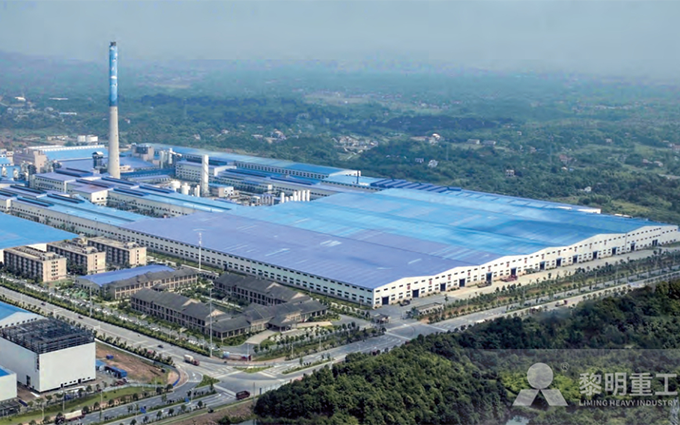
We are Liming Heavy Industry, a manufacturer of various types of industrial crushers, such as Raymond Mill, Trapezoidal Mill, Vertical Mill, Ultrafine Mill, Ball Mill, etc.
Our mills can process the following minerals:
limestone, quicklime, kaolin, talc, barite, bentonite, calcium carbonate, dolomite, coal, gypsum, clay, carbon black, slag, cement raw materials, cement clinker, etc.
If you need a mill to process stone or minerals into powder, please feel free to contact me (WhatsApp: +8615333807511). Thank you.
Choose a calcium carbonate grinding mill by starting with the finished powder specification: target particle-size distribution, required capacity, feed size and moisture, source-rock quality, downstream coating needs, and the end market. A mill selected only by nominal mesh or nameplate capacity often creates costly problems in product consistency, energy use, classifier performance, and plant uptime.
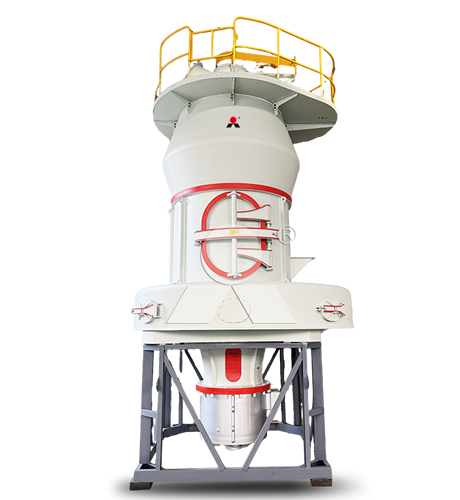
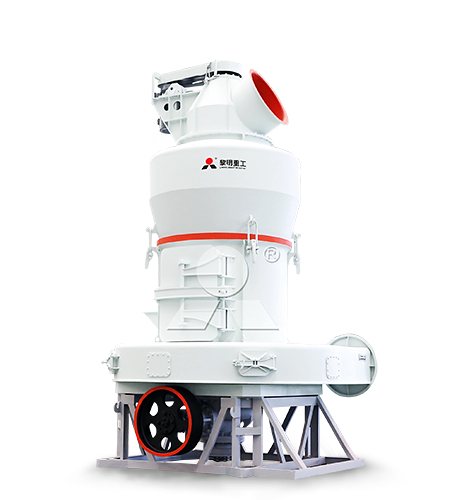
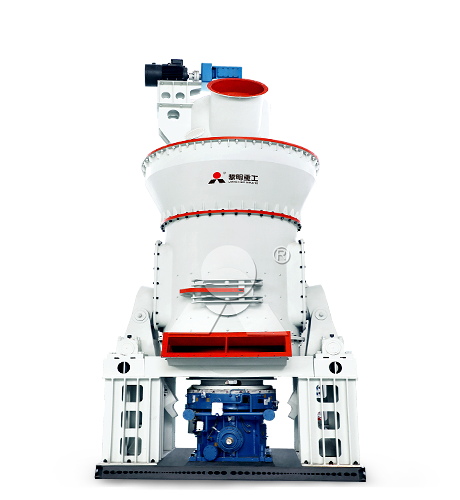
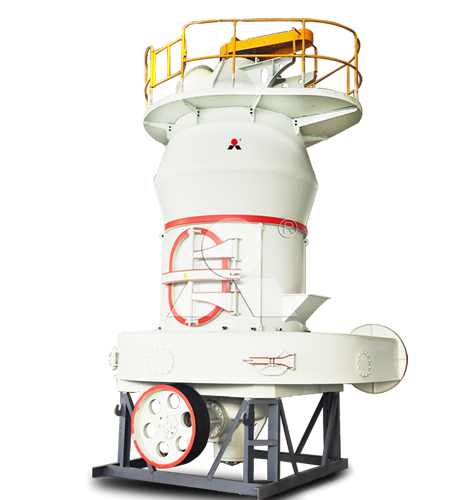
For standard GCC, an MTW Raymond mill is usually a practical choice for conventional fine powder; an LM vertical roller mill suits large-capacity production where integrated drying is valuable; an MW micro powder mill fits fine and ultrafine dry GCC; and an LUM ultrafine mill is appropriate when consistently fine, narrow-distribution high-value powder is the goal. The final decision should be based on trial material and a guaranteed product PSD—not a generic mesh claim.
Start with the product target
“Calcium carbonate powder” covers a wide range of products. A 200-mesh construction filler, a 325-mesh PVC filler, a fine coating-grade GCC, a 5–10 µm plastic grade, and an ultrafine powder for premium paper or paint have different process requirements.
Before selecting a grinding mill, define the product using measurable quality targets:
Target particle-size distribution: D10, D50, D90, D97, or D98.
Required product fineness and permitted coarse-particle residue.
Annual production volume, operating hours, and required hourly throughput.
CaCO3 purity, whiteness, brightness, and impurity limits.
Maximum feed size after crushing.
Feed moisture and whether drying is required.
Whether the powder will be uncoated or stearic-acid-coated.
End-use market: PVC, PP, PE, paper, paint, coatings, rubber, sealants, adhesives, food, or pharmaceutical applications.
Required packaging format: valve bags, open-mouth bags, bulk bags, silo truck, or slurry.
For fine calcium carbonate, mesh should be treated as a rough commercial description rather than the full quality target. Modern GCC plants should use particle-size distribution data because two powders with the same mesh label can have very different D50, D97, coarse residue, specific surface area, and application performance.
Match the mill to fineness and capacity
| Production requirement | Suitable equipment direction | Best fit |
|---|---|---|
| Conventional powder, approximately 80–325 mesh | MTW Raymond mill | Standard GCC for general filler applications where moderate capacity, stable operation, and economical investment are priorities. |
| Large-volume fine GCC with moisture handling | LM vertical roller mill | High-throughput plants producing standard to fine calcium carbonate where grinding, drying, conveying, and classification should be integrated. |
| Fine to ultrafine dry powder | MW micro powder mill | Fine GCC for plastics, rubber, coatings, paper, and other applications that require tighter particle-size control than conventional milling. |
| Premium ultrafine GCC and narrow PSD | LUM ultrafine mill | High-value powder grades where ultrafine performance, consistent classification, and lower coarse-particle content are central requirements. |
| Specialized ultrafine slurry product | Wet grinding and classification system | Slurry GCC applications requiring very fine particles, controlled viscosity, and wet downstream processing. |
Published equipment-selection guides similarly differentiate conventional roller milling, high-capacity vertical milling, and ultrafine grinding according to required particle size and production scale. One comparison places Raymond-type mills in the conventional 45–180 µm range, vertical mills around 3–45 µm, and micro powder mills around 5–45 µm, while noting that the exact result depends on the classifier and process configuration.
When to choose an MTW Raymond mill
An MTW Raymond mill is generally suitable for conventional calcium carbonate powder production where the target is in the standard fine range and the operation needs an economical, established dry-grinding solution. It is commonly considered for general filler markets such as construction materials, putty, standard plastics, rubber, and lower-to-medium specification coatings.
This option is most suitable when:
The target product is mainly conventional fine GCC rather than ultrafine specialty powder.
The plant needs moderate capacity rather than very large-scale output.
Feedstone is dry or can be pre-dried economically.
The product can tolerate a broader PSD than premium ultrafine grades.
The buyer prioritizes practical investment cost, straightforward operation, and common maintenance practices.
Do not select an MTW Raymond mill merely because the requested product is described as “325 mesh.” Confirm whether the customer actually requires a fine D97 limit, high brightness retention, low coarse residue, or a narrow PSD. If those requirements are strict, an ultrafine mill with a high-efficiency classifier may be the better choice.
When to choose an LM vertical roller mill
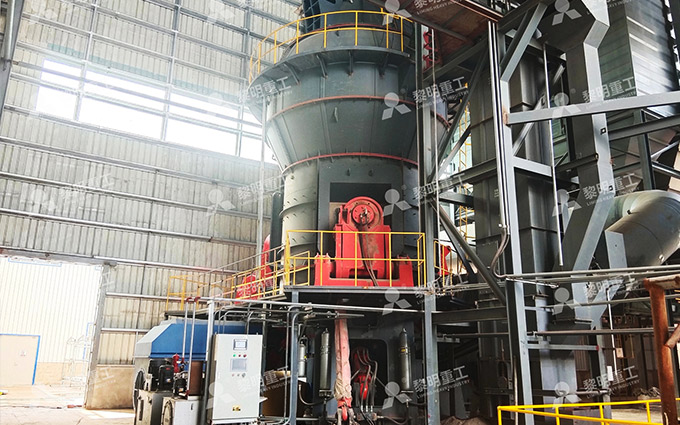
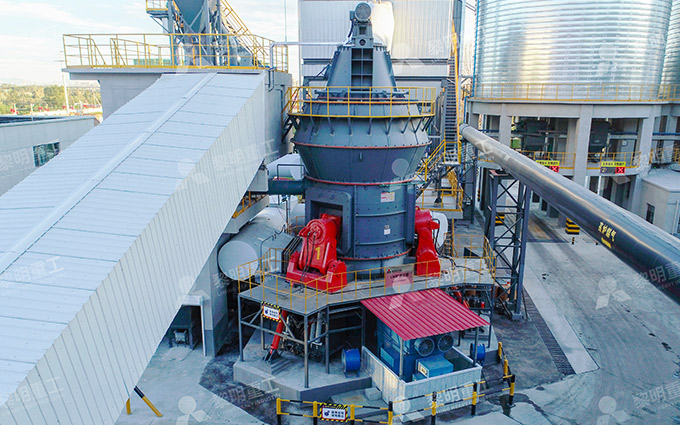
An LM vertical roller mill is typically the strongest option for large-capacity GCC plants, especially when feed moisture needs to be managed within the grinding circuit. Its integrated grinding, drying, classification, and conveying design can reduce the number of process stages compared with a separate conventional grinding and drying arrangement.
Choose an LM vertical roller mill when:
The plant requires high hourly output and continuous operation.
The feed has moisture that must be reduced before final powder separation and storage.
The main products are standard to fine GCC grades rather than the most demanding ultrafine specialty grades.
Floor-space efficiency and integrated process layout are important.
The producer wants to reduce transfer points and simplify plant material flow.
Large-volume calcium carbonate grinding generally favors vertical roller mills because they combine material-bed grinding with internal classification and can handle drying. Selection guidance for GCC plants specifically recommends vertical roller mills for large-volume coarse and fine powder production where hourly output and unit energy cost are key priorities.
The main caution is that capacity must be guaranteed at the required final PSD. A vertical roller mill may produce a high tonnage at a coarser setting but substantially less throughput when the target becomes finer or when the customer limits the coarse tail of the distribution.
When to choose an MW micro powder mill
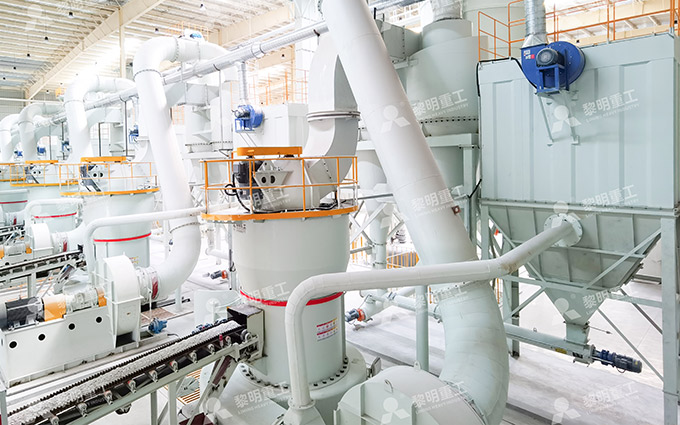
An MW micro powder mill is suitable for producers moving beyond standard filler grades into fine and ultrafine GCC. It is appropriate where the market requires improved surface smoothness, more controlled PSD, lower coarse-particle content, or better performance in plastics, rubber, coatings, paper, adhesives, and sealants.
Consider an MW micro powder mill when:
The product target is finer than typical conventional roller-mill output.
Customers require controlled fine fractions and low coarse residue.
The plant produces several grades for plastics, PVC, PP, PE, paint, coatings, rubber, or sealants.
The capacity requirement is moderate rather than at the largest industrial scale.
The producer needs dry powder for downstream surface coating or direct packing.
Fine powder production becomes increasingly sensitive to classification efficiency. As particle size decreases and PSD targets become narrower, grinding and classifying energy requirements increase. An MW micro powder mill should therefore be paired with a properly designed air-classification and dust-collection system rather than treated as a stand-alone grinding machine.
When to choose an LUM ultrafine mill
An LUM ultrafine mill is intended for high-value GCC where particle fineness, narrow PSD, and stable product consistency are more important than producing the maximum possible coarse powder tonnage. It is suitable for premium ultrafine grades used in selected paper, paint, coating, plastic, rubber, adhesive, and sealant applications.
Choose an LUM ultrafine mill when:
The product requires ultrafine calcium carbonate with a tightly controlled upper particle-size limit.
Customers evaluate D97 or D98, not only a nominal mesh value.
Low coarse-particle content is essential for film, smooth coatings, white compounds, or appearance-sensitive products.
The plant needs premium grades with stronger value per tonne than standard filler powder.
Process stability and particle-size consistency are more important than the lowest initial equipment investment.
Ultrafine grinding should be economically justified by the market. Producing an unnecessarily fine product can increase power consumption, reduce throughput, raise wear, increase classifier load, and create excessive fines that do not improve the end-use application. Select the finest grade the market genuinely needs, not simply the finest grade the mill can make.
Evaluate the raw calcium carbonate feed
Even the best grinding mill cannot turn unsuitable stone into premium GCC. Feed quality affects final whiteness, purity, wear rate, energy consumption, coating response, and customer acceptance.
| Feed characteristic | Effect on mill selection and plant design |
|---|---|
| CaCO3 content | Determines suitability for high-purity GCC markets and affects the commercial value of the powder. |
| Whiteness and brightness | Critical for paper, paint, coatings, white PVC, masterbatch, sealants, and food-related markets. |
| Silica and abrasive impurities | Increase wear on rollers, tables, liners, grinding rings, classifier parts, and conveying equipment. |
| Mohs hardness and grindability | Influence mill capacity, energy consumption, grinding pressure, and wear-part selection. |
| Feed moisture | May require drying, affect mill stability, increase bag-filter load, and influence product flowability. |
| Maximum feed size | Defines the upstream crushing and screening requirement and affects stable mill feeding. |
| Clay, organics, or weathered material | Can reduce whiteness, create handling problems, affect coating quality, and require beneficiation before grinding. |
Before ordering equipment, complete a representative feed analysis and grinding test. The sample should reflect normal quarry variation rather than one exceptional piece of high-grade stone. This is especially important if the quarry contains changes in calcite quality, silica content, moisture, or color across different benches.
Do not ignore crushing and feed preparation
Grinding-mill performance depends on consistent feed. Oversized feed, fluctuating moisture, poor crusher settings, and inconsistent feed rate can reduce output, destabilize the classifier, increase wear, and make final powder quality difficult to control.
A typical dry GCC preparation line includes:
Raw-stone receiving and storage.
Primary and secondary crushing.
Screening and removal of oversize material.
Magnetic separation and metal control.
Drying when feed moisture exceeds the mill’s practical operating limit.
Surge storage and controlled feeding to the mill.
Grinding, air classification, dust collection, finished-product storage, and packing.
Grinding selection guides emphasize that crushing capacity must match the mill’s feed demand. If the crushing section cannot continuously supply uniformly sized material, the mill becomes starved or overloaded and the downstream plant cannot reach its design capacity.
Air classification determines product quality
For fine and ultrafine calcium carbonate, the classifier is as important as the grinding mill. The mill creates a range of particle sizes; the classifier separates acceptable fine product from coarse particles that must return for further grinding.
A high-efficiency classifier helps control:
Product D50 and upper particle-size limit.
Coarse-particle residue and D97 or D98 performance.
Amount of overground ultrafine material.
Specific energy consumption.
Product consistency between shifts and production lots.
Suitability for downstream coating, plastic compounding, paint, paper, and other high-value applications.
Efficient classification removes finished fine powder before it is unnecessarily reground. This preserves mill capacity for coarse material and can reduce unit energy demand. One industry source estimates that high-efficiency classification can reduce unit energy consumption by 10–30% in actual calcium carbonate grinding projects, although the achieved result depends on the feed, product target, and plant configuration.
Plan for coating if the target is plastic-grade GCC
If the plant will produce stearic-acid-coated calcium carbonate for PVC, PP, PE, rubber, sealants, or adhesives, include the coating system in the original project design. Do not treat coating as a simple final add-on.
A typical dry coating section includes finished-powder storage, accurate stearic-acid dosing, controlled heating, intensive mixing or coating, post-treatment cooling, dust collection, and coated-product storage or packing. The coating line must be sized to match the grinding circuit, and its operating conditions must avoid product overheating, insufficient coating, excess treatment, or contamination.
The coating grade should be designed around particle surface area. Finer GCC generally requires more precise treatment control than coarser powder because it has more surface area. Quality evaluation should include moisture, coating level, hydrophobicity, flowability, dispersion performance, particle-size retention, and application testing in the target polymer compound.
Assess energy, wear, and operating cost
Mill selection should be based on cost per tonne of qualified product, not only the purchase price. A lower-cost mill may become expensive if it consumes excessive power, requires frequent wear-part replacement, cannot maintain the requested PSD, or creates high recirculation and dust-collection loads.
Compare suppliers on the following basis:
Guaranteed capacity at the stated D50 and D97 or D98.
Guaranteed specific power consumption for the tested feed material.
Expected wear rate for grinding elements, liners, classifier parts, and ducts.
Fan power, air volume, filter area, and pressure-drop requirements.
Drying fuel or hot-gas demand when feed moisture is significant.
Number of operators, automation level, and maintenance access.
Availability and delivery time of critical spare parts.
Noise, dust, vibration, and environmental-control requirements.
Product changeover time when producing several GCC grades.
Ask for performance guarantees using your actual calcium carbonate sample. A guarantee based on a different feed source, a coarser finished product, or a short test period may not represent long-term commercial operation.
Use a practical selection workflow
Define the target GCC products by application and PSD, not only by mesh.
Test representative limestone, marble, or calcite for purity, whiteness, moisture, hardness, silica, and grindability.
Set the required annual tonnage, operating hours, and minimum guaranteed hourly capacity.
Confirm upstream crushing, feed size, feed consistency, and moisture-control requirements.
Select the mill family: MTW Raymond mill, LM vertical roller mill, MW micro powder mill, or LUM ultrafine mill.
Design the classifier, fan, bag filter, conveying system, silos, packing line, and automation around the final product, not only around the mill.
Add a coating system if coated GCC is part of the product plan.
Evaluate total operating cost per tonne of qualified powder.
Run pilot or factory acceptance tests using the actual feed material and written PSD acceptance limits.
Common mill-selection mistakes
Choosing by mesh only: Mesh does not define the full PSD, coarse tail, brightness, surface area, or application performance.
Comparing capacity at different fineness: A capacity claim is meaningless unless suppliers state the same product PSD and feed condition.
Ignoring feed moisture: Wet feed can reduce grinding efficiency, overload filters, block conveying, and cause unstable product quality.
Oversizing for capacity but undersizing classification: The plant may make tonnes of powder that fail the customer’s D97, surface-finish, or dispersion requirements.
Producing unnecessarily ultrafine powder: Finer grinding increases energy, wear, and cost without automatically improving the final application.
Neglecting crushing and storage: Inconsistent mill feed creates production bottlenecks and makes stable grinding impossible.
Planning coating too late: Plastic-grade coated GCC needs coordinated grinding, storage, dosing, heating, mixing, cooling, and packaging.
Buying on initial price alone: Long-term cost depends on qualified output, power, wear, maintenance, availability, and rejected-product rate.
Key takeaway
The best calcium carbonate grinding mill is the one that produces the required GCC particle-size distribution, purity retention, whiteness, and capacity at the lowest total cost per tonne of qualified product. Use an MTW Raymond mill for conventional fine powder, an LM vertical roller mill for large-scale integrated grinding and drying, an MW micro powder mill for fine and ultrafine dry GCC, and an LUM ultrafine mill for premium narrow-PSD grades. Validate the choice with representative material testing and a written performance guarantee based on the actual final product specification.