Calcium Carbonate Knowledge Hub
Which Mill Is Best for Calcium Carbonate?
2026-09-04 17:06:09
We are Liming Heavy Industry, a manufacturer of various types of industrial crushers, such as Raymond Mill, Trapezoidal Mill, Vertical Mill, Ultrafine Mill, Ball Mill, etc.
Our mills can process the following minerals:
limestone, quicklime, kaolin, talc, barite, bentonite, calcium carbonate, dolomite, coal, gypsum, clay, carbon black, slag, cement raw materials, cement clinker, etc.
If you need a mill to process stone or minerals into powder, please feel free to contact me (WhatsApp: +8615333807511). Thank you.
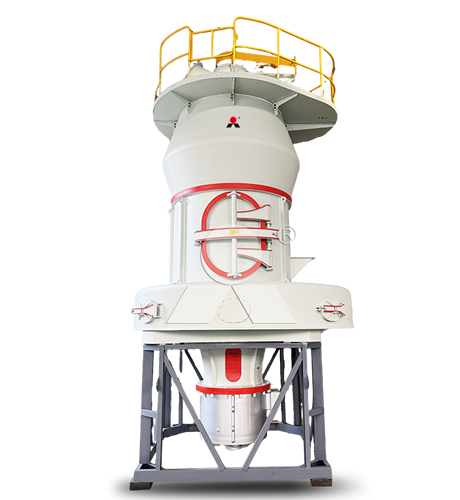
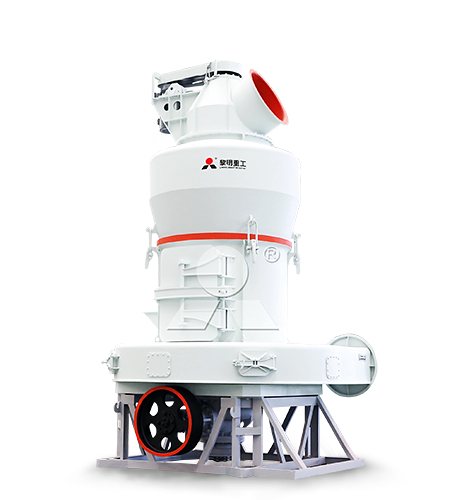
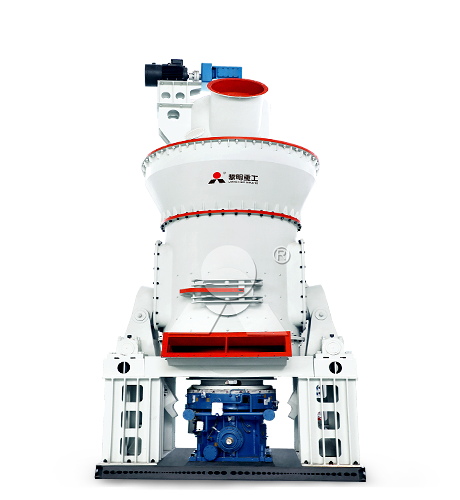
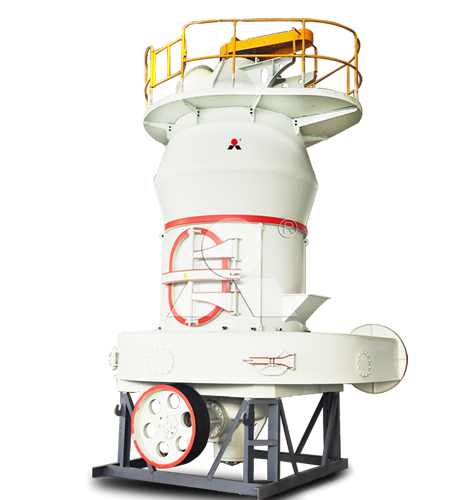
No single mill is best for every calcium carbonate project. The best choice depends on the required particle-size distribution, production capacity, feed moisture, product value, and downstream application. For conventional GCC, an MTW Raymond mill is often the best economic choice; for large-scale fine powder with drying requirements, an LM vertical roller mill is usually stronger; for fine and ultrafine grades, an MW micro powder mill or LUM ultrafine mill is the better fit.
The most important rule is to select the mill by the guaranteed finished product—not by a broad mesh claim. A mill should be compared at the same feed material, final D50 and D97/D98, capacity, moisture condition, power consumption, and product-quality requirement.
Best mill by requirement
| Your calcium carbonate requirement | Best mill choice | Why it fits |
|---|---|---|
| Conventional GCC, roughly 80–325 mesh | MTW Raymond mill | Practical investment, stable dry grinding, straightforward operation, and suitable fineness for many standard filler markets. |
| Large-scale standard to fine GCC with feed moisture | LM vertical roller mill | Combines grinding, drying, classification, and conveying in one system, making it suitable for continuous high-throughput production. |
| Fine GCC for PVC, PP, PE, rubber, paint, coatings, adhesives, or sealants | MW micro powder mill | Provides finer grinding and better particle-size control than conventional Raymond milling for higher-value dry powder grades. |
| Premium ultrafine GCC with low coarse residue and narrow PSD | LUM ultrafine mill | Designed for demanding fine-powder production where D97/D98 control, product consistency, and low coarse-particle content matter. |
| Very fine specialty GCC slurry | Wet grinding and classification system | Suitable where a slurry product and very fine controlled particles are required, particularly in some specialty paper and coating applications. |
Industry data show that different grinding systems occupy different particle-size and capacity ranges. Dry ball-mill classification systems can cover a broad GCC range around D97 = 5–45 µm, while vertical stirred-media systems are used for finer products around D97 = 2.5–10 µm at low to medium capacities. The same data also show that energy demand rises sharply as the required top size becomes finer.
MTW Raymond mill: best for standard GCC
An MTW Raymond mill is typically the best choice when the business focus is conventional calcium carbonate powder rather than premium ultrafine material. It suits standard GCC applications in construction materials, putty, ordinary plastics, rubber, and lower-to-medium specification filler markets.
Choose an MTW Raymond mill when the plant needs:
Conventional fine powder, generally in the 80–325 mesh range.
Moderate capacity with reasonable capital investment.
Stable operation and relatively simple maintenance.
Dry limestone, marble, or calcite feed with controlled feed size.
Standard filler products where an extremely narrow ultrafine PSD is not required.
For standard GCC, Raymond-type milling remains a strong economic option. Published selection guidance places practical Raymond-mill output mainly around 80–400 mesh for conventional filler-grade calcium carbonate.
Its limitation is ultrafine production. As the target becomes much finer, capacity falls, recirculating load rises, and the system may struggle to maintain a tight upper particle-size limit efficiently. If customers require consistently low D97 or D98 values, a dedicated fine or ultrafine system should be evaluated instead.
LM vertical roller mill: best for scale
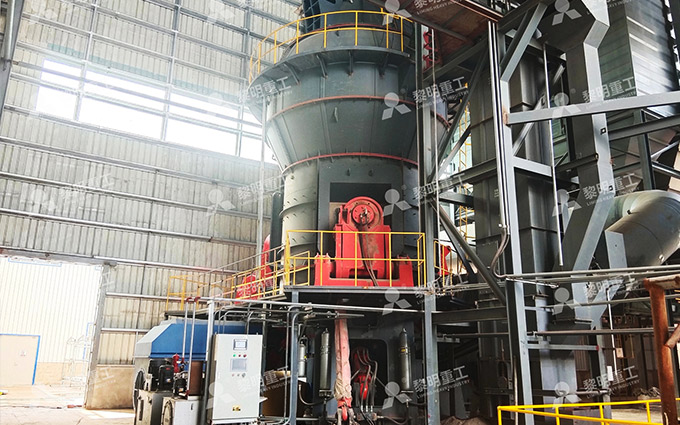
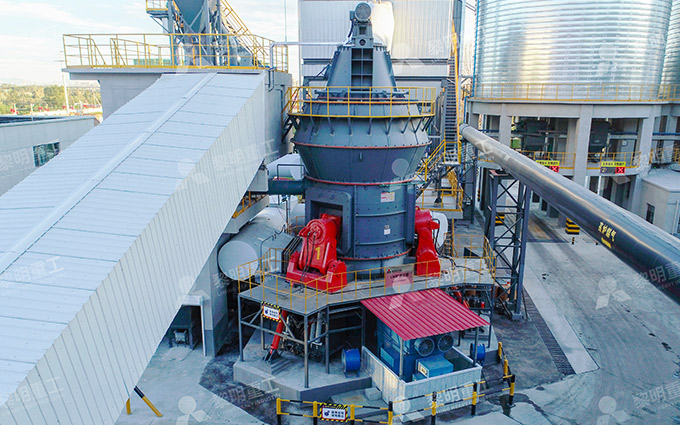
An LM vertical roller mill is usually the best choice for a large GCC plant that needs continuous production, integrated drying, and efficient material flow. It is especially relevant when raw stone contains enough moisture that a separate drying system would add complexity and cost.
Choose an LM vertical roller mill when:
High hourly throughput is the main business requirement.
Production runs continuously with a stable quarry feed.
The plant needs to grind, dry, classify, and convey material in an integrated layout.
Feed moisture must be managed without relying entirely on a separate dryer.
The product is standard to fine GCC rather than the most demanding ultrafine specialty grade.
The main advantage is plant-scale efficiency. Vertical roller mills combine material-bed grinding with internal classification, and they can simplify the process flow by integrating several functions. But large capacity is meaningful only if it is demonstrated at the required final PSD. A mill producing high tonnage at a coarse setting may deliver much less qualified output when the customer requires a fine D97 or a strict coarse-residue limit.
MW micro powder mill: best for fine GCC
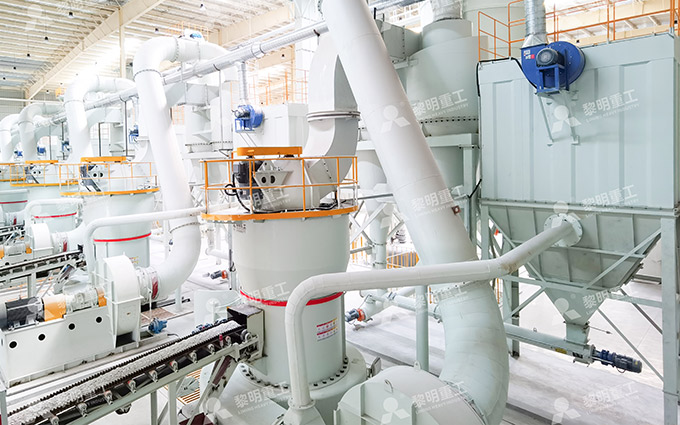
An MW micro powder mill is generally the best choice for producers that need fine and ultrafine dry calcium carbonate with more control than conventional milling can provide. It is appropriate for higher-value GCC used in PVC, PP, PE, masterbatch, rubber, paint, coatings, paper, adhesives, and sealants.
Choose an MW micro powder mill when:
Your buyers specify micron-based PSD rather than only mesh.
Fine particle distribution and low coarse residue affect end-product performance.
The plant needs several fine GCC grades for different industrial applications.
Downstream stearic-acid coating is planned for plastic, rubber, adhesive, or sealant markets.
You need a dry powder system at moderate production capacity.
For example, a calcium carbonate producer serving PVC and masterbatch markets may need more than a nominal 1250-mesh product. The customer may require a stable D50, strict top-size control, low moisture, good dispersion, and consistent coating response. An MW micro powder mill is more appropriate when those finer-grade requirements drive the product value.
LUM ultrafine mill: best for premium grades
An LUM ultrafine mill is the best choice when the product is premium ultrafine GCC and the commercial value depends on reliable PSD control. It is intended for producers serving applications where coarse particles, broad distribution, and batch variation can create customer problems.
Choose an LUM ultrafine mill when:
The target powder has a very fine D50 and strict D97 or D98 limit.
Low coarse-particle content matters in film, coating, paper, white plastic, sealant, or adhesive applications.
The product needs a narrow PSD rather than simply a very fine average size.
The powder will be surface coated and sold into demanding plastic or polymer-compounding markets.
Higher product value justifies higher process complexity and a greater focus on classifier performance.
Ultrafine production should be driven by market need. Grinding becomes progressively more energy-intensive as the target particle size becomes smaller and the distribution becomes narrower. Producing powder finer than the application requires can reduce profitability through lower throughput, higher energy consumption, more wear, and additional classification load.
The classifier can decide the result
For fine and ultrafine calcium carbonate, the best mill without the right classifier will not produce a stable commercial grade. Grinding creates a distribution of particles; air classification separates the acceptable fine fraction from oversized material that must be returned to the grinding zone.
A properly selected classifier controls:
Median particle size, such as D50.
Upper particle-size limit, such as D90, D97, or D98.
Coarse-particle residue and hard agglomerate carryover.
Amount of unnecessary overgrinding.
Specific energy use and circulating load.
Lot-to-lot product consistency.
Classifier-selection guidance for GCC plants emphasizes defining the required application, fineness range, PSD, and capacity first; then matching the classifier to the grinding circuit, airflow, pressure, material purity requirements, and total operating cost.
This is particularly important for fine coated GCC. A plastic compounder may reject a powder because of coarse particles or weak dispersion even when the supplier’s nominal mesh number appears correct. The mill and classifier must be evaluated as one system.
Other factors that change the answer
| Decision factor | Why it changes mill selection |
|---|---|
| Target fineness and PSD | The finer and narrower the product specification, the more important ultrafine grinding and high-efficiency classification become. |
| Required capacity | Large-volume production often favors an LM vertical roller mill; moderate-capacity specialty production may favor MW or LUM ultrafine milling. |
| Feed moisture | Moist feed may favor a vertical mill with integrated drying or require dedicated drying before dry ultrafine milling. |
| Feed purity and silica content | Abrasive impurities increase wear and may change the required mill protection, wear materials, and product-market suitability. |
| Downstream coating | Plastic-grade coated GCC requires stable fine PSD, low moisture, good flowability, and a coating system sized to match mill output. |
| End-use application | Construction filler, PVC, film, paper, paint, sealant, food, and pharmaceutical applications have very different quality expectations. |
| Operating cost | Power, wear parts, fan load, drying fuel, filter performance, maintenance, and rejected-product rate determine cost per tonne. |
How to make the final decision
Define the target calcium carbonate products by actual application and PSD, including D50 and D97/D98 where needed.
Test representative limestone, marble, or calcite for purity, whiteness, silica, moisture, hardness, and grindability.
Calculate qualified-product capacity, not just annual installed capacity.
Choose MTW Raymond milling for conventional products, LM vertical milling for large-scale integrated output, MW micro powder milling for fine dry GCC, or LUM ultrafine milling for premium narrow-PSD products.
Specify the air classifier, fan, bag filter, pneumatic conveying, finished-product silos, packaging system, and automation as part of the mill project.
Run a trial using the actual feed and require a written guarantee for capacity, PSD, power consumption, and product quality.
Common mistakes
Buying the cheapest mill: The lowest initial price may result in higher power use, greater wear, lower qualified output, and more rejected product.
Comparing capacity at different fineness: A meaningful comparison requires the same feed, final PSD, moisture, and operating conditions.
Using mesh alone: Mesh does not show the full PSD, coarse tail, particle shape, or suitability for high-value applications.
Ignoring moisture: Wet feed can reduce grinding efficiency, create handling problems, and overload dust-collection equipment.
Undersizing the classifier: Classification limits product quality and can become the bottleneck even when the grinding mill has enough installed power.
Grinding finer than necessary: Unnecessary ultrafine production increases energy, wear, and cost without guaranteeing better customer performance.
Key takeaway
The best calcium carbonate mill depends on the powder you need to sell. Choose an MTW Raymond mill for economical conventional GCC, an LM vertical roller mill for high-capacity grinding and drying, an MW micro powder mill for fine dry GCC, and an LUM ultrafine mill for premium ultrafine powder with tight PSD control. In every case, confirm the final choice with representative material testing and a performance guarantee based on the qualified finished product—not a general mesh range or nameplate capacity.