Calcium Carbonate Knowledge Hub
What Mill Is Used to Grind Limestone Into Calcium Carbonate Powder?
2026-09-04 17:06:39
We are Liming Heavy Industry, a manufacturer of various types of industrial crushers, such as Raymond Mill, Trapezoidal Mill, Vertical Mill, Ultrafine Mill, Ball Mill, etc.
Our mills can process the following minerals:
limestone, quicklime, kaolin, talc, barite, bentonite, calcium carbonate, dolomite, coal, gypsum, clay, carbon black, slag, cement raw materials, cement clinker, etc.
If you need a mill to process stone or minerals into powder, please feel free to contact me (WhatsApp: +8615333807511). Thank you.
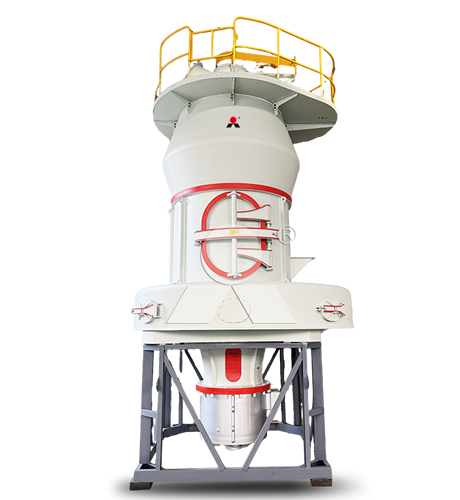
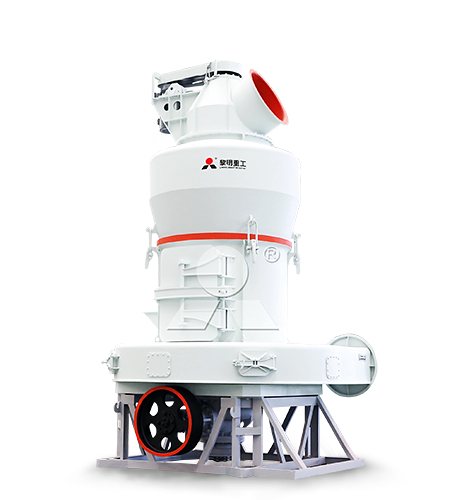
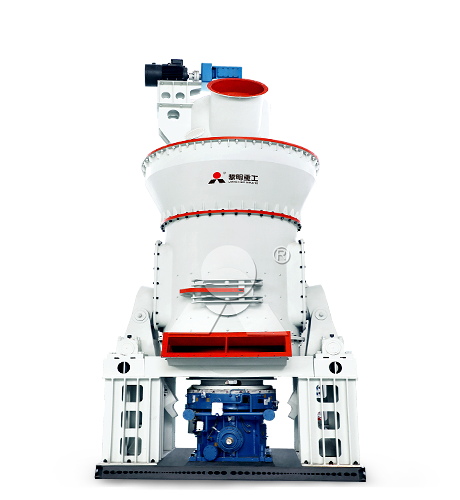
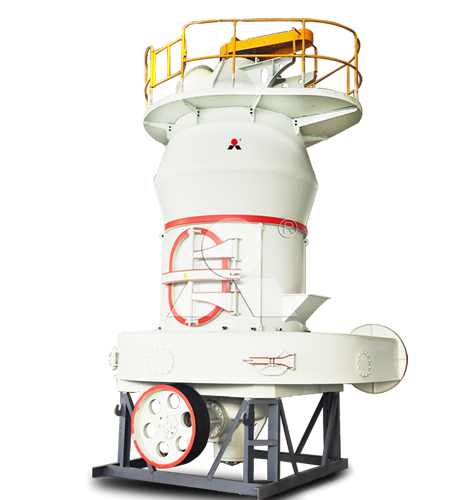
Limestone is ground into calcium carbonate powder using a grinding mill selected by the target fineness and production capacity. For conventional GCC powder, an MTW Raymond mill is commonly used; for large-scale production with integrated drying, an LM vertical roller mill is often preferred; and for fine or ultrafine calcium carbonate, an MW micro powder mill or LUM ultrafine mill is more suitable.
The mill alone does not determine finished powder quality. A complete limestone-to-GCC line normally includes crushing, controlled feeding, grinding, air classification, dust collection, finished-powder storage, and packing. For fine grades, the classifier is as important as the mill because it controls the particle-size distribution and removes coarse particles from the finished product.
Mill selection by powder grade
| Target limestone powder | Recommended mill | Typical use |
|---|---|---|
| Conventional powder, about 80–325 mesh | MTW Raymond mill | Construction materials, putty, general fillers, standard rubber compounds, and lower-to-medium specification GCC. |
| High-capacity standard to fine GCC | LM vertical roller mill | Large-volume production for plastics, rubber, paper, paint, coatings, and general calcium carbonate markets. |
| Fine powder, about 325–1250 mesh | MW micro powder mill | Fine GCC for PVC, PP, PE, filler masterbatch, paint, coatings, rubber, adhesives, and sealants. |
| Ultrafine GCC, commonly above 1250 mesh or with strict micron PSD | LUM ultrafine mill | Premium paper, coating, white plastic, film, fine rubber, sealant, and adhesive applications. |
| Very fine calcium carbonate slurry | Wet grinding and classification system | Specialty slurry products where very fine particle size and wet-process handling are required. |
Published GCC process guidance describes dry production as crushing, grinding, classification, and packaging, with Raymond mills generally used for standard powder, vertical or ultrafine vertical mills for finer products, and wet grinding systems for selected slurry grades.
MTW Raymond mill for standard powder
An MTW Raymond mill is a practical choice for limestone powder in the conventional fine range. It is used when the plant mainly produces standard GCC rather than premium ultrafine powder and when investment cost, stable operation, and simple maintenance are key priorities.
It is usually suitable for:
General limestone powder and standard calcium carbonate filler.
Products around 80–325 mesh.
Construction materials, putty, mortar, and standard industrial mineral products.
Moderate-capacity plants using dry, pre-crushed limestone.
Applications that do not require an especially narrow PSD or very low D97/D98 value.
Raymond-type milling is commonly positioned for conventional limestone powder around 80–400 mesh. It becomes less economical when a project requires consistently ultrafine powder, a narrow PSD, or very low coarse-particle residue.
LM vertical roller mill for large output
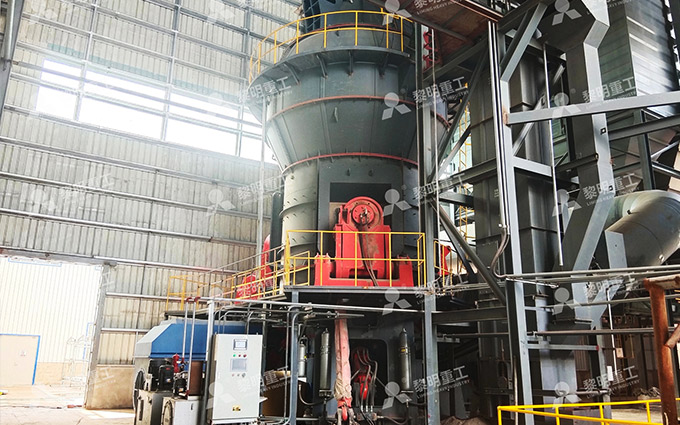
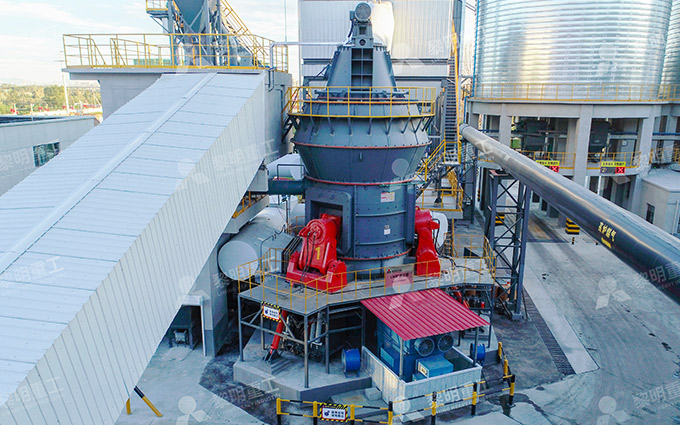
An LM vertical roller mill is generally the preferred option for high-capacity limestone and calcium carbonate production. It combines grinding, classification, drying, and material conveying in a compact process layout, which can reduce transfer points and simplify the production line.
It is a good fit when:
The plant needs high continuous output.
The raw limestone has moisture that needs to be reduced during processing.
The producer sells standard to fine GCC into several industrial markets.
Energy efficiency, automation, and plant footprint are important.
The project needs integrated drying rather than a separate drying circuit.
In a vertical mill, grinding and classification operate together. The internal separator returns coarse material for further grinding while qualified powder leaves with the air stream. This makes the system suitable for high-throughput GCC production, but the supplier should guarantee output at the requested PSD, not only at a coarse nominal mesh setting.
MW micro powder mill for fine GCC
An MW micro powder mill is used when limestone must be processed into fine GCC for higher-value filler applications. It is more appropriate than conventional milling when customers specify micron-based particle-size distribution, low coarse residue, smoothness, and stable dispersion performance.
Typical applications include:
Fine calcium carbonate for PVC pipe, profiles, cable compounds, and flooring.
Fine GCC for PP, PE, and filler masterbatch.
Rubber compounds that require smoother extrudates or more controlled filler dispersion.
Decorative paint, primer, coating, adhesive, and sealant formulations.
Fine powder intended for stearic-acid coating.
A fine GCC plant must control more than average particle size. The mill system should consistently meet the product’s D50 and upper particle-size limit, such as D97 or D98. A powder with the correct average size but too many coarse particles can still fail in plastic film, smooth coatings, white PVC, sealants, and other appearance-sensitive applications.
LUM ultrafine mill for premium powder
An LUM ultrafine mill is used for premium calcium carbonate grades where fine particle size and narrow particle-size distribution are central to product value. It is appropriate for high-specification GCC applications where coarse particles, wide PSD, excessive agglomeration, or lot variation can create downstream performance problems.
Choose an LUM ultrafine mill when the project requires:
Ultrafine limestone powder with a strict micron-based specification.
Low coarse-particle content for plastic film, fine coatings, paper, adhesives, sealants, or white masterbatch.
Stable D97 or D98 control rather than only a nominal mesh result.
Fine powder suitable for premium coated GCC products.
Higher-value output that justifies additional classification and process-control requirements.
Grinding limestone increasingly fine raises power demand, wear, and classification load. Therefore, ultrafine milling is most profitable when the downstream market pays for the additional product quality. Producing a 2500-mesh powder for an application that only needs standard 400-mesh filler usually reduces plant economics rather than improving it.
The basic limestone-to-GCC process
Grinding limestone into calcium carbonate powder is generally a dry mechanical process. The core flow is simple, but every stage must be matched to the required product grade.
Raw-material selection: Select limestone, marble, or calcite with suitable CaCO3 content, whiteness, silica level, and impurity profile.
Crushing: Reduce large quarry stone to a stable mill-feed size using primary and secondary crushing.
Screening and metal control: Remove oversize material and protect the grinding system from tramp metal.
Drying if needed: Reduce moisture when wet stone would affect grinding, classification, conveying, or final powder flowability.
Grinding: Use the selected mill to reduce limestone to the target powder range.
Air classification: Separate qualified fine powder from coarse particles and return oversized material to the grinding circuit.
Dust collection: Recover fine powder and maintain clean, stable plant operation through bag filters and controlled airflow.
Storage and packaging: Store the qualified GCC in silos or bins and pack it into bags, bulk bags, or bulk-delivery systems.
GCC is produced directly by grinding limestone rock into powder. Depending on classifier design and process setup, dry systems can produce products from coarse grades near 100 mesh to fine material around 20 µm and, in specialized systems, products with D50 below 5 µm.
Why air classification matters
Air classification separates the desired fine powder from coarse material. It is particularly important for calcium carbonate because many end users require controlled particle-size distribution, not just a broad “mesh” description.
A high-efficiency classifier helps maintain:
Stable D50 and consistent product fineness.
Low D97 or D98 for fine and ultrafine applications.
Low coarse-particle residue.
Reduced overgrinding of already finished powder.
Better energy use and more stable mill capacity.
Consistent powder performance in plastics, paint, rubber, paper, and coatings.
Without efficient classification, fine material can remain in the mill too long and become overground, while oversized particles can contaminate the finished product. Both outcomes reduce the value of the powder.
Feed quality affects the mill choice
| Limestone property | Why it matters |
|---|---|
| CaCO3 content | Determines whether the material can serve high-purity GCC markets such as white plastics, coatings, paper, food, or pharmaceutical applications. |
| Whiteness and brightness | Critical for white PVC, paint, coatings, paper, toothpaste, food-grade, and light-colored products. |
| Silica and abrasive impurities | Increase wear in crushers, mills, classifiers, fans, ducts, and conveying equipment. |
| Feed moisture | Can reduce grinding efficiency, affect classification, create handling issues, and increase drying requirements. |
| Feed size | Determines the required crushing stage and affects stable mill operation. |
| Clay and weathered material | Can reduce whiteness, increase moisture, block equipment, and lower final GCC quality. |
Always test representative quarry material before final equipment selection. A small laboratory sample may not reflect normal mine variation in purity, color, moisture, silica, or grindability. The mill supplier should evaluate samples that represent the actual long-term feed source.
Common mistakes
Selecting only by mesh: Mesh does not fully describe D50, D97, D98, coarse residue, agglomerates, or application performance.
Choosing a mill before defining the market: A standard filler mill may not meet the needs of coated GCC, film, paper, paint, or premium plastic markets.
Ignoring feed moisture: Wet limestone can lower output, destabilize classification, clog conveyors, and create poor powder flowability.
Neglecting crushing capacity: A high-capacity mill cannot perform well if the crushing circuit cannot supply stable, correctly sized feed.
Undersizing the classifier: The mill may have enough grinding power but still fail the final PSD because the classifier cannot separate particles effectively.
Grinding finer than customers need: Unnecessary ultrafine grinding raises energy and wear costs while reducing throughput.
Using poor-quality limestone for premium GCC: Grinding cannot remove all colored or abrasive impurities from unsuitable feedstone.
FAQ
Can a Raymond mill grind limestone into calcium carbonate powder?
Yes. An MTW Raymond mill is suitable for conventional limestone and GCC powder, commonly around 80–325 mesh. It is a practical solution for standard fillers and general industrial applications but is less suitable for demanding ultrafine grades with strict PSD requirements.
What mill is used for 1250-mesh calcium carbonate?
An MW micro powder mill is generally a suitable choice for fine calcium carbonate around this range. If the customer requires a very narrow PSD, low coarse residue, or premium ultrafine performance, an LUM ultrafine mill may be the stronger option.
What mill is used for 2500-mesh calcium carbonate?
An LUM ultrafine mill is generally more suitable for this level of fineness because it is designed for ultrafine powder and strict particle-size control. The complete system must include high-efficiency classification and dust collection to maintain consistent product quality.
Is a crusher enough to make calcium carbonate powder from limestone?
No. Crushing reduces limestone to mill feed or coarse aggregate size. To make fine calcium carbonate powder, the crushed limestone must be further ground and classified in a mill system.
Key takeaway
The mill used to grind limestone into calcium carbonate powder depends on the powder grade. Use an MTW Raymond mill for conventional GCC, an LM vertical roller mill for high-capacity production and integrated drying, an MW micro powder mill for fine GCC, and an LUM ultrafine mill for premium ultrafine calcium carbonate. The best plant combines properly prepared limestone feed, grinding, high-efficiency air classification, dust collection, and quality control to deliver the required particle-size distribution consistently.