Calcium Carbonate Knowledge Hub
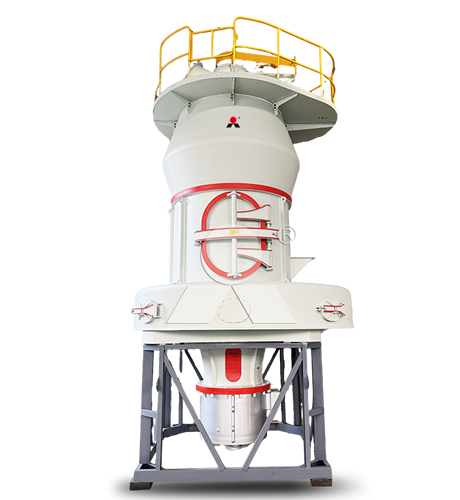
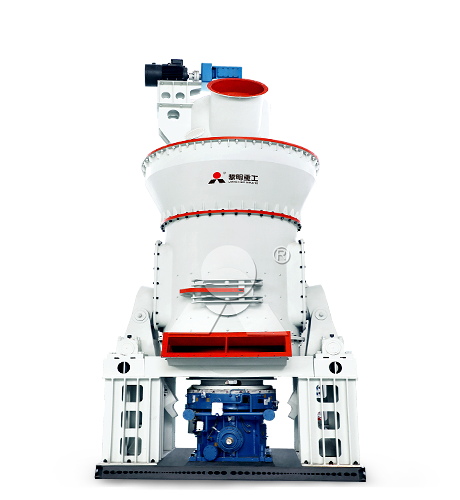
LM Vertical Roller Mill for Large-Capacity Calcium Carbonate Grinding
2026-09-04 17:15:15
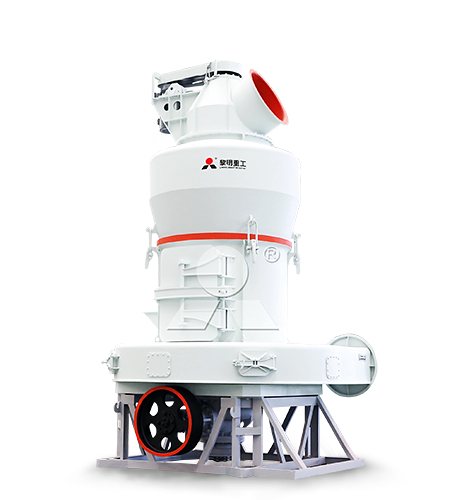
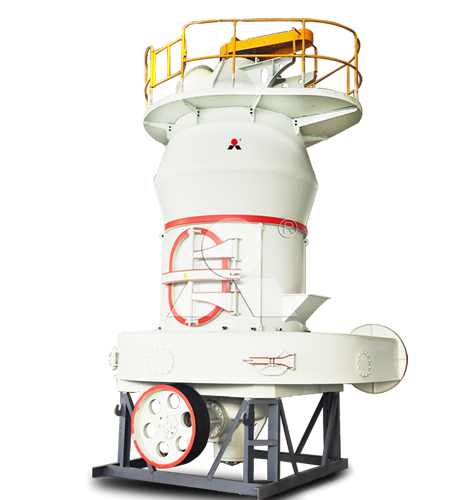
We are Liming Heavy Industry, a manufacturer of various types of industrial crushers, such as Raymond Mill, Trapezoidal Mill, Vertical Mill, Ultrafine Mill, Ball Mill, etc.
Our mills can process the following minerals:
limestone, quicklime, kaolin, talc, barite, bentonite, calcium carbonate, dolomite, coal, gypsum, clay, carbon black, slag, cement raw materials, cement clinker, etc.
If you need a mill to process stone or minerals into powder, please feel free to contact me (WhatsApp: +8615333807511). Thank you.
An LM Vertical Roller Mill is a strong choice for large-capacity calcium carbonate grinding when a plant needs continuous production, integrated drying, controlled classification, and efficient material handling. It is particularly suitable for standard to fine GCC production from limestone, marble, or calcite, where output volume, energy efficiency, and process integration matter more than producing the finest specialty powder.
For large calcium carbonate projects, the LM mill should be selected based on qualified output at the required particle-size distribution—not its maximum nameplate capacity. The plant must be designed around actual feed moisture, feed size, limestone purity, target D50 and D97/D98, product whiteness, dust-control requirements, and whether the final powder will be sold uncoated or sent to a coating line.
Why LM for large-capacity GCC?
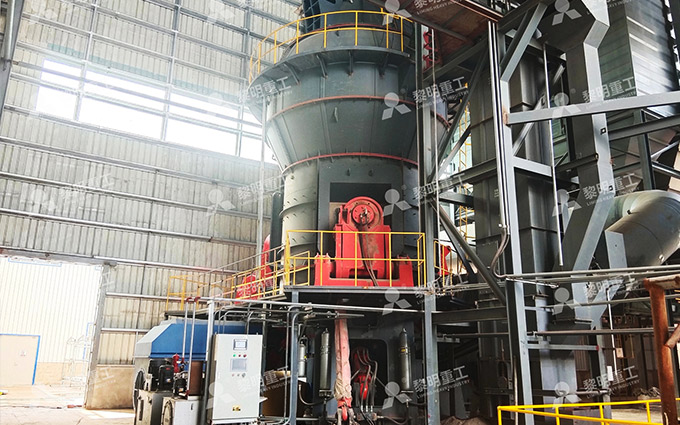
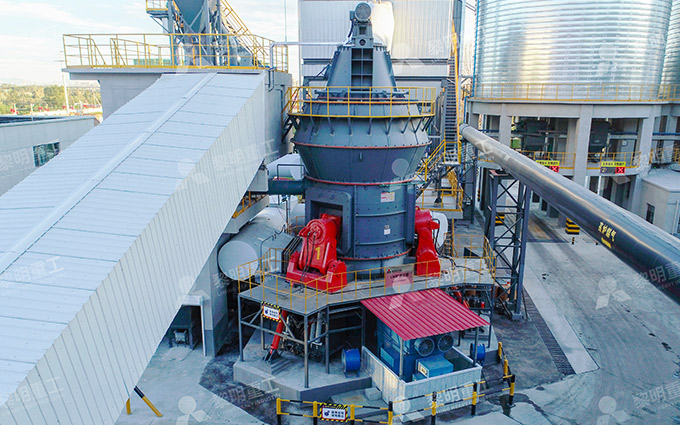
The LM Vertical Roller Mill integrates several process steps in one system: grinding, drying, classification, conveying, and often some feed-size reduction. This reduces transfer points between separate machines and makes the vertical mill especially suitable for high-throughput calcium carbonate plants.
In the grinding chamber, material forms a bed on the rotating grinding table. Rollers apply pressure to the material bed, while hot air or process air moves upward through the mill. The air stream dries the feed where needed and carries fine particles to the classifier. Coarse particles return to the grinding zone, while qualified powder leaves the mill with the air stream and is collected downstream.
Liming describes the LM Vertical Mill as a system integrating crushing, drying, grinding, classifying, and conveying for non-metallic minerals. This integrated arrangement is the central reason to consider an LM mill for high-capacity GCC rather than a smaller conventional grinding circuit.
Best product range
An LM Vertical Roller Mill is most appropriate for standard to fine ground calcium carbonate. It can serve broad-volume markets such as PVC, rubber, paint, coatings, putty, construction materials, general plastics, and selected paper-filler applications where the required powder is not at the most demanding ultrafine end.
| Calcium carbonate requirement | LM mill suitability | Typical applications |
|---|---|---|
| 200–325 mesh conventional GCC | Excellent | PVC pipe and profile filler, rubber, wall putty, construction materials, basic coatings, and general mineral filler. |
| 325–600 mesh fine GCC | Strong, subject to classifier and capacity verification | Fine PVC, masterbatch, paint, coatings, rubber, adhesives, sealants, and selected paper applications. |
| Fine micron-grade GCC with controlled D97 | Possible with a suitable classifier and process design | Higher-quality industrial fillers where low coarse residue and stable PSD are required. |
| Premium ultrafine GCC, around 1250–2500 mesh | Usually not the first choice | High-value coated GCC, film, high-gloss coatings, specialty paper, premium adhesives, and sensitive sealants. |
For non-metallic minerals, published LM vertical-mill specifications show products in a range around D97 = 10–40 µm, with output varying by model and feed characteristics. This makes the LM mill especially relevant where a plant needs large tonnage of standard and fine GCC rather than the narrowest ultrafine distribution.
Core advantages for calcium carbonate
Large continuous output
The LM mill is designed for continuous high-throughput operation. Larger grinding-table diameters, multiple rollers, high installed power, and an integrated air circuit make it suitable for plants that serve regional or export markets with sustained demand for standard and fine GCC.
Large capacity is especially valuable when a quarry has stable high-purity limestone or marble, the market has enough demand to keep the plant operating at a high utilization rate, and downstream logistics can handle bulk loading or high-volume bagging.
Integrated drying
Feed moisture is a common challenge in calcium carbonate processing. Moist stone can reduce grinding efficiency, create buildup in bins and chutes, make classification unstable, overload dust filters, and cause poor flowability in finished powder.
An LM Vertical Roller Mill can use hot air to dry the feed during grinding. This reduces the need for a separate dryer in many projects and can simplify the plant layout. The actual drying capacity depends on inlet-air temperature, airflow, ambient conditions, feed moisture, material flow, and final-product moisture requirement.
Liming’s LM mill design highlights a large grinding area and hydraulic pressure system, while its vertical-mill product materials describe the system as capable of drying material during grinding.
Compact process layout
Because grinding, classification, drying, and conveying are integrated, an LM plant can have fewer transfer points than a line built from separate mills, dryers, classifiers, and conveyors. This can reduce structural steel, handling equipment, floor-space demand, and maintenance points.
A compact layout does not eliminate the need for supporting equipment. The plant still requires proper raw-material storage, crushing, feed preparation, hot-air generation where needed, dust collection, product silos, packing, electrical control, and quality-control systems.
Efficient product classification
The classifier is located at the top of the mill. It separates fine powder carried by airflow from particles that remain too coarse. Proper classifier performance is essential to maintain product fineness, prevent excessive coarse residue, and avoid wasting energy by overgrinding particles that are already within specification.
For a high-volume GCC plant, classification should be specified using actual particle-size data. A request for “400 mesh calcium carbonate” is not enough if the downstream user evaluates D50, D97, D98, sieve residue, surface smoothness, or dispersion in PVC and coatings.
Typical process flow
An LM Vertical Roller Mill line for calcium carbonate normally follows a dry process. The arrangement changes with feed moisture, capacity, product grade, available heat source, and packaging method.
Raw stone receiving: Limestone, marble, or calcite is received, sampled, and separated by quality where the quarry has variation in purity, color, or moisture.
Crushing and screening: Large stone is reduced to stable mill-feed size. Screens remove oversize material, and magnets help protect the grinding system from tramp metal.
Buffer storage and feeding: Crushed stone is stored in a covered bin or silo, then delivered through a controlled feeder to maintain stable mill loading.
Drying and grinding: Feed enters the LM mill, where rollers grind it on the rotating table while process air removes moisture where necessary.
Internal classification: Fine particles are carried upward to the classifier; coarse particles fall back to the table for additional grinding.
Powder collection: Qualified GCC is collected by a cyclone, bag filter, or comparable collection system.
Finished-product storage: The powder is conveyed to silos, where it can be blended, sent to coating, or routed to packing.
Packing or bulk dispatch: Finished calcium carbonate is packed in valve bags, open-mouth bags, bulk bags, or loaded into bulk transport.
The dry GCC production route is commonly described as crushing, grinding, classification, collection, storage, and packaging. In a vertical mill, drying and classification are integrated into the grinding stage, which is why the equipment is widely considered for large-scale plants.
Capacity: what should be guaranteed?
For a large-capacity project, do not accept a general claim such as “100 tonnes per hour” without defining the product conditions. Output changes significantly as particle size becomes finer, feed moisture increases, or customer limits on coarse particles become stricter.
A proper LM mill performance guarantee should state:
Feed material source and representative chemical analysis.
Feed-size range and maximum feed size.
Normal and maximum feed moisture.
CaCO3 content, whiteness, silica, and acid-insoluble residue.
Target product D50 and maximum D97 or D98.
Maximum sieve residue where applicable.
Guaranteed qualified production rate in tonnes per hour.
Specific power consumption at the guaranteed output.
Finished-product moisture and temperature.
Dust-emission performance at agreed operating conditions.
Wear-part life assumptions and recommended spare-parts plan.
As an example of why conditions matter, published non-metallic LM mill data show a product target around D97 = 10–40 µm, with capacities ranging from less than 1 t/h on small units to more than 100 t/h on larger models. Those ranges are equipment-selection references, not a substitute for a guarantee on a specific limestone and product grade.
Feed quality and moisture
Large LM mills need stable feed to achieve stable capacity. A vertical mill cannot compensate for poor quarry segregation, oversized feed, large moisture fluctuations, or high levels of abrasive impurities.
| Feed characteristic | Effect on large-capacity LM grinding |
|---|---|
| CaCO3 content | Determines whether the product can meet the required purity for standard filler or higher-value calcium carbonate markets. |
| Whiteness and brightness | Controls suitability for white PVC, paint, coatings, paper, sealants, adhesives, food, and pharmaceutical markets. |
| Silica and hard impurities | Increase wear on rollers, table liners, classifier parts, ducts, fans, and downstream conveying equipment. |
| Feed moisture | Determines hot-air demand, mill drying load, final powder moisture, and stable operating capacity. |
| Feed size and size variation | Inconsistent or oversized material can disturb the grinding bed, reduce output, and increase wear. |
| Clay, weathered rock, and organic contamination | Can reduce whiteness, increase moisture, impair handling, and cause unstable classifier performance. |
For a large GCC line, quarry planning and production planning are part of milling performance. The raw-material stockpile should homogenize normal variations in feed quality, and moisture should be measured rather than estimated before setting mill drying conditions.
LM mill and coated GCC
An LM Vertical Roller Mill can produce uncoated base GCC for downstream stearic-acid coating. This is relevant for PVC, PP, PE, filler masterbatch, rubber, adhesives, and sealants. However, the grinding and coating sections must be designed together.
For standard coated GCC, the LM mill can feed a coating plant after powder collection and intermediate storage. The coating line normally needs accurate powder feeding, stearic-acid dosing, controlled heating, intensive mixing, cooling, dust collection, and finished-product storage.
For premium fine coated GCC, evaluate whether the LM mill can meet the required particle-size distribution at acceptable capacity. If the target requires an especially narrow ultrafine PSD or very low coarse residue, an MW micro powder mill or LUM ultrafine mill may be the more appropriate upstream grinding choice.
When LM is not the best choice
| Requirement | Why LM may not be optimal | Better direction |
|---|---|---|
| Small-scale standard GCC plant | The investment, civil work, hot-air system, and auxiliary equipment may be disproportionate to the required output. | MTW Raymond mill. |
| Fine GCC with moderate capacity and frequent grade changes | A dedicated fine-grinding system may provide more practical grade flexibility and tighter control for specialty products. | MW micro powder mill. |
| Premium ultrafine GCC with strict D97 or D98 limits | Large-volume vertical milling is not always the most efficient way to produce the narrowest ultrafine particle-size distribution. | LUM ultrafine mill. |
| Product below about 5 µm with a highly controlled coarse tail | The product requires specialized ultrafine grinding and high-efficiency classification beyond the normal strength of a standard large-capacity GCC line. | LUM ultrafine mill or a specialized wet grinding and classification system. |
| Very low feed moisture and only conventional powder demand | The drying capability of the LM mill may not add enough value to justify the higher plant complexity. | MTW Raymond mill for conventional grades. |
The LM Vertical Roller Mill is not automatically the “best” mill simply because it has high capacity. It is best when the business case requires sustained high output, integrated drying, and reliable production of standard to fine GCC. For smaller plants or premium ultrafine products, another mill type may deliver lower cost per tonne of qualified product.
How to design an LM GCC plant
A successful large-capacity calcium carbonate project needs more than a correctly selected LM mill. The supporting systems must be sized for the real operating target. A mill that can theoretically grind 50 tonnes per hour cannot maintain that output if the crusher, dryer, classifier, bag filter, conveying line, silo capacity, or packing system is undersized.
Upstream crushing system
The crushing circuit must provide a steady, correctly sized feed to the vertical mill. Oversized rock, irregular feed size, and large swings in feed rate can disturb the material bed on the grinding table and reduce grinding stability.
For a large plant, the crushing section normally includes:
Raw-stone receiving hopper and controlled unloading area.
Primary crushing for large quarry stone.
Secondary crushing to achieve the mill-feed specification.
Screening to remove oversize material.
Magnetic separation or tramp-metal protection.
Covered crushed-stone storage or homogenization stockpile.
Metered feeding to the LM mill.
The crushing system should have enough capacity to continue feeding the LM mill during normal variations in quarry material and crusher maintenance. If crushing capacity is too close to mill demand, the grinding section may spend too much time operating below design load.
Hot-air and drying system
When limestone moisture is significant, the LM mill needs a correctly engineered hot-air system. The heat source may use hot gas from an approved process source or a dedicated hot-air generator, depending on project conditions, local fuel availability, emissions requirements, and product-quality needs.
The hot-air system should be designed around the worst normal moisture condition, not only the dry-season average. Important operating variables include feed moisture, desired finished-powder moisture, mill airflow, inlet-gas temperature, outlet-gas temperature, ambient conditions, and production rate.
Excessive drying temperature can create unnecessary energy use and may complicate downstream coating. Insufficient drying can cause poor powder flow, silo buildup, unstable classification, and packaging problems. The aim is controlled final moisture, not the highest possible gas temperature.
Air classification and collection
For calcium carbonate, the separator determines whether the mill produces saleable powder or only large quantities of material with an uncertain particle-size distribution. The classifier must separate fines efficiently, return coarse particles to the grinding table, and maintain stable product quality as feed properties and production rate change.
Classifier performance affects:
Median particle size, commonly reported as D50.
Upper particle-size limit, often reported as D90, D97, or D98.
Coarse-particle residue in the finished GCC.
Specific surface area and downstream coating demand.
Whiteness perception and surface smoothness in end-use applications.
Qualified output and energy consumption per tonne.
For standard construction-grade or putty-grade calcium carbonate, a broad particle-size target may be acceptable. For PVC, coated GCC, paint, paper, coatings, sealants, or fine polymer applications, the classifier must meet stricter PSD targets. A high hourly output has limited value if a large portion of the powder falls outside the customer’s specification.
Dust collection and conveying
Large GCC plants handle significant air volume and fine mineral dust. The bag filter, fan, ductwork, airlocks, rotary valves, pneumatic conveying system, and product silos must be designed as an integrated system.
Dust collection has several functions:
Recover valuable fine calcium carbonate instead of losing it to exhaust.
Maintain stable negative pressure and airflow through the mill.
Protect workers and surrounding areas from dust exposure.
Support compliance with applicable local environmental requirements.
Prevent product loss, material buildup, and contamination around the production line.
Poorly balanced airflow can reduce grinding efficiency and classification accuracy. Excessive air velocity can carry too much coarse material into the finished product, while insufficient airflow can reduce throughput, increase internal circulation, and create unstable mill operation.
Key performance indicators
Large-capacity calcium carbonate grinding should be managed by qualified product output and total operating cost, not by mill running hours alone. The following indicators are useful for plant management and supplier comparison.
| Indicator | What it shows | Why it matters |
|---|---|---|
| Qualified output | Tonnes per hour of powder that meets the agreed PSD, moisture, and quality specification. | This is the real production capacity available for sale. |
| Specific power consumption | Electrical energy used per tonne of accepted GCC. | Directly affects operating cost and profitability. |
| Product PSD stability | Consistency of D10, D50, D90, D97, or D98 across shifts and production lots. | Protects downstream customer performance and reduces rejected material. |
| Finished-product moisture | Residual moisture after grinding and collection. | Influences powder flow, storage, coating response, packing, and polymer-compounding performance. |
| Mill differential pressure | Pressure behavior through the grinding and airflow system. | Helps identify buildup, abnormal feed, airflow imbalance, or process instability. |
| Classifier speed and circulating load | How much coarse material is returning for regrinding. | Influences product fineness, throughput, and energy efficiency. |
| Wear-part consumption | Roller, table liner, classifier, and related wear-component use. | Reflects feed abrasiveness and affects maintenance cost. |
| Bag-filter pressure drop | Condition of the dust-collection system. | High pressure drop can restrict airflow and reduce system performance. |
Quality control for large-volume GCC
Large capacity should not mean low product control. A calcium carbonate producer serving PVC, coatings, paper, paint, rubber, adhesive, sealant, food, or pharmaceutical markets needs a quality-control plan that links quarry feed to finished-product release.
At minimum, routine testing should cover:
Calcium carbonate content and acid-insoluble residue.
Whiteness, brightness, and color consistency.
Particle-size distribution, including D50 and upper-size control.
Moisture content and finished-product flowability.
Sieve residue or coarse-particle contamination.
Bulk density and packing behavior.
Surface-treatment level and hydrophobicity for coated GCC.
Dispersion performance in the intended downstream application when required.
For a standard 325-mesh product, a basic sieve and PSD-control program may be sufficient. For fine coated GCC used in plastics, the producer may need tighter testing of D97 or D98, moisture, coating level, dispersion, and lot-to-lot consistency. The quality system should reflect the value and technical sensitivity of the target market.
Common operating problems
Output is below target
Low output can result from oversized feed, high moisture, insufficient hot-air volume, excessive classifier speed, worn grinding parts, unstable feeder operation, insufficient airflow, or a product target that is finer than the original design basis.
The first step is to compare actual feed size, feed moisture, product PSD, and mill operating data with the guaranteed design conditions. Do not assume the mill is undersized before confirming whether the actual quarry feed and final product are the same as the original project basis.
Product is too coarse
Coarse product may result from low classifier speed, excessive feed rate, worn rollers or table liners, poor airflow balance, inadequate grinding pressure, or internal bypass of coarse material. The solution should begin with PSD measurement and classifier inspection rather than changing several variables at once.
Product is too fine
Overgrinding reduces capacity and raises energy consumption. It can also create excessive surface area, which may increase stearic-acid demand during coating and change the behavior of calcium carbonate in plastics, paints, or sealants.
Possible causes include excessive classifier speed, low feed rate, incorrect airflow, or unnecessarily strict fineness settings. The target should be the customer’s actual PSD requirement, not the finest powder the mill can produce.
High vibration or unstable mill operation
Unstable operation can be caused by feed fluctuations, excessive feed size, poor grinding-bed formation, sudden moisture variation, mechanical wear, improper hydraulic pressure, or foreign metal entering the mill. Continuous feed control and upstream metal protection are essential in large-capacity projects.
High wear cost
High wear is often associated with silica, sand, quartz, metal fragments, or hard impurities in the limestone feed. Quarry segregation, washing or beneficiation where justified, screening, magnetic separation, and proper crusher maintenance can reduce the amount of abrasive contamination entering the LM mill.
How to specify an LM mill project
To obtain a meaningful technical proposal, provide the equipment supplier with a complete project brief. This reduces the risk of selecting an LM mill based on incomplete or overly optimistic assumptions.
Representative limestone, marble, or calcite sample for test grinding.
Full chemical analysis, including CaCO3, silica, magnesium, iron-related impurities, and acid-insoluble residue.
Whiteness, brightness, moisture, hardness, and grindability data.
Maximum and average feed size after crushing.
Normal and worst-case feed moisture.
Target powder grades, including D50 and D97/D98 where required.
Permitted coarse-particle residue and finished-powder moisture.
Required qualified output in tonnes per hour and annual operating hours.
Whether the powder will be sold uncoated or processed through a stearic-acid coating line.
Packaging format, bulk-loading requirements, storage capacity, and automation level.
Local power supply, fuel availability, environmental limits, and site conditions.
The supplier should provide a written guarantee covering throughput, fineness, power consumption, product moisture, and other agreed quality targets under defined feed conditions. For a large project, it is also advisable to define acceptance-test procedures, sampling methods, test duration, and the analytical method used for PSD measurement before equipment installation.
Key takeaway
An LM Vertical Roller Mill is an effective solution for large-capacity calcium carbonate grinding when the project needs high continuous throughput, integrated drying, internal classification, and efficient process flow. It is especially suitable for standard to fine GCC used in PVC, rubber, paint, coatings, putty, construction materials, and other broad-volume industrial markets.
The correct project decision depends on qualified product output—not maximum mill capacity. Define the required particle-size distribution, feed moisture, limestone quality, and downstream application first; then size the LM mill together with crushing, hot air, classification, dust collection, storage, packing, and coating equipment where required.