Industry News
Two Practical Methods for Analyzing Calcium Carbonate (CaCO₃) Content in PVC Plastics
2026-05-12 16:41:18
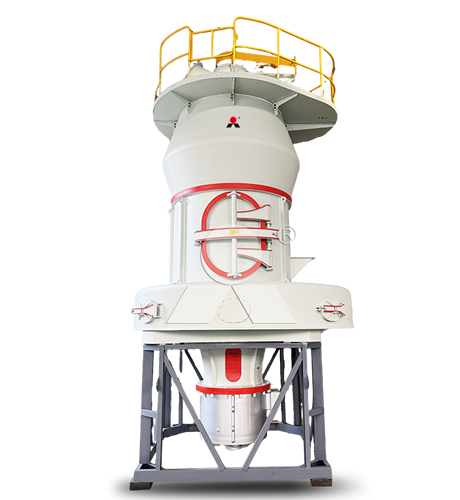
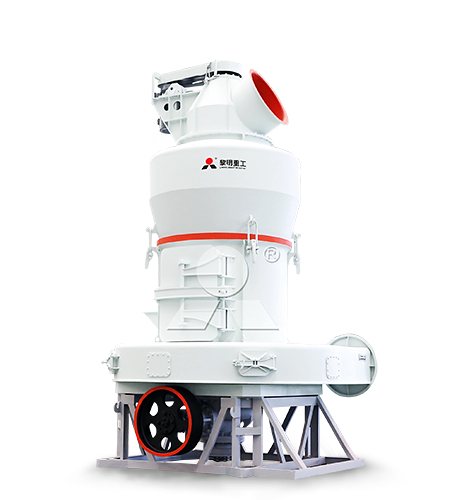
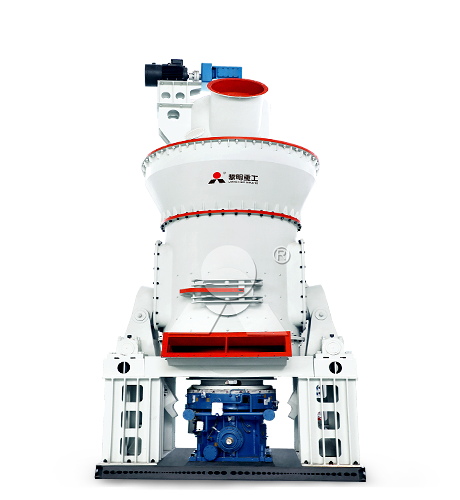
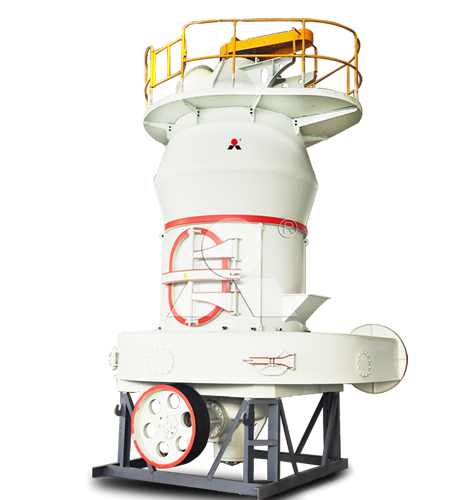
We are Liming Heavy Industry, a manufacturer of various types of industrial crushers, such as Raymond Mill, Trapezoidal Mill, Vertical Mill, Ultrafine Mill, Ball Mill, etc.
Our mills can process the following minerals:
limestone, quicklime, kaolin, talc, barite, bentonite, calcium carbonate, dolomite, coal, gypsum, clay, carbon black, slag, cement raw materials, cement clinker, etc.
If you need a mill to process stone or minerals into powder, please feel free to contact me (WhatsApp: +8615333807511). Thank you.
Calcium carbonate (CaCO₃) is one of the most commonly used fillers in PVC products. In industrial production, manufacturers often adjust the CaCO₃ ratio to reduce costs, improve rigidity, and optimize processing performance.
Because different PVC formulations usually contain different filler ratios, calcium carbonate analysis is also important in material identification, quality control, and forensic investigations involving plastic samples.
Among the available testing technologies, Scanning Electron Microscopy-Energy Dispersive Spectroscopy (SEM-EDS) and Fourier Transform Infrared Spectroscopy (FT-IR) are two widely used methods for determining CaCO₃ content in PVC materials.
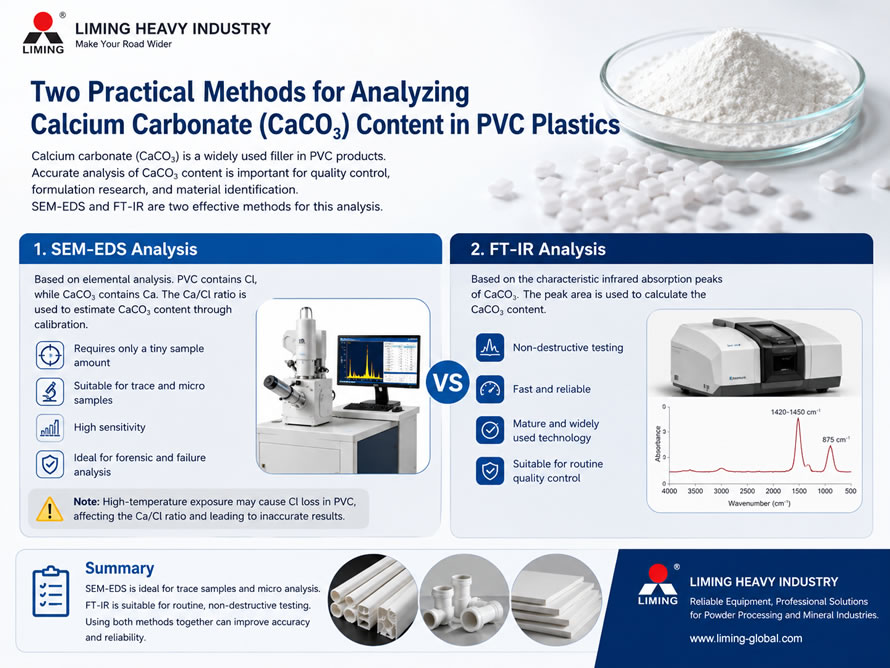
1. SEM-EDS Analysis
Scanning Electron Microscopy with Energy Dispersive Spectroscopy (SEM-EDS) is mainly used for microscopic elemental analysis.
PVC contains chlorine (Cl), while calcium carbonate contains calcium (Ca). By measuring the relative proportion of Ca and Cl elements in the sample, technicians can estimate the calcium carbonate filler content through calibration data.
Advantages of SEM-EDS
Requires only a very small sample amount
Suitable for tiny plastic fragments and trace samples
High sensitivity for micro-area analysis
Useful for forensic and failure analysis applications
Limitations of SEM-EDS
SEM-EDS results can be influenced by the thermal history of the sample.
If PVC materials have experienced burning or prolonged high-temperature exposure, chlorine may partially escape from the material as HCl gas. This changes the Ca/Cl ratio and may lead to inaccurate results.
For this reason, severely heat-damaged PVC samples are generally not recommended for SEM-EDS quantitative analysis.
2. FT-IR Analysis
Fourier Transform Infrared Spectroscopy (FT-IR) is a mature non-destructive material analysis method widely used in laboratories and industrial quality control.
Calcium carbonate produces characteristic absorption peaks in the infrared spectrum. By analyzing these peaks and comparing them with calibration standards, the CaCO₃ concentration in PVC can be estimated.
Advantages of FT-IR
Non-destructive testing method
Fast and stable analysis process
Mature and widely available technology
Suitable for routine quality control
FT-IR is commonly preferred when the sample needs to remain intact or when sufficient material is available for standard testing procedures.
SEM-EDS vs. FT-IR
Both methods have their own advantages depending on the testing objective and sample condition.
| Method | Main Advantages | Typical Applications |
|---|---|---|
| SEM-EDS | High sensitivity and very low sample requirement | Trace evidence analysis and microscopic investigation |
| FT-IR | Non-destructive and suitable for routine testing | Quality control and standard PVC material analysis |
In many practical applications, laboratories combine SEM-EDS and FT-IR to cross-check data and improve analytical reliability.
As PVC formulations continue evolving in industries such as cable, pipe, flooring, and construction materials, accurate calcium carbonate filler analysis remains an important part of product quality control and material identification.
About Liming Heavy Industry
Liming Heavy Industry is a professional manufacturer of grinding mills and mineral powder processing equipment. We provide complete solutions for calcium carbonate, limestone, gypsum, dolomite, marble, barite, and other industrial mineral grinding projects.
Our equipment is widely used in powder processing plants around the world, supporting customers with high-capacity grinding, stable operation, energy-efficient production, and customized engineering solutions.
Whether you are planning a new mineral grinding project or upgrading an existing production line, our technical team can help provide suitable equipment and process solutions.
Contact Liming Heavy Industry today to discuss your mineral grinding project and request a customized solution.