Calcium Carbonate Knowledge Hub
How to Choose Calcium Carbonate Grinding Equipment
2026-09-04 17:27:35
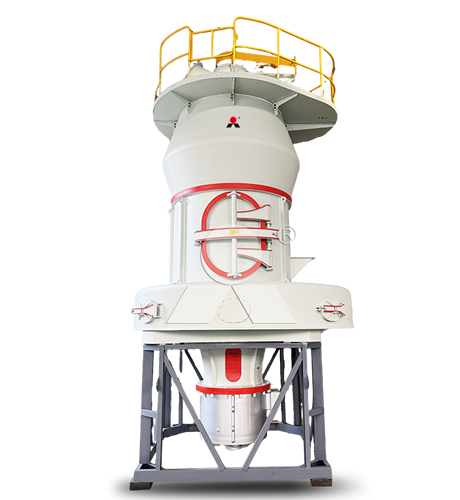
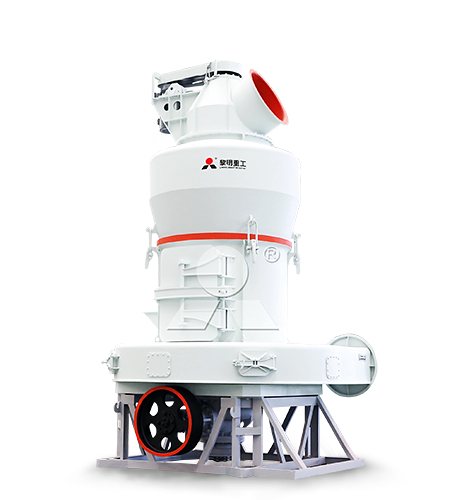
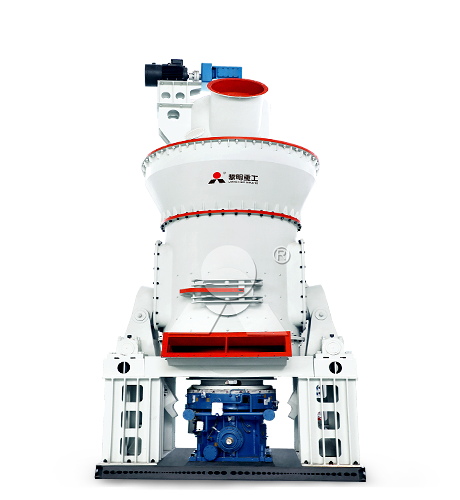
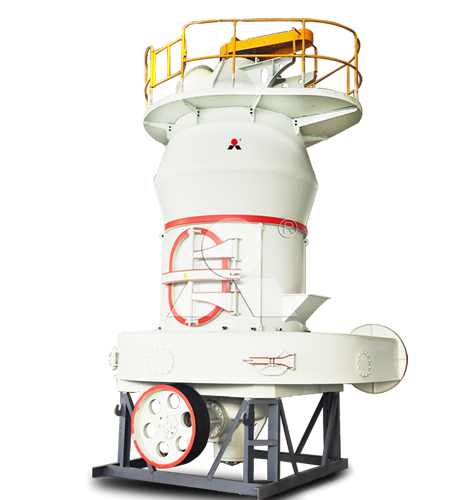
We are Liming Heavy Industry, a manufacturer of various types of industrial crushers, such as Raymond Mill, Trapezoidal Mill, Vertical Mill, Ultrafine Mill, Ball Mill, etc.
Our mills can process the following minerals:
limestone, quicklime, kaolin, talc, barite, bentonite, calcium carbonate, dolomite, coal, gypsum, clay, carbon black, slag, cement raw materials, cement clinker, etc.
If you need a mill to process stone or minerals into powder, please feel free to contact me (WhatsApp: +8615333807511). Thank you.
Choose calcium carbonate grinding equipment by matching the machine and complete process system to the required finished-product specification: particle-size distribution, capacity, raw-material condition, coating requirement, and operating cost. The best choice is not the mill with the highest catalog output; it is the system that can consistently produce the required GCC grade at the target D50 and D97 using the actual calcite, marble, limestone, or chalk feedstock.
For industrial buyers in PVC, PP, PE, masterbatch, rubber, sealants, adhesives, coatings, paper, and construction materials, the selection process should begin with the downstream application. A coarse construction filler, a fine PVC filler, and an ultrafine coated masterbatch grade can require very different grinding, classification, collection, coating, and powder-handling configurations.
Start with the Finished Product
Before comparing equipment, define what customers will buy. “800 mesh,” “1,250 mesh,” or “2,500 mesh” is not enough for a serious equipment decision. Mesh is only a rough commercial reference; it does not reliably describe the full particle-size distribution of a fine or ultrafine calcium carbonate powder.
Specify each target grade using measurable parameters:
Target D10, D50, D90, and D97 or D98.
Maximum coarse residue using an agreed test method.
Minimum whiteness or brightness.
CaCO3 content and limits for silica, iron, or other impurities.
Maximum moisture and expected bulk-density range.
Uncoated GCC or coated calcium carbonate.
Coating agent and treatment-performance requirement, where applicable.
Required net finished-product capacity in tonnes per hour.
Annual production volume and planned operating hours.
Packaging format: bags, jumbo bags, or bulk tanker.
For example, instead of requesting a “2,000-mesh calcium carbonate mill,” define the actual requirement:
Produce coated GCC for PP masterbatch with D50 2.5–3.5 μm, D97 maximum 10 μm, low coarse residue, specified whiteness, controlled moisture, agreed stearic-acid treatment, and net output of 3 t/h.
This gives equipment suppliers a clear basis to recommend and guarantee a grinding circuit.
Match Equipment to Fineness
Fineness is the first technical filter for equipment selection. As calcium carbonate becomes finer, grinding energy rises, output generally falls, classification becomes more important, and powder handling becomes more demanding.
| Product direction | Indicative PSD range | Potential equipment choice | Primary selection concern |
|---|---|---|---|
| Coarse and standard GCC | Approximately 80–325 mesh or D97 45–150 μm | Raymond or pendulum mill, often with a simple classifier arrangement | High throughput, low operating cost, and stable feed handling |
| Fine GCC | Approximately D97 20–45 μm | Ball mill + air classifier, ring-roller mill, or vertical roller mill | PSD consistency, practical energy use, and reliable coarse-particle rejection |
| Ultrafine GCC | Approximately D97 5–20 μm | Ball mill + high-efficiency classifier, micro powder roller mill, or superfine vertical mill | Classifier precision, circulating load, power demand, and wear |
| Very fine specialty GCC | Approximately D97 below 5–10 μm | Advanced classification circuit, stirred-media mill, jet mill, or specialty ultrafine system | Commercial justification, narrow PSD, contamination control, and high energy demand |
Supplier equipment-selection data commonly place ball mills with classifiers and micro powder roller mills in approximately the D97 5–45 μm GCC range, while vertical mills may be configured for roughly D97 3–45 μm depending on the system. These values are useful for initial screening, but they are not a substitute for testing the actual feedstock at the required product grade and capacity.
Compare the Main Grinding Options
Raymond or pendulum mill
A Raymond-type or pendulum mill is often considered for coarser calcium carbonate products. It can be a practical, cost-effective solution for general filler grades where ultrafine PSD control is not required. Supplier recommendations commonly position Raymond milling in the approximate 80–325 mesh range for conventional calcium carbonate filler processing.
This option may be appropriate for putty, dry-mix mortar, construction filler, and selected standard industrial uses. It is usually less suitable when the target requires a narrow D97, very low coarse residue, or premium ultrafine coated GCC.
Ball mill plus air classifier
A ball mill with an external dynamic air classifier is a common solution for fine and ultrafine GCC, especially when the producer needs flexible product grades or larger continuous output. The ball mill performs the size reduction while the classifier separates qualified powder from coarse particles that return for regrinding.
This separation of functions can help optimize the system for different D50 and D97 targets. However, it requires correct grinding-media design, classifier sizing, fan selection, filter capacity, circulating-load control, and maintenance planning. Ball mills are commonly paired with external air classifiers for accurate GCC fineness control.
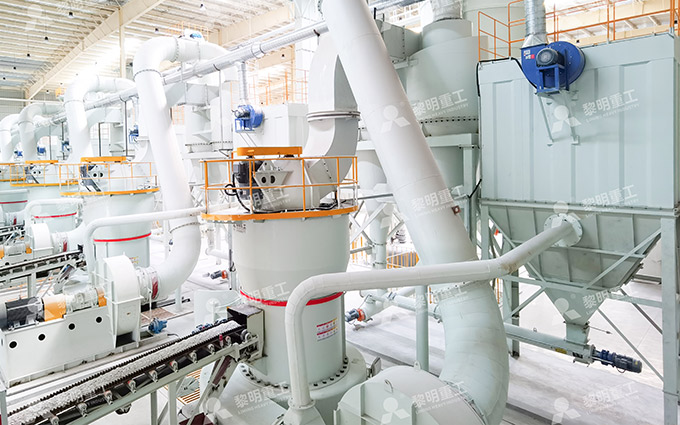
Micro powder roller mill
Micro powder roller mills are often selected for fine and ultrafine dry GCC at small to medium production scales. Their integrated grinding and classification arrangement can offer a compact layout and flexible adjustment across multiple fine grades.
This option is sensitive to feed moisture, stable dosing, airflow balance, and wear condition. It is usually most suitable where the required throughput is moderate and the producer needs controlled fine powder without installing a larger ball-mill circuit.
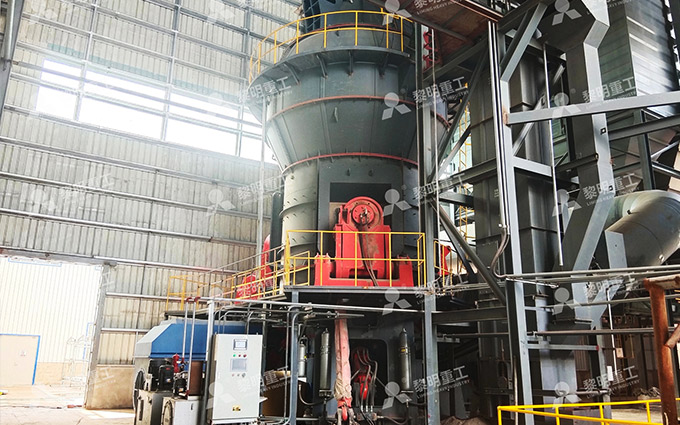
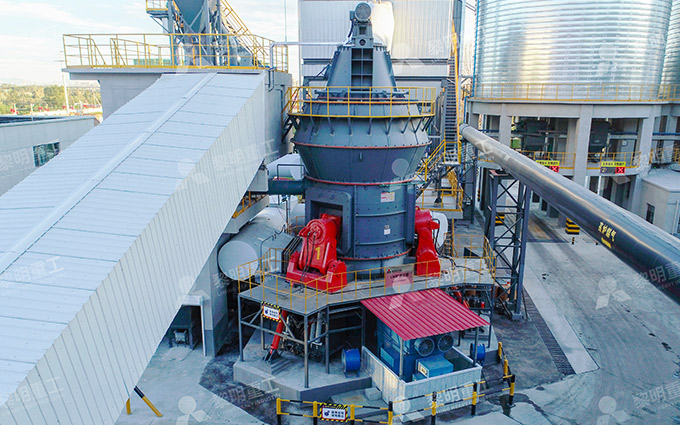
Vertical roller mill
Vertical roller mills can combine grinding, drying capability in some configurations, and classification in a vertical process arrangement. They can be attractive where floor area is limited or a continuous, integrated system is preferred.
When considering a vertical roller mill, verify the guaranteed output at the requested D97—not at a much coarser reference product. Also review feed moisture tolerance, classifier design, wear protection, maintenance access, and actual specific energy for the planned product mix.
Stirred-media and specialty mills
Stirred-media mills and jet mills may be considered for very fine or specialty calcium carbonate grades. They can support extremely fine particle sizes, but their higher process complexity, wear, energy demand, media requirements, or compressed-air consumption must be commercially justified by the intended market.
These systems are usually evaluated for high-value ultrafine GCC rather than as the default choice for general-purpose calcium carbonate filler production.
Evaluate Raw Material Before Selecting a Mill
Grinding equipment must match the real mineral—not an assumed “calcium carbonate” material. Calcite, marble, chalk, and limestone can differ substantially in hardness, whiteness, moisture, silica, iron content, abrasiveness, and grindability.
Send representative material samples for testing and provide:
Full chemical analysis, including CaCO3, MgO, SiO2, Fe2O3, and relevant trace components.
Whiteness, brightness, color, and variability across the deposit.
Moisture range in dry and wet seasons.
Hardness, abrasiveness, and expected grinding-media or roller wear.
Feed-size distribution after crushing.
Potential clay, quartz, metal, or organic contamination.
Required end-use certifications or impurity restrictions.
High silica or quartz content can raise equipment wear, increase energy consumption, reduce whiteness, and create dust-control concerns. Iron-bearing contaminants may reduce color quality. Even a small change in moisture can affect feed flow, milling efficiency, classifier operation, and bag-filter performance.
Supplier operating guidance for fine calcium carbonate mills states that raw-material moisture should be kept below approximately 1% in certain ultrafine dry-grinding applications because higher moisture can create buildup on grinding tracks and blind classifier components. The actual limit depends on the mill and process design, but moisture must be treated as a core design input rather than a minor operating detail.
Size the Whole Grinding System
Do not select the main mill in isolation. The complete system includes feed preparation, grinding, classification, powder collection, conveying, storage, packing, and—if required—coating. Any undersized section can become the actual capacity bottleneck.
| System component | What it must be sized for | Common error |
|---|---|---|
| Crusher and screen | Mill feed rate and maximum acceptable feed size | Oversize feed reaches the mill and reduces stability or damages equipment |
| Feeder and buffer silo | Continuous, accurate mass flow to the mill | Intermittent feeding causes mill-load and PSD variation |
| Grinding mill | Net finished-product output at target D50/D97 | Selecting based on maximum output at a coarser grade |
| Air classifier | Fresh feed plus coarse-return circulating load | Sizing only for net product output |
| Fan and ducting | Required process airflow and system pressure losses | Unstable air balance changes classifier cut point |
| Cyclone and bag filter | Powder recovery, airflow stability, and dust-control duty | Undersized filters increase pressure drop and product loss |
| Coating system | Planned coated-product throughput and powder surface area | Treating surface modification as a minor downstream add-on |
| Silos and packing | Daily output, grade segregation, loading schedule, and product flow behavior | Grinding capacity exceeds storage or dispatch capacity |
For a closed-circuit system, request a full material balance. It should show raw feed, mill feed, mill discharge, classifier feed, fine-product flow, coarse-return flow, circulating-load ratio, product yield, and expected losses. The classifier may process much more material than the net tonnes per hour of qualified product, particularly for D97 10 μm and finer GCC.
Choose by Net Capacity, Not Catalog Capacity
Capacity figures are only comparable when the product and feed conditions are the same. A supplier might state a mill’s maximum throughput at coarse fineness, low moisture, and soft feedstock; that rating may not apply to your intended D97, whiteness requirement, coating status, or annual operating schedule.
Ask each supplier to state:
Guaranteed net output at the required D50 and D97.
Raw-material chemistry, hardness, feed size, and moisture assumed.
Product test method, sample preparation, and permitted tolerance.
Specific energy in kWh per tonne of qualified finished powder.
Classifier configuration, expected circulating load, and fine-product yield.
Fan duty, bag-filter area, compressed-air demand, and dust-control scope.
Expected wear-part life and replacement-cost assumptions.
Equipment boundary, including conveyors, silos, packing, coating, electrical, and controls.
Commissioning support, spare parts, operator training, and acceptance-test procedure.
A mill that appears cheaper initially can be more expensive over its operating life if it uses excessive energy, produces unstable PSD, requires frequent wear-part replacement, causes product losses, or cannot meet the customer’s quality specification consistently.
Consider Coated GCC Requirements
If the target market includes PVC, PP, PE, masterbatch, rubber, sealants, or adhesives, determine whether coated GCC is required. Surface treatment is commonly used to improve compatibility between mineral particles and hydrophobic polymer systems. It can also reduce agglomeration and influence powder flow.
Equipment selection for coated GCC must consider the powder’s surface area. A finer calcium carbonate grade has more surface area, requiring more accurate coating-agent dosage and more uniform mixing. The coating section may include low-moisture powder conditioning, stearic-acid storage and melting, metered dosing, high-intensity mixing, cooling, collection, and segregated product storage.
Test coated GCC in the intended application. Acceptable PSD alone does not confirm performance in a PVC pipe compound, PE film masterbatch, rubber formulation, sealant, or adhesive. Confirm dispersion, processing behavior, mechanical performance, and final-product appearance with the actual resin and formulation.
Assess Energy, Wear, and Maintenance
Equipment selection should use total cost of ownership rather than purchase price alone. The most important comparison is the cost per tonne of qualified, saleable GCC—not simply kW installed or dollars per mill.
| Cost factor | Why it changes by equipment type | What to compare |
|---|---|---|
| Grinding energy | Different mills use different size-reduction mechanisms and recirculation levels | kWh/t at the same D50/D97 and raw material |
| Classifier and fan energy | Fine cuts require high-speed classification and process airflow | Classifier drive, fan duty, duct losses, and filter pressure drop |
| Wear parts | Abrasion depends on mineral impurities and equipment design | Media, liners, rollers, rings, classifier wheel, and duct wear cost |
| Maintenance downtime | Access, component life, and spare-part availability vary | Expected availability, maintenance hours, and critical spares |
| Product yield | Poor classification can lose fine product to the coarse return | Qualified-product yield and rejected fine fraction |
| Dust collection | Fine GCC requires effective powder recovery and clean operation | Filter area, bag life, compressed-air demand, and emission performance |
Common Equipment-Selection Mistakes
Choosing by mesh and maximum output
Mesh does not define ultrafine product quality, and maximum output is usually stated for favorable feed and coarser products. Select based on guaranteed net output at the required D50/D97.
Ignoring classifier performance
For fine GCC, the classifier controls the top size and coarse tail. A good mill with an undersized or inefficient classifier can consume excessive energy and still produce off-spec powder.
Not testing the actual raw material
Supplier demonstrations using another calcite or limestone source may not predict your performance. Test representative samples that reflect expected quarry variation, moisture, impurities, and hardness.
Buying a dry mill for wet feed without a moisture plan
Wet feed can cause caking, poor flow, reduced output, classifier instability, and filter buildup. Include covered storage, drying, conditioning, or a different process route if the feed cannot remain within the mill’s moisture tolerance.
Forgetting storage and dispatch
A grinding circuit cannot operate continuously if silos, packing, FIBC filling, or tanker loading cannot clear the finished powder. Size product handling for daily production and grade segregation.
FAQ
Which mill is best for calcium carbonate?
There is no single best mill. A Raymond or pendulum mill can suit coarser filler grades; ball mill plus air classifier systems are common for fine and ultrafine GCC; micro powder roller mills may suit flexible fine production at moderate capacity; vertical roller mills can suit integrated continuous systems. The right selection depends on PSD, output, raw material, moisture, coating requirements, energy cost, and maintenance capability.
Should I choose a ball mill or a vertical roller mill?
Choose by required product and total economics. A ball mill plus external classifier can offer flexible control for fine GCC and allows grinding and classification to be optimized separately. A vertical roller mill can offer a compact integrated process. Compare both on the same raw material, D50/D97, net throughput, kWh/t, wear cost, product-quality guarantee, and full equipment scope.
How important is feed moisture?
Feed moisture is highly important in dry grinding. It can affect flow, agglomeration, mill efficiency, classification, dust collection, and powder storage. Certain ultrafine mill guidance recommends keeping raw-material moisture below about 1% to avoid buildup and classifier blockage. Confirm the acceptable moisture range for the specific system during testing.
Do I need a coating machine for calcium carbonate?
You need a coating section if the product portfolio requires coated GCC for polymer, rubber, sealant, or adhesive applications. For uncoated construction, paint, putty, or selected paper-related grades, coating may not be necessary. The decision should be based on customer formulation requirements and expected margin.
Bottom Line
Choose calcium carbonate grinding equipment from the finished product backward. Define the target D50/D97, whiteness, moisture, purity, coating requirement, packaging, and net output; test the actual raw material; then compare complete grinding-and-classification systems using the same performance basis.
The best equipment is the system that delivers stable, saleable GCC with acceptable specific energy, wear cost, dust control, and operating reliability. For most projects, that means selecting the mill, classifier, fan, baghouse, coating section, silos, and packing equipment as one integrated production line rather than as separate purchases.