Calcium Carbonate Knowledge Hub
Calcium Carbonate Grinding Plant
2026-09-04 17:22:08
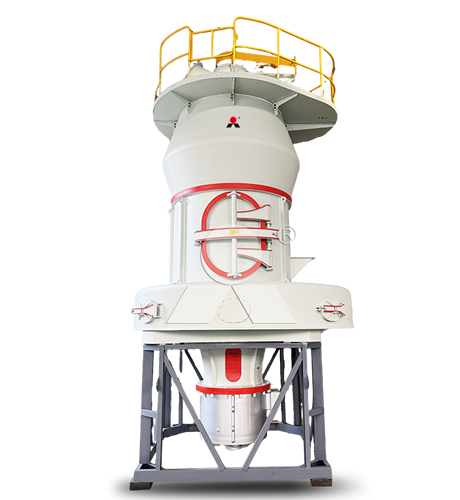
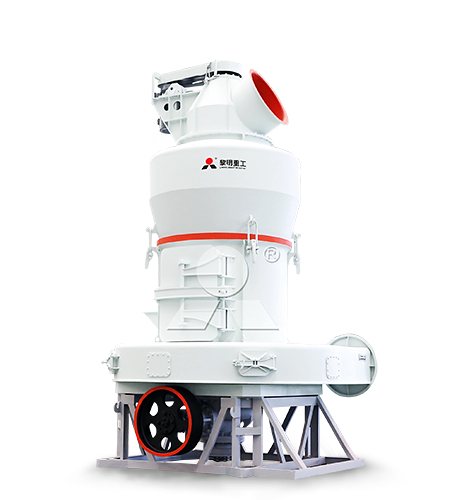
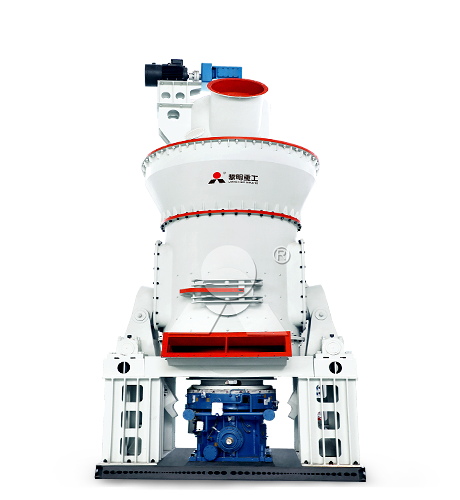
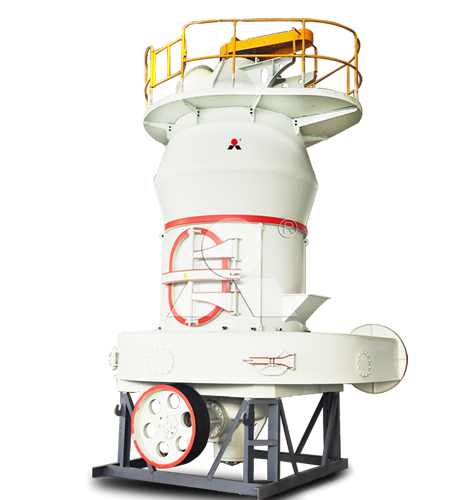
We are Liming Heavy Industry, a manufacturer of various types of industrial crushers, such as Raymond Mill, Trapezoidal Mill, Vertical Mill, Ultrafine Mill, Ball Mill, etc.
Our mills can process the following minerals:
limestone, quicklime, kaolin, talc, barite, bentonite, calcium carbonate, dolomite, coal, gypsum, clay, carbon black, slag, cement raw materials, cement clinker, etc.
If you need a mill to process stone or minerals into powder, please feel free to contact me (WhatsApp: +8615333807511). Thank you.
A calcium carbonate grinding plant is a dry mineral-processing facility that converts crushed calcite, marble, limestone, or chalk into ground calcium carbonate (GCC) with controlled particle size and consistent industrial quality. A complete plant includes more than a grinding mill: it combines feeding, milling, air classification, powder collection, conveying, optional surface treatment, storage, packing, and process control.
The correct grinding-plant design is determined by the powder customers need to buy. For PVC, PP, PE, masterbatch, rubber, sealants, adhesives, coatings, paper, and construction materials, the plant must deliver a specified D50 and D97, limited coarse residue, stable whiteness and moisture, and the required tonnes per hour—not merely a nominal “mesh” number.
What a Grinding Plant Includes
A calcium carbonate grinding plant starts with prepared mineral feed and ends with packed or bulk-loaded GCC. Depending on the project, it can produce uncoated standard filler grades, fine GCC, ultrafine GCC, or coated calcium carbonate for polymer and rubber applications.
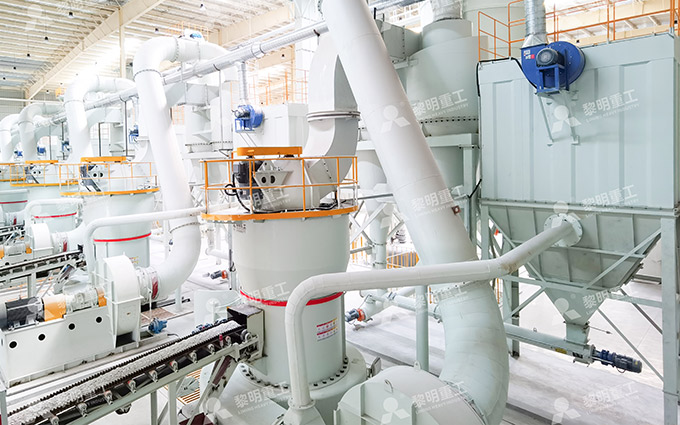
Common equipment in a dry GCC grinding plant includes a crusher, vibrating or belt feeder, bucket elevator or belt conveyor, grinding mill, air classifier, cyclone, dust collector, fan, product silos, coating machine, packing machine, and electrical control system.
| Plant section | Main equipment | Primary function |
|---|---|---|
| Feed preparation | Hopper, feeder, crusher, screen, magnetic separator | Creates clean, consistent mill feed |
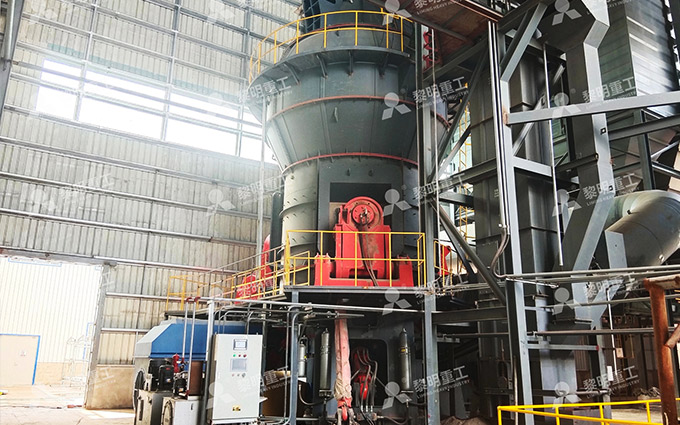
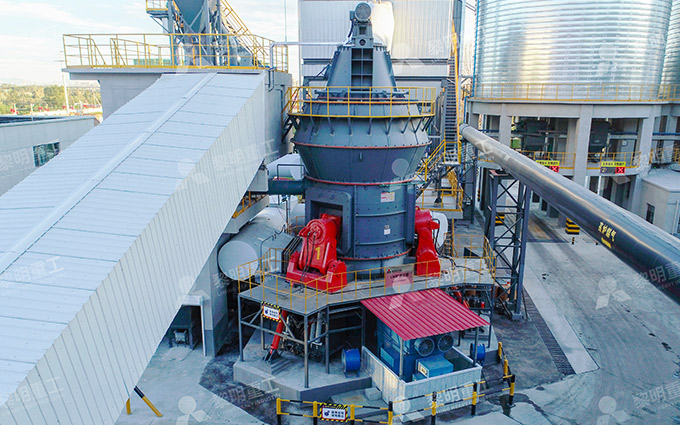
| Grinding | Ball mill, ring-roller mill, vertical roller mill, or pendulum mill | Reduces calcium carbonate to the required powder range |
| Classification | Dynamic air classifier and coarse-return conveyor | Separates qualified powder from particles requiring further grinding |
| Collection | Cyclone, baghouse, induced-draft fan, rotary valve | Recovers powder and maintains airflow balance |
| Surface treatment | Coating mixer, additive feeder, heating and cooling equipment | Produces coated GCC for selected polymer applications |
| Product handling | Finished-product silo, screw conveyor, packing machine, bulk loader | Stores, packs, and dispatches saleable GCC |
Typical Grinding Process
The standard dry process uses closed-circuit grinding. Crushed calcium carbonate enters the mill, then the ground material is carried by air to a classifier. Fine particles that meet the selected cut size go to a cyclone and bag filter for collection; coarse particles return to the mill for further grinding.
This arrangement is important because it prevents qualified powder from being ground unnecessarily while retaining oversize particles in the circuit. Supplier descriptions of ball-mill-and-air-classifier systems follow this same sequence: crushed material is conveyed to the classifier, qualified fine powder is collected by cyclone or dust collector, and coarse material returns to the ball mill for additional grinding.
Receive and inspect raw material. Check chemical composition, whiteness, moisture, silica, iron, and visible contamination.
Crush and screen the stone. Reduce rock to the feed size required by the selected mill.
Meter feed continuously. A controlled feeder keeps mill loading and product quality stable.
Grind the calcium carbonate. The mill applies compression, impact, attrition, or media grinding depending on the technology.
Classify by air. A dynamic classifier accepts fine material and rejects coarse particles.
Collect the product. Cyclones and pulse-jet bag filters separate powder from conveying air.
Store, coat, or pack. GCC moves to product silos, a coating unit, packing line, or bulk tanker loading point.
Choose the Grinding System
Grinding technology should match the target product range and capacity. A plant making standard filler for putty or construction products does not necessarily need the same circuit as a plant making coated ultrafine GCC for high-loading PVC, PP, or PE compounds.
| Grinding option | Typical role | Suitable project profile | Key requirement |
|---|---|---|---|
| Pendulum or Raymond mill | Coarse to medium-fine GCC | Standard industrial filler grades | Confirm whether its PSD capability meets the intended market |
| Ring-roller micro powder mill | Fine and ultrafine dry GCC | Flexible product range at small to medium capacities | Maintain stable feed, air volume, and classifier conditions |
| Vertical roller mill | Continuous grinding with integrated air classification | Compact plant arrangement and higher-capacity dry production | Validate output at the specified D97 rather than at a coarse reference grade |
| Ball mill + air classifier | Fine and ultrafine GCC in a dedicated closed circuit | Large-scale production and multi-grade flexibility | Optimize media charge, classifier efficiency, circulation, and energy use |
| Stirred media mill | Very fine specialty calcium carbonate | Specialty grades or wet-processing routes | Assess media wear, slurry handling, and possible drying cost |
A dry ball mill with a high-efficiency air classifier is commonly used for fine calcium carbonate. Supplier process references describe such systems as capable of producing controlled powder in the approximate 45–5 μm range, with a classifier wheel separating fine product from material returned for regrinding. Actual results depend on the raw material, target PSD, installed power, classifier design, and operating conditions.
Define Fineness Correctly
For a grinding plant, mesh is only a rough commercial description. It should not be the main technical basis for equipment selection, production guarantees, or customer acceptance. Fine and ultrafine GCC should be specified through particle-size distribution data measured by an agreed method, typically laser diffraction.
| PSD parameter | Meaning | Why it matters to GCC customers |
|---|---|---|
| D10 | 10% of particles are below this size | Shows the fine end and helps indicate surface-area behavior |
| D50 | 50% of particles are below this size | Represents median particle size |
| D90 | 90% of particles are below this size | Indicates distribution breadth toward the coarse end |
| D97 or D98 | 97% or 98% of particles are below this size | Controls coarse particles that can affect product appearance and processing |
| Sieve residue | Oversized material retained on a defined screen | Provides a practical quality-control check for selected grades |
For example, two calcium carbonate grades may both be sold as “1,250 mesh,” yet one may have a much coarser D97 or higher sieve residue. In PVC extrusion, masterbatch, coating, or sealant production, that difference can influence dispersion, gloss, surface smoothness, screen-pack pressure, extrusion stability, and customer complaints.
Raw Material Controls Plant Performance
A calcium carbonate grinding plant cannot consistently make premium GCC from inconsistent stone. Before plant design, test the actual calcite, limestone, marble, or chalk source for calcium carbonate content, whiteness, brightness, silica, iron, moisture, hardness, abrasiveness, and grindability.
Silica and quartz impurities deserve particular attention. They can increase wear on grinding media, rollers, rings, liners, classifier wheels, and conveying components. They can also create occupational exposure concerns if respirable crystalline silica is present in dust. OSHA’s general-industry guidance requires worker exposures to respirable crystalline silica to remain at or below 50 µg/m³ as an 8-hour time-weighted average.
Use enclosed transfer points, local exhaust ventilation, effective bag filtration, sealed discharge equipment, planned housekeeping, and exposure assessment where relevant. The plant’s dust-control strategy should be developed for the actual feed chemistry and local regulatory requirements, rather than treated as a standard accessory package.
Air Classification and Dust Collection
In fine GCC production, the classifier and dust collector are not secondary components. The classifier controls which particles leave as finished product; the collection system controls whether those particles are recovered efficiently and whether process airflow remains stable.
Classifier selection
For fine and ultrafine calcium carbonate, dynamic air classifiers are normally used because their wheel speed can adjust the cut point. Increasing wheel speed generally produces a finer product by rejecting more coarse particles, but it may reduce throughput and increase circulating load. The best setting is the point that meets D50 and D97 requirements with acceptable qualified-product yield and energy use.
Collection-system design
The fan, cyclone, filter bags, hopper, rotary valve, ducts, and conveyors must be correctly matched. A bag filter with excessive differential pressure can alter airflow and product fineness; poor hopper discharge can cause powder buildup; duct leakage can disturb the designed air balance; and inadequate collection can cause product loss and dust leakage.
For a plant producing several grades, the collection and conveying system must also prevent cross-contamination. Fine ultrafine GCC can remain in ducts, cyclones, filters, and conveyors after a grade change, so cleanout access and operating procedures should be included in the original layout.
Coated Calcium Carbonate Section
Many GCC grades for PVC, PP, PE, masterbatch, rubber, sealants, and adhesives are surface treated to improve compatibility with organic polymers and to reduce particle agglomeration. Stearic acid is widely used for this purpose, but the optimum treatment level depends on the particle surface area, powder moisture, raw-material chemistry, downstream resin, and the required formulation performance.
A coating section commonly includes powder conditioning, accurate additive dosing, a high-speed mixer or coating machine, temperature control, cooling where needed, finished-product collection, and coated-product storage. The coating system should be selected alongside the mill because finer powders have more surface area and can require different coating dosage and mixing conditions than coarser products.
For coated GCC, confirm quality through both powder tests and application tests. A grade may have acceptable PSD and apparent coating coverage but still perform poorly in a PVC compound, PE film masterbatch, rubber formulation, or sealant if treatment is uneven or mismatched to the polymer system.
How to Size a Grinding Plant
Capacity must be calculated for every product grade. As target fineness increases, net output generally decreases and specific grinding energy rises. Therefore, do not size the line based only on its coarsest product or on an equipment supplier’s maximum catalog rating.
Provide the following information when requesting a plant proposal:
Raw-material chemical analysis, moisture, whiteness, hardness, and abrasiveness.
Maximum feed size after crushing and target feed consistency.
Finished GCC grades with D50, D97/D98, residue, moisture, whiteness, and coating requirement.
Required net output in tonnes per hour for each product grade.
Annual tonnage and planned annual operating hours.
Electricity supply, local power cost, site altitude, ambient temperature, and humidity.
Available plant footprint, installation height, and maintenance access.
Required packaging formats: valve bags, open-mouth bags, jumbo bags, or bulk tankers.
Dust-emission, safety, and environmental requirements.
Required automation level, laboratory testing equipment, and spare-parts support.
Ask for a written performance guarantee tied to your actual calcium carbonate feedstock, product PSD, net throughput, product moisture, quality criteria, energy basis, and defined equipment boundary. This makes competing proposals easier to compare and reduces the risk of an underperforming plant.
Common Grinding Plant Problems
Product is too coarse or PSD is unstable
Check feed rate, classifier wheel speed, fan performance, filter differential pressure, air leakage, feed moisture, grinding-media condition, roller or ring wear, and coarse-return flow. A PSD problem often comes from interaction between several process variables rather than a single machine fault.
Throughput drops after initial commissioning
Typical reasons include worn grinding parts, changing stone hardness, high feed moisture, filter loading, insufficient air volume, excess circulating load, or a target grade that is finer than the original design condition. Compare current operating data with commissioning data and the supplier’s guarantee.
High power consumption
High specific energy can result from overgrinding, low classifier efficiency, worn media or liners, incorrect mill loading, poor air balance, or excessive fine material returning to the mill. Evaluate kWh per tonne of qualified product rather than only total plant power.
Dust leakage and poor housekeeping
Inspect transfer-point sealing, duct joints, bag-filter condition, rotary valves, hopper discharge, fan pressure, and cleaning practices. For silica-bearing feedstock, worker protection requires particular attention because respirable crystalline silica is a recognized occupational hazard.
Poor powder flow or packing instability
Fine GCC can be aerated, cohesive, and prone to bridging. Review silo geometry, bin venting, fluidization or vibration aids, rotary-valve design, screw-conveyor settings, and packing-machine calibration. Do not assume flow behavior from one product grade will apply to another, especially when comparing coated and uncoated powders.
FAQ
What equipment is needed for a calcium carbonate grinding plant?
A typical plant includes a hopper and feeder, crusher, screen, conveyor or elevator, grinding mill, dynamic air classifier, cyclone and pulse-jet bag filter, induced-draft fan, product silo, packing system, and control cabinet. A coated-GCC plant also requires additive dosing and surface-treatment equipment.
What is the best mill for a calcium carbonate grinding plant?
The best mill depends on the target PSD, output, raw material, and product mix. Pendulum mills suit many coarser grades; ring-roller and vertical roller mills can serve fine and ultrafine dry products; ball mill plus air classifier systems are widely used for larger-scale fine GCC production. Select using sample testing and a performance guarantee at the required D97.
Can a grinding plant produce both coated and uncoated GCC?
Yes. Uncoated product can be collected after classification, while selected grades are routed to a coating system. The plant should include separate silos or controlled routing, effective cleaning procedures, and quality checks to prevent cross-contamination.
How is grinding-plant capacity calculated?
Calculate it at the exact product PSD, feedstock properties, and operating conditions. Finer GCC grades require more grinding energy and usually lower net throughput. Use annual demand by grade and scheduled operating hours to determine the required hourly capacity and reserve margin.
Bottom Line
A calcium carbonate grinding plant is a complete GCC production system built around consistent product specifications. The mill is important, but stable results depend equally on raw-material quality, feeding, air classification, dust collection, powder conveying, optional coating, and laboratory control.
Design the plant around the intended market grade: target D50 and D97, whiteness, moisture, coating status, throughput, and packaging method. Then validate the complete circuit using representative calcite, limestone, marble, or chalk. This approach provides a stronger foundation for reliable GCC supply to PVC, plastics, rubber, sealants, adhesives, coatings, paper, and construction-material customers.