Calcium Carbonate Knowledge Hub
GCC Production Line
2026-09-04 17:21:33
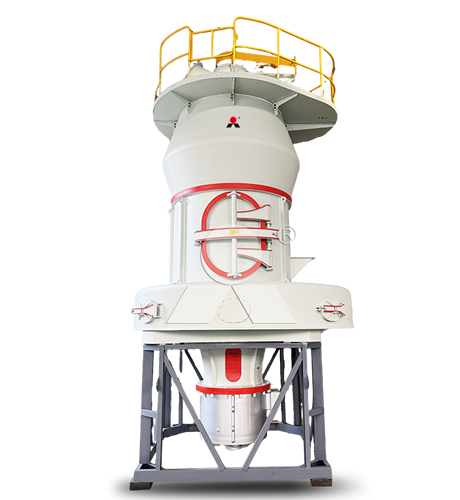
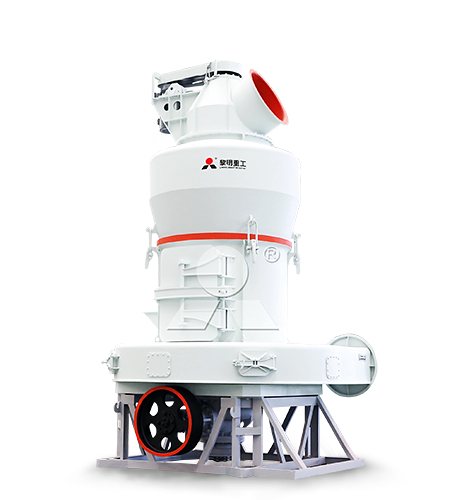
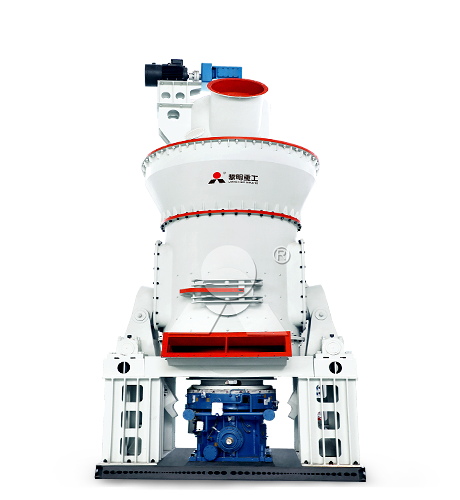
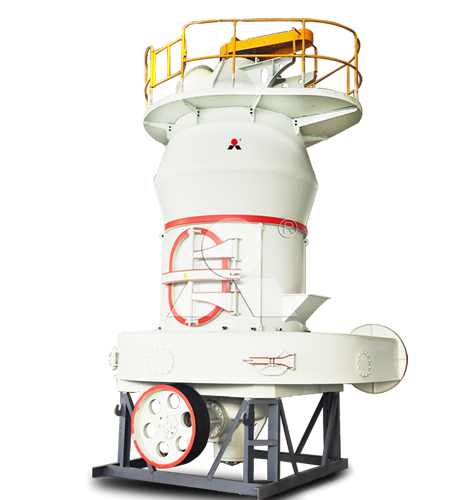
We are Liming Heavy Industry, a manufacturer of various types of industrial crushers, such as Raymond Mill, Trapezoidal Mill, Vertical Mill, Ultrafine Mill, Ball Mill, etc.
Our mills can process the following minerals:
limestone, quicklime, kaolin, talc, barite, bentonite, calcium carbonate, dolomite, coal, gypsum, clay, carbon black, slag, cement raw materials, cement clinker, etc.
If you need a mill to process stone or minerals into powder, please feel free to contact me (WhatsApp: +8615333807511). Thank you.
A GCC production line is a ground calcium carbonate manufacturing system that turns natural calcite, marble, limestone, or chalk into industrial mineral powders with controlled particle size, whiteness, moisture, and surface properties. The line normally combines raw-material preparation, crushing, grinding, air classification, powder collection, optional coating, storage, and packing.
For calcium carbonate producers supplying PVC, PP, PE, masterbatch, rubber, sealants, adhesives, coatings, paper, and construction-material markets, the objective is not simply to make fine powder. The line must repeatedly produce the customer’s required D50, D97, coarse-tail limit, purity, whiteness, and—where required—surface-treated GCC at a commercially viable tonnes-per-hour rate.
What GCC Means in Production
GCC means ground calcium carbonate: a natural calcium carbonate mineral that is mechanically processed rather than chemically precipitated. It is commonly made from calcite, marble, limestone, and similar high-calcium raw materials through grinding and classification.
The word “ground” is important because GCC quality is built through mineral selection and physical processing. The deposit’s chemistry, whiteness, impurities, hardness, moisture, and grindability affect both production cost and end-use value. A high-CaCO3 stone is not automatically suitable for every GCC market; premium polymer and coating applications may also require high whiteness, low iron content, low silica contamination, low moisture, and stable PSD.
Typical GCC Production Process
Most GCC plants use dry processing. The material is crushed, metered to a grinding mill, classified by air, collected in filtration equipment, then stored and packed. In a closed grinding circuit, coarse particles return to the mill while qualified fine particles leave as finished GCC.
Raw-material receiving: Calcite, limestone, marble, or chalk is received from a quarry, mine, or purchased-stone supplier.
Cleaning and sorting: Soil, weathered rock, visible dark material, metal, and unsuitable stone are removed where necessary.
Crushing: Large rock is reduced to a consistent mill-feed size through primary and secondary crushing.
Feed storage and dosing: Crushed material is stored in a buffer silo and supplied continuously to the grinding circuit.
Grinding: The mill reduces the feed to the required fine or ultrafine GCC range.
Air classification: A classifier separates qualified particles from coarse particles that need further grinding.
Powder collection: Cyclones and pulse-jet bag filters separate GCC powder from the process air.
Optional coating: Fine GCC may be surface treated for polymer, rubber, adhesive, or sealant applications.
Storage and packing: Product moves to silos, bagging equipment, jumbo bags, or bulk tanker loading.
In a standard ball-mill-and-classifier circuit, powder that meets the target fineness passes through the classifier wheel to the collection system, while oversize material is rejected and returned for regrinding. This closed-circuit design is widely used because it separates qualified product from particles that still require grinding.
Core Equipment in a GCC Line
| Equipment section | Main function | Why it affects GCC quality |
|---|---|---|
| Raw-stone hopper and feeder | Receives and meters material | Stable feed prevents output and PSD fluctuations |
| Crusher and screen | Reduces rock to a controlled feed size | Oversized or inconsistent feed reduces mill efficiency |
| Magnetic separator | Removes tramp metal before milling | Protects equipment and helps control contamination |
| Grinding mill | Reduces calcium carbonate to fine powder | Controls capacity, energy use, and achievable fineness |
| Air classifier | Separates fine product from coarse return | Determines D97, coarse residue, and PSD consistency |
| Fan, cyclone, and bag filter | Moves air and recovers powder | Controls yield, cleanliness, airflow stability, and dust emissions |
| Coating unit | Applies surface-treatment agent where required | Improves compatibility with polymers and organic formulations |
| Finished-product silo and packing line | Stores and dispatches GCC | Preserves flowability, prevents contamination, and supports accurate delivery |
Grinding System Options
The grinding circuit is selected according to product fineness, throughput, feed moisture, annual production plan, power cost, footprint, and desired flexibility. A system suitable for standard filler grades may not provide the PSD control needed for ultrafine coated GCC.
| System type | Typical GCC role | Strength | Selection caution |
|---|---|---|---|
| Raymond or pendulum mill | Coarse to medium-fine GCC | Simple dry processing for standard grades | Usually less suited to narrow ultrafine PSD requirements |
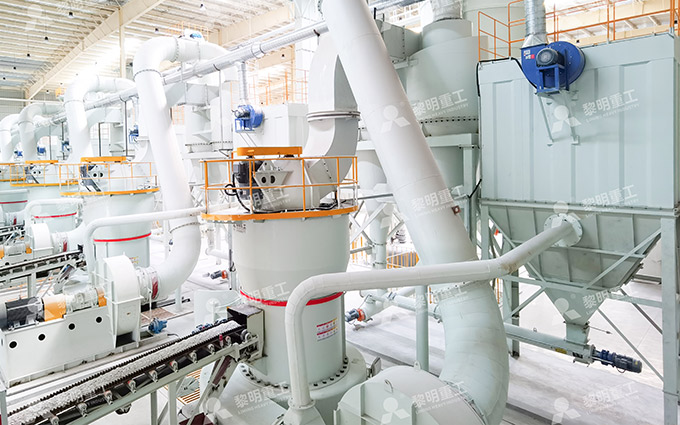
| Ring-roller micro powder mill | Fine and ultrafine GCC | Compact layout and flexible fine-grade production | Output is sensitive to feed moisture, airflow, and classifier settings |
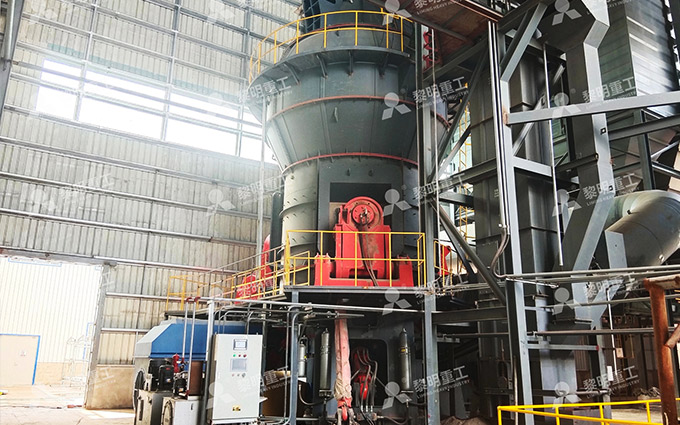
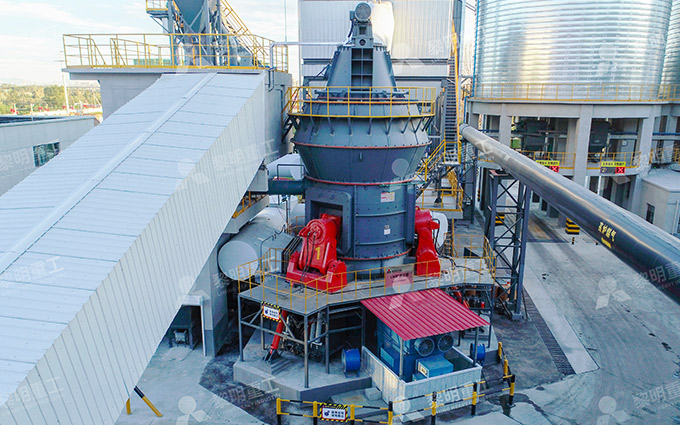
| Vertical roller mill | Continuous fine grinding with internal classification | Integrated process flow and potentially compact plant arrangement | Confirm actual capacity at the required D97, not at a coarser grade |
| Ball mill + air classifier | Fine and ultrafine GCC at larger scale | Flexible PSD control and proven closed-circuit configuration | Requires optimization of media, classification, circulation, and energy |
| Stirred media mill | Specialty ultrafine GCC, wet or dry by configuration | Potentially very fine products | Evaluate media wear, water handling, and drying requirements |
Ball-mill-plus-classifier systems are often specified for continuous GCC production. Supplier references describe standard GCC production in approximately the D97 10–45 μm range, with finer performance depending on the complete circuit configuration, classifier design, and feedstock.
Particle Size Is the Commercial Specification
In a GCC production line, the most important output is not the nominal mesh description; it is the particle-size distribution. Customers usually experience product quality through dispersion, viscosity, extrusion stability, surface smoothness, mechanical properties, gloss, opacity, and filler loading. These performance outcomes are strongly influenced by PSD and especially by the coarse particle tail.
Use laser-diffraction values and an agreed testing method for production control:
D10: Indicates the fine end of the distribution.
D50: Indicates the median particle size.
D90: Indicates the size below which 90% of particles fall.
D97 or D98: Defines upper-size control and helps limit coarse particles.
Sieve residue: Provides a quick check for oversize particles on an agreed screen.
A plant may produce two grades with the same average D50 but very different customer results if one grade has a broader distribution or more oversized particles. This is why the classifier, air balance, feed rate, and grinding-media condition must be monitored continuously.
Coated GCC Production
Coated GCC is widely used in PVC, polyolefins, rubber, sealants, adhesives, and masterbatch because surface treatment can improve the mineral’s compatibility with hydrophobic organic systems. Stearic acid is a common coating agent for dry GCC processing, although the optimal chemistry and treatment level depend on the target application and filler surface area.
Research on stearic-acid-modified GCC reports that the treatment can bind stearic acid to the GCC surface, while dry coating references describe the practical sequence of drying GCC to low moisture, liquefying stearic acid, and mixing it intensively with the powder. Production conditions must be developed around the actual powder because finer GCC has higher surface area and therefore requires closer control of coating-agent dosage and distribution.
Typical coated GCC sequence
Produce GCC to the required PSD through grinding and classification.
Control moisture to support consistent surface treatment.
Heat or melt the treatment agent according to the selected process.
Mix the powder and treatment agent under controlled temperature and residence time.
Cool, collect, and convey the coated powder without excessive moisture pickup.
Verify PSD, moisture, bulk density, hydrophobicity or activation, and downstream dispersion.
For coated GCC, do not qualify the line using PSD alone. Confirm product performance in the intended PVC compound, PP/PE masterbatch, rubber compound, sealant, or adhesive formulation.
How to Size a GCC Production Line
Line capacity must be calculated at the actual product mix. Finer grades require more grinding energy and normally reduce net throughput. Therefore, a plant rated at 10 t/h for a coarse product cannot automatically produce 10 t/h of a D97 5 μm or D97 10 μm grade.
Use the following information when developing a plant specification:
Raw material type, chemical analysis, whiteness, moisture, hardness, and abrasiveness.
Feed size after crushing and the permitted maximum particle size.
Each finished GCC grade, including D50, D97, residue, moisture, whiteness, and coating status.
Required tonnes per hour for each grade.
Annual demand by grade and anticipated annual operating hours.
Power supply, site elevation, ambient temperature, humidity, and available footprint.
Product storage volume, packaging format, and bulk-loading needs.
Dust-emission requirements and site environmental controls.
Automation level, laboratory equipment, spare-parts plan, and maintenance resources.
Ask suppliers to provide a performance guarantee that states the exact raw material, target PSD, net output, specific energy basis, operating hours, and product-quality conditions. This is more useful than comparing maximum catalog capacities.
Quality Control Points
A reliable GCC line uses routine testing from incoming stone to packed product. Quality control is a production function, not only a laboratory function.
| Control point | What to test | Reason |
|---|---|---|
| Incoming raw material | CaCO3 content, whiteness, silica, iron, moisture, visual contamination | Protects product value and predicts wear or processing difficulty |
| Crushed feed | Top size, size consistency, moisture, metal contamination | Maintains stable mill feeding and protects equipment |
| Classifier product | D10, D50, D97, residue, moisture, bulk density | Confirms that the GCC grade meets specification |
| Coated product | PSD, moisture, coating level, activation, dispersion behavior | Confirms surface-treatment consistency for polymer markets |
| Packed or bulk product | Net weight, lot traceability, contamination, storage stability | Protects delivery quality and customer confidence |
Common GCC Line Problems
Unstable D97 or excessive coarse residue
Likely causes include changing feed size, feed moisture variation, excessive feed rate, incorrect classifier speed, unstable airflow, worn classifier parts, or overloaded dust collection. Check the full grinding-classification circuit rather than adjusting only the mill.
Lower output than the supplier estimate
Common causes include harder or wetter feed than assumed, a finer actual product target, insufficient grinding media or worn rollers, high circulating load, filter pressure loss, poor fan operation, or an undersized classifier. Compare operating data against the supplier’s guaranteed conditions.
Poor coating performance in PVC or polyolefins
Potential causes include high powder moisture, inconsistent stearic-acid addition, inadequate mixing or temperature, excessive or insufficient coating level, and a PSD that differs from the grade used during customer formulation trials. Test both powder properties and compounded-product behavior.
Powder leakage, silo bridging, or inaccurate packing
Fine GCC can be dusty and highly aerated. Review bag-filter operation, duct sealing, rotary-valve performance, silo venting, hopper geometry, discharge aid selection, and packing-machine calibration. Product handling must be designed for the actual bulk density and flowability of each grade.
FAQ
What is the difference between a GCC production line and a PCC plant?
A GCC line mechanically grinds natural calcium carbonate minerals such as calcite, marble, and limestone. A PCC plant produces precipitated calcium carbonate through chemical processing. GCC line design focuses on mineral selection, crushing, grinding, classification, and optional coating; PCC production involves chemical reaction, precipitation, filtration, drying, and particle-shape control.
Can one GCC production line make coated and uncoated calcium carbonate?
Yes. A line can produce uncoated GCC after classification and route selected grades through a downstream coating system. The design should include separate storage or cleaning procedures, controlled product routing, and enough silo capacity to prevent cross-contamination.
What is the best grinding system for a GCC line?
The best system depends on required PSD, capacity, feedstock, coating requirement, energy cost, and space. Ball mill plus air classifier systems are common for large-scale fine GCC; ring-roller and vertical mills can be suitable for integrated dry fine and ultrafine circuits. Confirm selection through raw-material testing and a guarantee at the required D97.
Why is air classification essential in GCC production?
Air classification removes particles that have already reached the required size and returns oversize material for further grinding. This controls the product’s top size, reduces unnecessary overgrinding, and helps maintain stable quality and energy efficiency.
Bottom Line
A GCC production line should be designed around the marketable powder grade, not around a single mill model. The strongest projects begin with a clear product specification, consistent raw material, a matched grinding-and-classification circuit, dependable dust collection, and—where needed—a controlled coating process.
For producers targeting PVC, plastics, rubber, sealants, adhesives, coatings, paper, and construction markets, the practical goal is repeatable GCC quality: controlled D50 and D97, low coarse residue, stable whiteness and moisture, reliable surface treatment, and efficient packing or bulk dispatch. That is what turns a grinding plant into a commercially effective GCC production line.