Calcium Carbonate Knowledge Hub
How Is GCC Made From Limestone?
2026-09-04 16:06:30
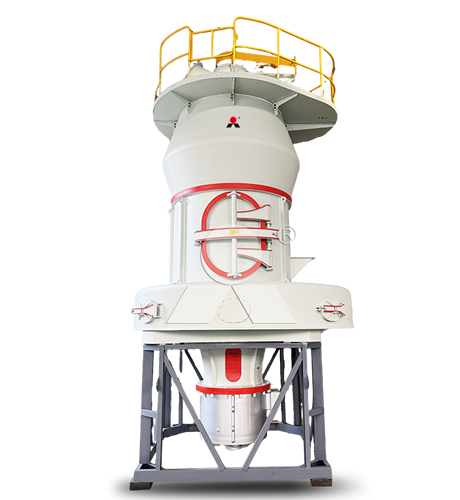
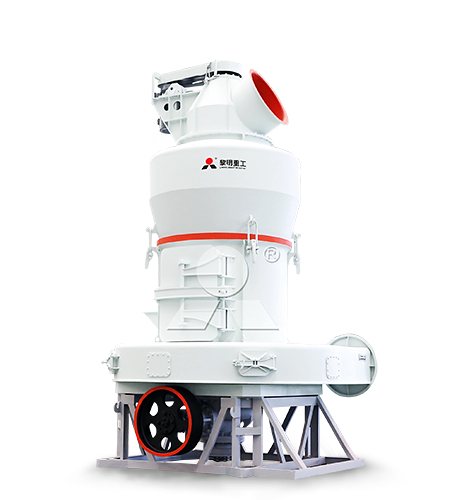
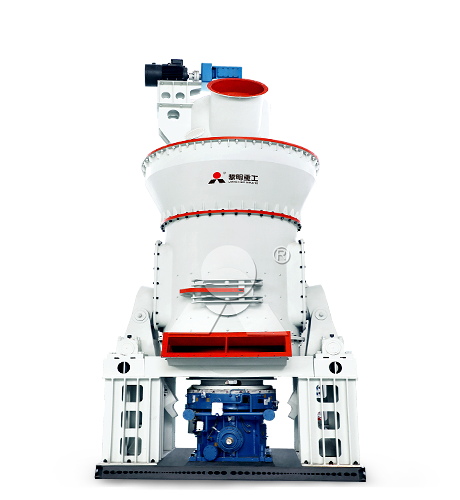
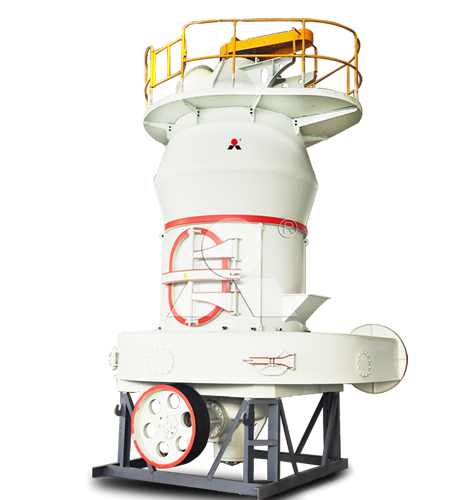
We are Liming Heavy Industry, a manufacturer of various types of industrial crushers, such as Raymond Mill, Trapezoidal Mill, Vertical Mill, Ultrafine Mill, Ball Mill, etc.
Our mills can process the following minerals:
limestone, quicklime, kaolin, talc, barite, bentonite, calcium carbonate, dolomite, coal, gypsum, clay, carbon black, slag, cement raw materials, cement clinker, etc.
If you need a mill to process stone or minerals into powder, please feel free to contact me (WhatsApp: +8615333807511). Thank you.
Ground calcium carbonate (GCC) is made from limestone through a physical mineral-processing process. High-quality limestone is quarried, selected, crushed, ground, classified, and sometimes surface-treated to produce calcium carbonate powder with controlled fineness and performance.
The essential point is that limestone is not chemically converted into GCC. Instead, suitable limestone—made primarily of calcium carbonate, CaCO3—is mechanically reduced from large rock into fine or ultrafine powder. This is why GCC is called ground calcium carbonate. In contrast, precipitated calcium carbonate (PCC) requires calcination, hydration, carbonation, and chemical precipitation.
GCC From Limestone: Quick Answer
| Question | Answer |
|---|---|
| What is the raw material for limestone-based GCC? | High-calcium limestone with suitable CaCO3 content, whiteness, and impurity control. |
| Does GCC production require calcination? | No. GCC is produced by mechanical crushing, grinding, and classification without converting CaCO3 to CaO. |
| What is the main process? | Quarrying → crushing → screening → grinding → classification → optional coating → collection and packaging. |
| What is the main product? | Fine, ultrafine, coated, or uncoated calcium carbonate powder, commonly called GCC. |
| What is GCC used for? | Plastics, PVC, paper, paint, coatings, rubber, adhesives, sealants, wall putty, dry mortar, and other industrial products. |
What Is Limestone-Based GCC?
Limestone-based GCC is a powder produced by grinding natural limestone. Limestone is a sedimentary rock composed mainly of calcium carbonate minerals, especially calcite. The final powder is still primarily CaCO3; grinding changes the rock’s physical size and particle-size distribution rather than its basic chemical identity.
Not all limestone is suitable for GCC production. The best raw material depends on the target market. Limestone used for cement, aggregate, or agricultural lime may have different specifications from limestone used to produce fine calcium carbonate for white PVC, paint, paper, sealants, or artificial stone.
For high-value GCC, producers generally seek limestone with high CaCO3 content, high whiteness, low iron, low silica, controlled magnesium content, stable mineralogy, low moisture, and good grinding behavior.
GCC Production Flow From Limestone
A typical dry limestone-to-GCC process follows this route:
High-calcium limestone quarry → selective mining → crushing → screening → feed storage → grinding → air classification → powder collection → optional surface coating → storage and packaging
For wet-ground calcium carbonate, the route is typically:
Limestone quarry → crushing → wet grinding → wet classification → slurry concentration → storage or drying → final product delivery
Production-line descriptions for GCC commonly identify natural limestone as a feed material and physical grinding as the core technology. After preliminary crushing, classification systems separate material to achieve the target particle-size distribution.
Step 1: Select the Right Limestone
Raw-material selection is the most important decision in GCC production. Grinding equipment can control particle size, but it cannot fully correct poor raw-material chemistry, low whiteness, excessive silica, or high iron content.
Key Limestone Quality Requirements
| Raw-Material Property | Why It Matters for GCC |
|---|---|
| CaCO3 content | Higher content generally supports higher-purity calcium carbonate powder. |
| Whiteness and brightness | Critical for white PVC, paper, paint, coatings, artificial stone, and sealants. |
| SiO2 content | High silica can increase abrasiveness, reduce whiteness, and limit premium applications. |
| Fe2O3 content | Iron can create yellow, brown, gray, or reddish discoloration. |
| MgO content | Helps indicate dolomite or magnesium-bearing mineral content rather than high-calcium limestone. |
| Clay and acid-insoluble residue | Can affect color, moisture, powder flow, grindability, and product consistency. |
| Moisture level | High moisture can reduce grinding efficiency and complicate dry classification or surface coating. |
| Mineralogy | Identifies calcite, dolomite, quartz, clay, feldspar, and other minerals that affect performance. |
Quarry quality can vary from one bench to another. A well-managed operation uses geological mapping, drilling data, laboratory sampling, selective mining, separate stockpiles, and controlled blending to maintain a stable limestone feed for the GCC plant.
Step 2: Quarrying and Raw-Limestone Handling
Limestone is normally extracted from an open-pit quarry. Depending on rock hardness and deposit conditions, the quarry may use drilling and blasting, ripping, hydraulic breakers, excavators, wheel loaders, and haul trucks.
After quarrying, limestone is transported to a primary crusher or raw-material stockpile. At this stage, producers may remove visibly contaminated stone, clay-rich material, dark rock, or material from lower-quality zones of the quarry.
Stockpiling provides a buffer between mining and continuous production. It can also help blend limestone from different quarry areas to reduce variation in CaCO3 content, whiteness, moisture, and impurity levels.
Step 3: Crushing Limestone
Raw limestone from the quarry can be too large for fine-grinding equipment. Crushing reduces large blocks into smaller, more uniform feed material for the mill.
A typical limestone crushing circuit may include:
Primary crusher: A jaw crusher or impact crusher receives large quarry rock.
Secondary crusher: A hammer crusher, impact crusher, or cone crusher reduces the material further.
Vibrating screen: Controls product size and returns oversized material for additional crushing.
Belt conveyor: Transfers crushed limestone between stages.
Magnetic separator: Removes tramp metal to protect grinding equipment.
Surge bin or feed silo: Maintains a steady supply of limestone to the grinding circuit.
In a common GCC line, raw limestone blocks are reduced through primary crushing to a controlled feed size, then screened and stored to ensure stable feeding to the grinding system. Depending on the mill and target product, a crushing circuit may reduce limestone from large quarry stone to approximately 10–30 mm or another mill-appropriate feed size.
Step 4: Drying and Feed Conditioning
Dry grinding works best when limestone moisture is controlled. If the feed contains too much moisture, powder can stick to equipment surfaces, block chutes, reduce grinding efficiency, impair air classification, and increase dust-collector load.
Depending on the climate, quarry condition, and product requirement, a GCC plant may use:
Natural stockpile drying.
Covered raw-material storage.
Hot-air drying before grinding.
Integrated drying in a vertical roller mill.
Heated air transport systems.
Dedicated drying equipment for high-moisture raw material.
For coated calcium carbonate, moisture control is especially important. Excess moisture can reduce coating efficiency, increase agglomeration risk, and affect powder flow in plastic, rubber, adhesive, and sealant applications.
Step 5: Grinding Limestone Into GCC Powder
Grinding is the stage that transforms crushed limestone into calcium carbonate powder. The target may range from relatively coarse filler grades to fine and ultrafine GCC with tightly controlled particle-size distribution.
Grinding does not change limestone into a different chemical material. The calcium carbonate remains CaCO3. The purpose is to create particles with a size, shape, surface area, and distribution suitable for the intended product.
Common Grinding Mills for Limestone GCC
| Grinding System | Typical Role | Suitable Product Direction |
|---|---|---|
| Raymond mill | Dry grinding for standard fine powder | Wall putty, dry mortar, general filler grades, moderate fineness |
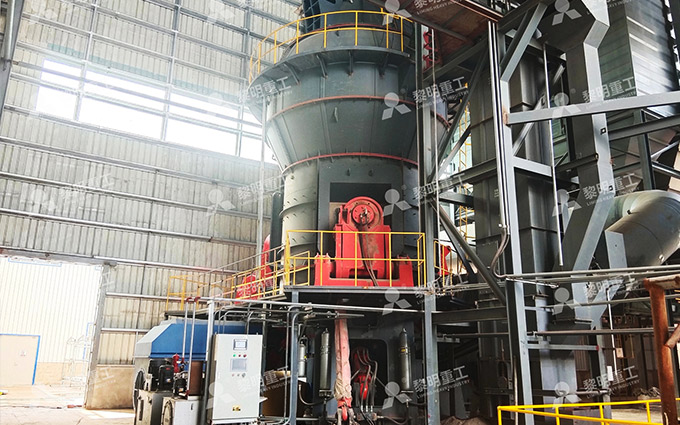
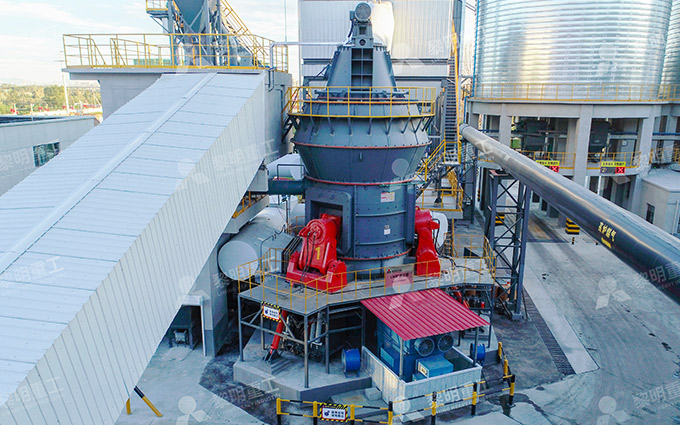
| Vertical roller mill | Large-capacity grinding with potential integrated drying and classification | Fine GCC, large-scale powder production, energy-efficient plant layouts |
| Ball mill with air classifier | Fine and ultrafine dry grinding with accurate particle-size control | Plastics, PVC, paint, rubber, sealants, coated GCC |
| Ring roller mill | Fine and ultrafine dry powder production | High-fineness GCC for industrial filler applications |
| Stirred media mill | Very fine wet grinding | Wet-ground GCC slurry for paper and specialized coatings |
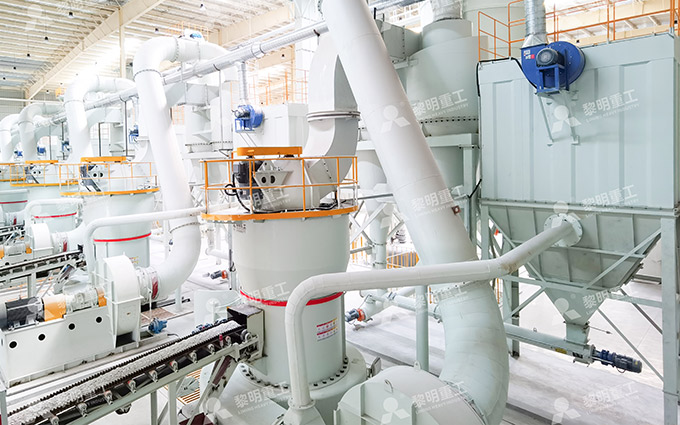
Ball mills, vertical roller mills, Raymond mills, and ultrafine grinding systems can be used in GCC production. The best selection depends on feed size, feed moisture, required fineness, capacity, energy cost, product quality, and whether surface coating is required.
Step 6: Air Classification
Grinding alone cannot guarantee a stable GCC product. The powder must be classified so that the final material meets the required particle-size distribution.
In a dry GCC plant, ground powder is carried by air into a classifier. The classifier separates fine particles from coarse particles:
Qualified fine powder exits with the air stream and is collected as product.
Coarse particles are rejected and returned to the grinding mill.
Classifier speed, air flow, feed rate, and mill settings are adjusted to control the final cut point.
Dynamic classifiers use rotating components and airflow to separate fine powder from coarse material. Oversized particles are recycled for regrinding, while qualified powder continues to collection and storage.
Classification is particularly important for fine and ultrafine calcium carbonate. Oversized particles can affect surface smoothness, paint gloss, paper coating quality, PVC extrusion, plastic-film appearance, sealant texture, and dispersion in the final formulation.
Step 7: Optional Surface Coating
Many GCC grades are sold without surface treatment. However, coated calcium carbonate is commonly used in PVC, plastic masterbatch, polyethylene, polypropylene, rubber, adhesives, and sealants.
Natural limestone-based GCC has a hydrophilic mineral surface, while many polymers are hydrophobic. Surface coating improves the interaction between powder and polymer resin. Stearic acid is one of the most common coating agents.
Why Coat Limestone-Based GCC?
Improve dispersion in hydrophobic polymers.
Reduce agglomeration risk.
Improve powder flow and handling.
Reduce moisture sensitivity.
Support more consistent extrusion and compounding.
Improve compatibility with PVC, PE, PP, rubber, and sealant matrices.
Coating typically takes place in a heated coating machine, high-speed mixer, pin mill, or integrated modification system. The coating level, powder temperature, feed moisture, mixing intensity, and retention time must be controlled to achieve uniform surface treatment.
Step 8: Powder Collection and Dust Control
After classification, qualified GCC powder is separated from the transport air. Cyclones, bag filters, and other dust-collection systems recover product while preventing powder loss and controlling plant emissions.
Dust control is essential because fine calcium carbonate powder can become airborne during grinding, classification, conveying, silo filling, bagging, and bulk loading. A well-designed system protects workers, reduces housekeeping requirements, improves product recovery, and supports environmental compliance.
Collected powder typically moves through screw conveyors, rotary valves, pneumatic conveying systems, or bucket elevators into finished-product silos.
Step 9: Storage, Packaging, and Delivery
Finished limestone-based GCC can be supplied in several forms, depending on the product grade and customer requirements:
Small valve bags.
Plastic-lined or moisture-protective bags.
25 kg bags.
500 kg, 1,000 kg, or other flexible intermediate bulk containers.
Bulk tankers for large-volume local delivery.
Containerized bulk bags for export markets.
Slurry tankers for wet-ground GCC products.
Fine and coated GCC should be protected from water, humidity, foreign material, and cross-contamination. Packaging must be matched with the customer’s storage and feeding system, especially for high-volume PVC, paint, rubber, paper, and sealant plants.
Dry Grinding vs Wet Grinding for Limestone GCC
| Feature | Dry GCC Process | Wet GCC Process |
|---|---|---|
| Processing medium | Dry limestone and air | Limestone dispersed in water |
| Main equipment | Dry mill, air classifier, cyclone, bag filter, coating system | Wet mill, slurry tank, hydrocyclone, wet classifier, filter or concentrator |
| Typical final product | Dry powder, coated powder, bagged or bulk GCC | Fine calcium carbonate slurry or dried ultrafine powder |
| Typical applications | PVC, plastics, rubber, coatings, adhesives, sealants, wall putty, mortar | Paper filler, paper coating, specialty coatings, selected paint applications |
| Key operating focus | Moisture control, dust collection, air balance, classifier efficiency | Slurry solids, viscosity, dispersant dosage, particle-size control, storage stability |
| Logistics | Efficient for bags, big bags, bulk tankers, and export containers | Requires tank storage and pumping, or drying before dry export shipment |
Dry and wet GCC routes are both used in industry. Dry processing is commonly selected for powder and coated-powder markets, while wet grinding is often used for very fine slurry products, especially where paper and coating performance require precise particle control.
Quality Control for Limestone-Based GCC
Quality control should begin at the quarry and continue through finished-product loading. Because limestone is a natural raw material, its composition can vary over time. Regular testing helps maintain stable product quality.
Typical Quality-Control Parameters
CaCO3 content.
Whiteness, brightness, and CIE Lab* values.
SiO2, Fe2O3, MgO, Al2O3, and acid-insoluble residue.
Particle-size distribution, including D50, D90, D97, or residue.
Moisture content.
Bulk density and true density.
Oil absorption, where relevant.
Surface-treatment level and dispersion performance for coated grades.
Visual inspection for contamination, oversized particles, agglomerates, and off-color material.
For premium applications, producers should test the powder in the actual downstream formulation. A calcium carbonate grade that meets basic laboratory data may still perform differently in a customer’s PVC extrusion line, paint system, paper coating, rubber compound, or sealant formulation.
Common Problems in Limestone-to-GCC Production
| Problem | Possible Cause | Potential Response |
|---|---|---|
| Low whiteness | Iron, clay, organic matter, mixed quarry feed, contamination | Improve selective mining, separate stockpiles, remove contaminated feed, inspect processing equipment |
| High silica or abrasion | Quartz, sand, chert, clay, poor feed selection | Improve raw-material testing, selective mining, beneficiation, and wear protection |
| Unstable particle size | Inconsistent feed, worn mill parts, unstable classifier speed, poor air balance | Stabilize feed rate, maintain equipment, calibrate classifier, monitor particle-size data |
| High moisture | Wet quarry feed, poor storage, inadequate drying, humid conditions | Improve raw-material storage, add drying capacity, control hot-air flow, improve packaging |
| Poor polymer dispersion | Incorrect particle size, inadequate coating, high moisture, agglomeration | Optimize coating process, verify dosage, improve drying and classification, conduct compound trials |
| Low production capacity | Oversized feed, poor grindability, inadequate mill power, classifier bottleneck, filter resistance | Optimize crushing, assess mill configuration, improve classification, inspect dust-collection system |
Frequently Asked Questions
How is GCC made from limestone?
GCC is made by quarrying suitable limestone, crushing it, grinding it into powder, classifying the particles, and optionally coating the powder. The process is physical, so the main chemical component remains calcium carbonate, CaCO3.
Is limestone chemically changed into GCC?
No. Standard GCC production does not chemically convert limestone. It reduces the limestone into a controlled powder through crushing, grinding, and classification. The CaCO3 remains calcium carbonate.
Does GCC production use a kiln?
Not for standard GCC production. Kilns are used when limestone is calcined into quicklime, CaO, which is part of lime and PCC production. GCC is normally made without calcination.
What equipment is used to make GCC from limestone?
Typical equipment includes crushers, screens, conveyors, feed silos, grinding mills, air classifiers, cyclones, bag filters, coating systems, finished-product silos, and packing machines. The exact configuration depends on capacity and target fineness.
Why is limestone quality important for GCC?
Limestone quality determines the potential purity, whiteness, silica level, iron level, magnesium content, grindability, and final application suitability of the GCC powder. Grinding cannot fully remove poor chemistry or major mineral impurities.
Can all limestone be used for GCC?
No. Most limestone can be crushed or ground, but not every deposit is suitable for high-quality GCC. Premium applications often require high CaCO3, high whiteness, low silica, low iron, controlled magnesium, and consistent mineralogy.
Conclusion
GCC is made from limestone through a physical processing route: high-quality limestone is selected, quarried, crushed, dried when needed, ground, classified, and optionally surface-treated to create calcium carbonate powder.
The core chemistry remains CaCO3; the production process controls the physical properties that determine commercial value. Raw-material quality, crushing efficiency, grinding technology, classifier performance, moisture control, coating quality, dust collection, and packaging all influence whether limestone can become a reliable GCC product for PVC, plastics, paper, paint, rubber, sealants, adhesives, construction materials, and other industrial applications.