FGD Limestone Grinding Plant
How Limestone Properties Affect FGD Grinding System Design
2026-09-19 10:33:33
We are Liming Heavy Industry, a manufacturer of various types of industrial crushers, such as Raymond Mill, Trapezoidal Mill, Vertical Mill, Ultrafine Mill, Ball Mill, etc.
Our mills can process the following minerals:
limestone, quicklime, kaolin, talc, barite, bentonite, calcium carbonate, dolomite, coal, gypsum, clay, carbon black, slag, cement raw materials, cement clinker, etc.
If you need a mill to process stone or minerals into powder, please feel free to contact me (WhatsApp: +8615333807511). Thank you.
Limestone is not a uniform raw material. Two deposits may both be sold as “high-calcium limestone,” yet require different crushing equipment, mill capacity, classifier settings, storage arrangements, slurry preparation conditions, and reagent-feed rates. For a wet FGD project, the grinding system should be designed around the actual limestone source rather than around CaCO3 content alone.
The most important limestone characteristics are chemical composition, reactivity, hardness, feed moisture, particle-size distribution, abrasiveness, bulk density, clay content, and impurity profile. These factors influence both the amount of limestone required for sulfur dioxide removal and the way the powder production line must be configured. FGD design references identify limestone composition and reagent stoichiometry, together with flue-gas conditions and removal requirements, as core design inputs.
Properties That Matter
| Limestone Property | Effect on FGD Operation | Effect on Grinding System Design |
|---|---|---|
| CaCO3 content | Determines the available alkaline reagent and directly affects limestone consumption. | Lower purity requires a higher hourly powder-production capacity and larger storage volume. |
| Reactivity | Controls how quickly limestone dissolves and reacts in the absorber slurry. | Low-reactivity limestone may require a finer finished powder, increased grinding energy, or a higher operating Ca/S ratio. |
| Hardness and Bond Work Index | Does not directly change the chemical reaction, but strongly affects grinding energy demand. | Harder limestone requires more mill power, more robust grinding components, and may reduce achievable output at the same fineness. |
| Moisture content | Can affect slurry concentration and raw-material handling stability. | High moisture may require drying air, larger feeders, anti-blocking measures, or a wet grinding route. |
| Particle-size distribution | Controls particle surface area, dissolution behavior, and reagent utilization. | Determines classifier settings, target fineness, recirculation load, and finished-powder quality-control method. |
| Silica, clay, and insoluble matter | Reduce effective reagent content and can increase inert solids in the slurry and gypsum stream. | May increase wear, reduce mill capacity, increase solids handling demand, and require more frequent cleaning. |
| Magnesium-bearing minerals | Can alter slurry chemistry and affect gypsum quality, depending on concentration and plant design. | May require tighter raw-material sampling and a larger reagent-consumption allowance. |
| Abrasiveness | Has limited direct influence on absorption chemistry but affects equipment lifetime. | Higher silica or quartz content increases wear on crusher liners, mill rollers, grinding rings, classifiers, and conveying equipment. |
| Bulk density and flowability | Influence powder inventory, slurry concentration, and dosing stability. | Determine silo volume, hopper angle, feeder selection, bin aeration requirement, and conveying conditions. |
CaCO3 Content Changes Required Capacity
Calcium carbonate is the active component that neutralizes absorbed sulfur dioxide. When limestone purity falls, more total powder must be ground, transported, stored, and fed into the slurry system to provide the same amount of available calcium.
For the overall wet FGD reaction:
CaCO3 + SO2 + ½O2 + 2H2O → CaSO4·2H2O + CO2
One tonne of SO2 removed theoretically requires 1.5625 tonnes of pure CaCO3. In practical operation, the calculation must also include the Ca/S molar ratio and the actual CaCO3 content of the limestone.
For example, assuming a Ca/S molar ratio of 1.03:
| CaCO3 Content | Limestone Required per 1 t SO2 Removed | Impact on Grinding Plant |
|---|---|---|
| 95% | Approximately 1.69 t | Lower powder throughput and lower inert-solids loading. |
| 90% | Approximately 1.79 t | Common reference condition for preliminary FGD sizing. |
| 85% | Approximately 1.89 t | Higher grinding capacity, silo capacity, slurry volume, and solids-handling requirement. |
In a large project, this difference can be significant. If the absorber removes 10 t/h of SO2, changing from 95% to 85% CaCO3 limestone increases the required powder supply by about 2 t/h. The grinding plant, powder silo, slurry tank, pumps, and gypsum-dewatering section should all be checked against this additional solids load.
Reactivity Determines the Best Fineness
CaCO3 content indicates how much calcium is present, but reactivity indicates how effectively that calcium becomes available in the absorber. Reactivity depends on mineral structure, crystal form, porosity, surface condition, impurity distribution, particle size, and the chemical environment of the slurry.
Low-reactivity limestone dissolves slowly. If the absorber residence time is limited or the target SO2 removal rate is high, slow dissolution can leave unreacted limestone in the reaction tank or gypsum slurry. The plant may compensate by grinding more finely, increasing the reagent feed rate, raising the Ca/S ratio, or changing slurry operating conditions.
Particle size has a major influence because a smaller particle exposes more surface area to the liquid. Research on limestone sulfation shows that decreasing particle size generally increases reaction rate and final calcium conversion, while finer particles can maintain better reactivity at low SO2 concentrations.
However, the finest possible powder is not automatically the best choice. Excessive grinding increases energy consumption and can make powder conveying, silo discharge, and slurry density control more difficult. The correct target is the coarsest particle-size distribution that still provides the required limestone dissolution and absorber performance.
For many wet FGD systems, limestone powder is commonly produced in the 250–325 mesh range, approximately 61–44 μm. The exact specification should be confirmed through limestone reactivity testing and FGD process design rather than selected solely from a general industry range.
Hardness Controls Mill Size and Power
Limestone hardness determines how much energy is needed to reduce feed stone to FGD powder. A soft, easily ground limestone can achieve the target fineness at higher throughput and lower specific energy consumption. A harder limestone may require a larger mill, greater installed power, more grinding pressure, and a lower guaranteed hourly output.
The Bond Work Index is commonly used to compare grinding resistance. A higher Work Index indicates that more energy is required to produce the same particle size. Project specifications for limestone grinding systems often require the supplier to evaluate limestone hardness, Work Index, feed moisture, bulk density, chemical composition, and product fineness together.
Hardness affects equipment selection in several ways:
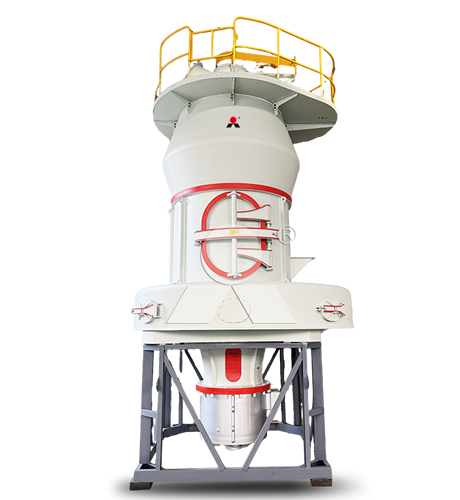
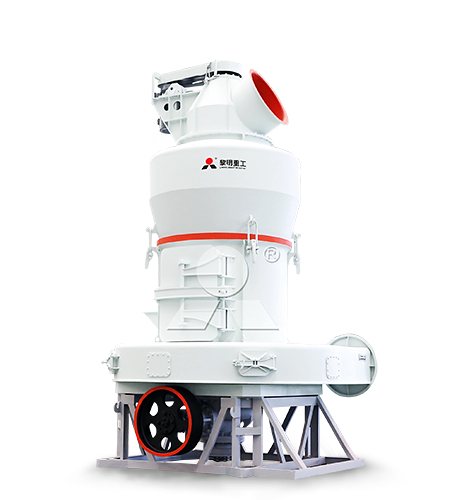
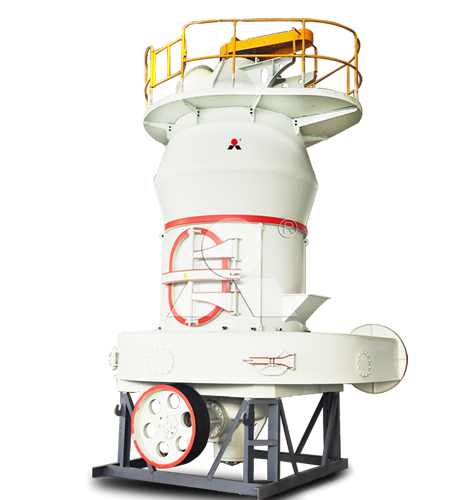
A higher Work Index may require a larger MTW European Mill model to achieve the same tonnes-per-hour output.
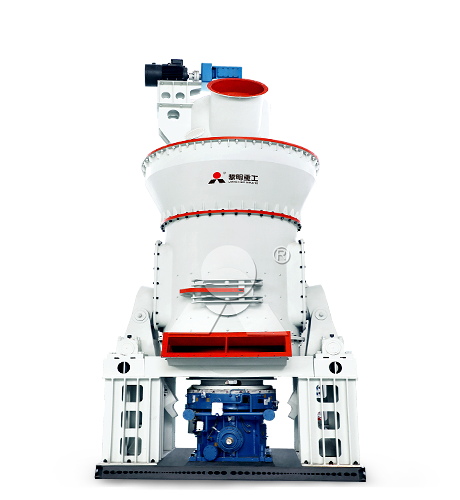
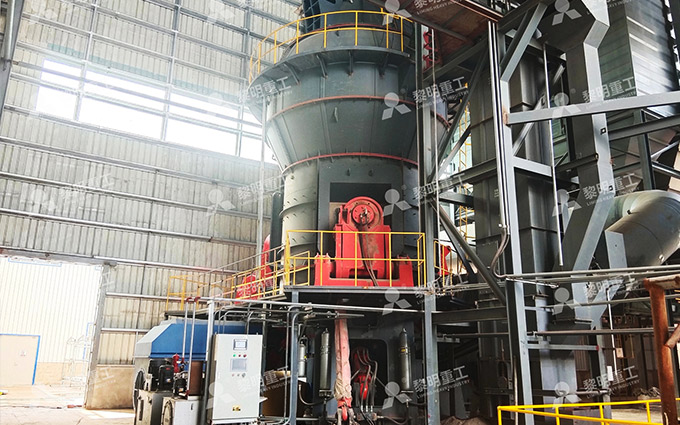
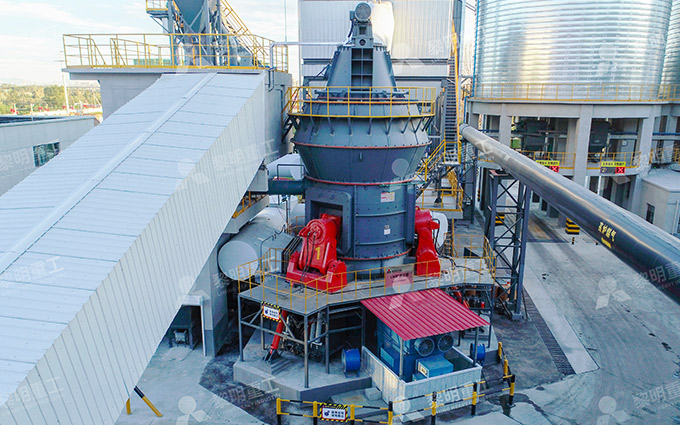
For large and continuous-demand projects, a higher-capacity LM Vertical Mill may be selected to maintain required output at the specified fineness.
Hard and abrasive feed may justify more wear-resistant grinding rollers, grinding rings, classifier blades, and crusher liners.
Mill capacity guarantees should be based on actual tested limestone, not on an assumed average hardness.
Maintenance planning should allow for wear-part inspection and replacement based on the actual quartz and silica content.
Moisture Affects the Process Route
Moisture changes the way limestone behaves before it reaches the mill. Dry limestone flows more easily through bins, feeders, bucket elevators, and pneumatic conveying lines. Wet limestone can stick to hoppers, form build-up in chutes, cause belt carryback, reduce screening efficiency, and create unstable feeding.
For a dry grinding line, high feed moisture may require one or more of the following measures:
Covered raw-material storage to reduce rainwater exposure.
Steeper hopper walls, bin vibrators, air cannons, or mechanical flow aids.
A larger feed bin and feeder designed for sticky material.
Hot-air introduction to support drying during grinding.
Insulated or protected conveying equipment in wet climates.
A wet grinding and direct slurry preparation route where available process water and plant conditions make it more suitable.
Moisture also affects finished-powder storage. If powder enters the silo too wet, it can bridge, cake, or compact. This reduces the accuracy of powder dosing and may interrupt slurry preparation. The finished-product moisture target should therefore be coordinated with the design of the collector, conveying line, silo, and dosing equipment.
Impurities Affect More Than Purity
Silica, clay, alumina, iron compounds, magnesium minerals, chlorides, and trace metals can affect the full FGD material balance. Some impurities simply dilute the available CaCO3; others may contribute to scaling, wear, wastewater-treatment load, gypsum contamination, or difficult slurry settling.
Fine clay is especially important because it can remain suspended and be difficult to remove by settling. EPRI guidance notes that limestone can contain fine-grained clay impurities rich in aluminum and silicon, which may contribute to solids and trace-metal loading in untreated FGD water.
From a grinding-system perspective, silica and quartz are often the most important wear-related impurities. They can increase the abrasion rate of crushing and milling components. A deposit with high silica content may therefore require more conservative production assumptions, additional wear-part inventory, and a maintenance plan that differs from one designed for soft, high-purity limestone.
Particle Size and Distribution
FGD performance depends not only on the average particle size but also on the full particle-size distribution. Two powders may have the same nominal 325-mesh residue but behave differently if one contains a high fraction of coarse particles or an excessive fraction of ultrafines.
A balanced distribution supports rapid dissolution while maintaining good slurry pumping and storage behavior. Too many coarse particles may settle in slurry tanks or pipelines and can reduce calcium utilization. Too many ultrafine particles can increase mill power demand, dust loading, slurry viscosity, and powder-handling sensitivity.
The grinding circuit should therefore include effective classification. The classifier must separate coarse particles for return grinding while allowing qualified powder to reach the finished-product silo. Routine particle-size testing should be used to verify both the control-sieve residue and the overall distribution.
Matching Limestone to Equipment
The selected grinding system should follow the limestone test report and the required hourly reagent demand.
| Limestone and Project Condition | Recommended Grinding Direction |
|---|---|
| Medium limestone demand, relatively dry feed, and a 200–325 mesh product requirement | The MTW European Mill from Liming Heavy Industry is suitable for stable medium-scale FGD powder production, with published capacity ranges of approximately 3–55 t/h and product fineness down to 0.038 mm. |
| Large continuous limestone demand, centralized supply, or need for integrated drying and classification | The LM Vertical Mill from Liming Heavy Industry is suitable for large FGD limestone powder projects requiring an integrated grinding, classification, drying, and conveying arrangement. |
| High feed moisture or sticky raw limestone | Evaluate drying requirements, protected storage, improved feeding equipment, and whether a wet grinding route offers a better overall plant arrangement. |
| Hard or abrasive limestone with elevated silica content | Size the mill using actual grinding tests, allow for lower throughput at target fineness, and select appropriate wear-resistant components. |
| Low-purity or low-reactivity limestone | Increase capacity calculations for purity correction, confirm the required Ca/S ratio, and evaluate whether a finer product or an alternative limestone source is needed. |
Required Limestone Test Data
Before finalizing an FGD limestone grinding plant, obtain representative samples from the actual quarry, not only a supplier’s typical analysis. The test program should include:
CaCO3, CaO, MgO, SiO2, Al2O3, Fe2O3, and loss on ignition.
Moisture content under normal and worst seasonal conditions.
Bond Work Index or another recognized grindability measure.
Hardness, abrasiveness, and mineralogical composition.
Feed-size distribution after quarry crushing.
Bulk density, repose angle, and flowability.
Particle-size distribution after laboratory or pilot grinding.
Limestone dissolution or reactivity test under representative FGD slurry conditions.
Clay, chloride, trace-metal, and insoluble-solids content where wastewater or gypsum quality is important.
These data allow the grinding system to be sized for actual production conditions and help prevent a mismatch between nominal mill capacity and the limestone powder required by the absorber. A properly designed FGD plant treats limestone chemistry, reactivity, and grindability as connected design factors—not as separate purchasing specifications.