Industrial By-product Gypsum Solutions
How to Improve the Efficiency of an Industrial Gypsum Grinding Plant?
2026-09-08 16:21:57
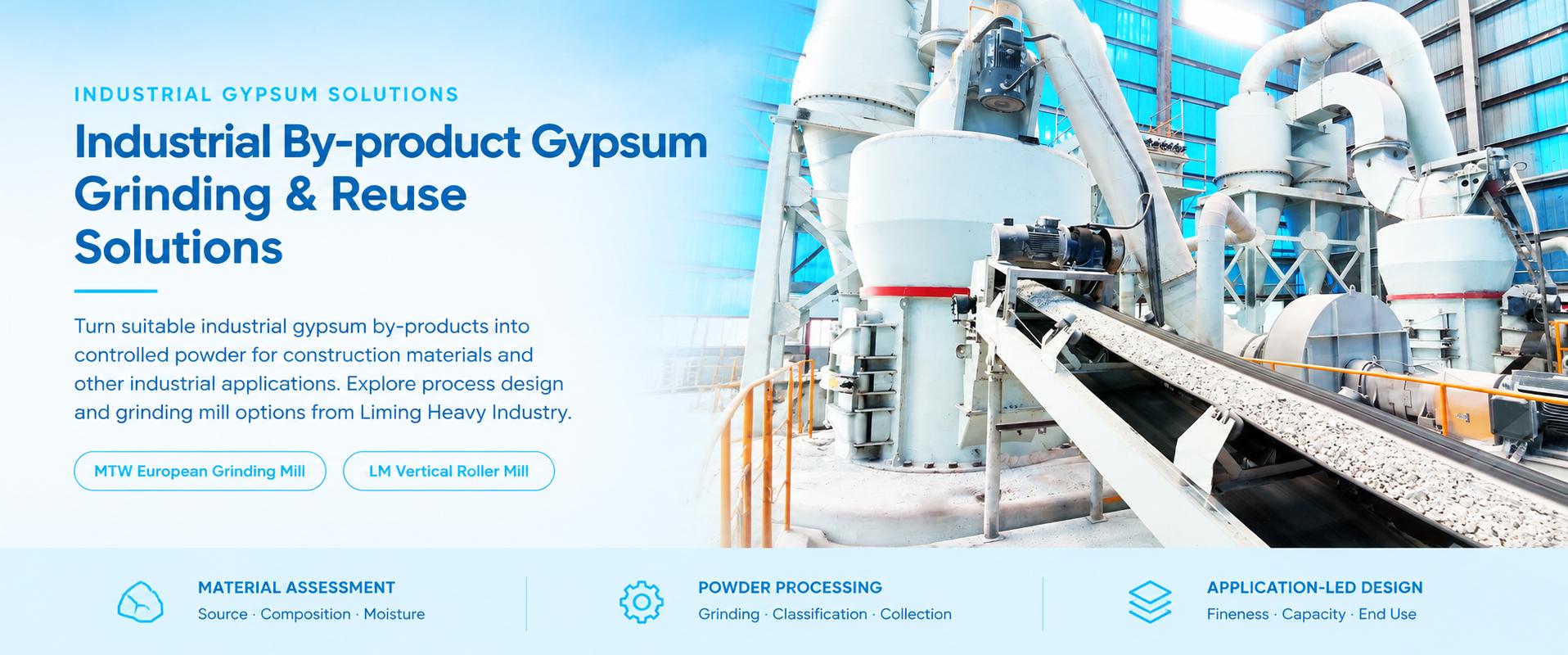
Improving an industrial gypsum grinding plant means increasing stable finished-powder output at the required fineness while reducing energy use, material loss, downtime and quality variation. The most effective improvements usually come from controlling feed moisture, feed size, feeding stability, airflow, classification, maintenance and finished-powder handling as one connected system.
Do not optimize the mill in isolation. A gypsum plant loses efficiency when wet filter cake bridges in a hopper, when the dryer cannot remove enough water, when airflow is unbalanced, when the classifier is set too fine, or when powder cakes in storage. The highest-value improvements normally begin with measured plant data and a clear definition of the target product.
Define Efficiency First
Before changing mill settings or adding equipment, define what “better efficiency” means for the plant. A useful target combines output, quality, energy and availability.
Track these key performance indicators:
| Indicator | Why it matters |
|---|---|
| Finished-powder output, t/h | Measures saleable production rather than wet-feed throughput. |
| Specific power consumption, kWh/t | Shows how much electrical energy is needed per tonne of qualified powder. |
| Thermal energy per tonne | Critical when drying wet FGD gypsum, phosphogypsum or other by-product gypsum. |
| Product fineness and particle-size distribution | Confirms that higher output does not come from producing out-of-spec powder. |
| Finished-powder moisture | Controls storage stability, flowability and customer acceptance. |
| Mill availability | Measures operating time after planned and unplanned stops are removed. |
| Unplanned downtime | Identifies recurring failures in feeding, drying, grinding, classification or collection. |
| Filter differential pressure | Indicates dust-collection condition and whether airflow is being restricted. |
| Reject or rework rate | Shows the cost of off-spec fineness, excessive moisture or powder caking. |
For vertical grinding systems, practical optimization normally aims for the highest stable product rate at the lowest specific energy while maintaining required fineness. Key variables include feed rate, grinding force, classifier speed, airflow, power consumption and equipment availability.
1. Stabilize the Gypsum Feed
A grinding plant cannot operate efficiently if the feed changes continuously. Industrial gypsum may vary in moisture, lump size, gypsum content, impurity level and flowability. FGD gypsum can vary with dewatering and washing performance. Phosphogypsum can vary between fresh material, aged stockpile material and rain-exposed zones.
Improve feed consistency by:
Sampling incoming gypsum regularly and recording moisture, lump size and visible condition.
Separating fresh wet material from older or drier stockpile material when their behavior differs.
Using controlled blending to reduce moisture and quality variation.
Protecting raw material from rain with covered storage.
Removing foreign materials before the feed enters the mill.
Using stable, adjustable feeders rather than relying on uncontrolled hopper discharge.
Monitoring feed rate continuously with a belt scale, weigh feeder or equivalent system.
A steady feed rate improves grinding stability, classifier performance and finished-powder consistency. A published gypsum-grinding guide identifies feed rate matched to mill power as a key requirement and recommends automated weigh feeding to prevent unstable operation and lost output.
2. Control Free Moisture Before Grinding
Free moisture is one of the largest efficiency losses in industrial gypsum grinding. Wet material can bridge in hoppers, stick to conveyors, coat grinding components, reduce classifier efficiency and cause finished powder to cake in storage.
The plant should measure minimum, average and maximum feed moisture. Do not design or operate only around the average value. The most difficult normal moisture condition often determines drying capacity and operating stability.
Use mechanical dewatering first
When gypsum is recovered as slurry or wet filter cake, mechanical dewatering should be optimized before thermal drying. Removing water through filtration, centrifuging or pressing generally costs less energy than evaporating the same water with heat.
For FGD gypsum, review hydrocyclone, wash-water and vacuum-belt-filter performance. A small improvement in filter-cake moisture can reduce dryer fuel use, improve feeding and increase mill output.
Match drying capacity to real moisture variation
If the material remains too wet for stable grinding, ensure that the dryer or integrated hot-gas system can remove water at the highest normal feed moisture. An undersized drying system will limit the entire plant even when the grinding mill has spare power.
Gypsum dryers are used to prepare gypsum materials for grinding, screening, storage, packing and other industrial uses by reducing free moisture. The dryer selection should match the material’s actual moisture level and handling behavior.
Prevent unintended calcination
For dihydrate gypsum powder, drying should remove free water without converting calcium sulfate dihydrate into hemihydrate. Control gas temperature, material residence time, outlet temperature and finished-powder moisture. If the plant needs plaster or stucco, calcination should be treated as a separate controlled process stage.
3. Improve Feed Size and Deagglomeration
Industrial gypsum can have fine primary particles but still arrive as compacted filter cake or wet lumps. Large agglomerates cause unstable feed, increase mill load and reduce the efficiency of grinding and classification.
Improve feed preparation through:
Screening to remove oversize material and foreign objects.
Lump breaking or deagglomeration before drying or grinding.
Crushing hard compacted material from long-term storage.
Using hoppers and feeders designed for cohesive material.
Avoiding excessive crushing that creates unnecessary fines and dust before the mill.
A consistent, manageable feed size improves mill loading and reduces recirculation. Published guidance for gypsum powder plants identifies feed size, moisture and feed stability as critical to output, and notes that oversized material can reduce capacity and increase wear.
4. Optimize Grinding Conditions
Grinding efficiency depends on maintaining the correct balance between feed rate, grinding force, mill load and product fineness. Excessive grinding pressure can waste energy and increase wear. Too little grinding force can allow coarse material to pass through or increase internal circulation.
The best operating point is not the maximum setting for every variable. It is the lowest energy setting that consistently produces the required fineness and capacity.
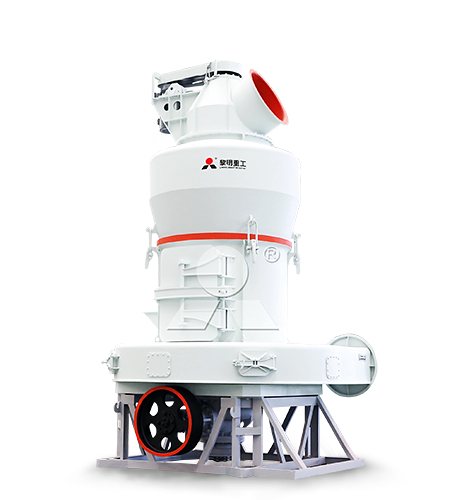
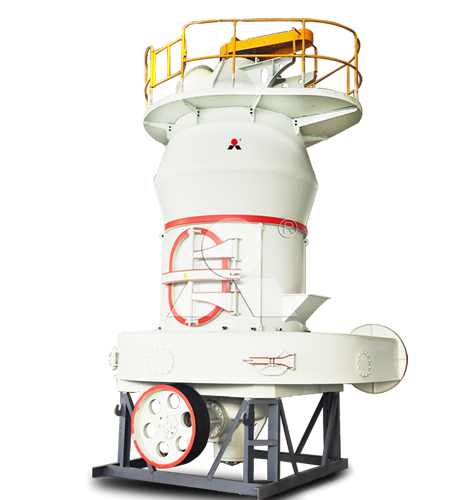
For MTW European Grinding Mill and Raymond Mill
For conventional dry grinding systems, focus on stable feed, correct roller and ring condition, suitable airflow, proper classifier adjustment and effective dust collection.
Keep feed moisture within the mill’s operating range.
Maintain uniform feed size after deagglomeration or crushing.
Inspect rollers, grinding rings, blades and classifier components for wear.
Adjust feed rate gradually and compare output, power and fineness.
Maintain proper system airflow so powder can be classified and collected efficiently.
Do not run at a finer classifier setting than the product requires.
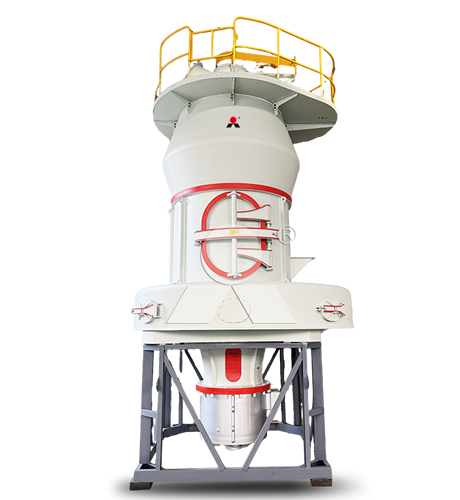
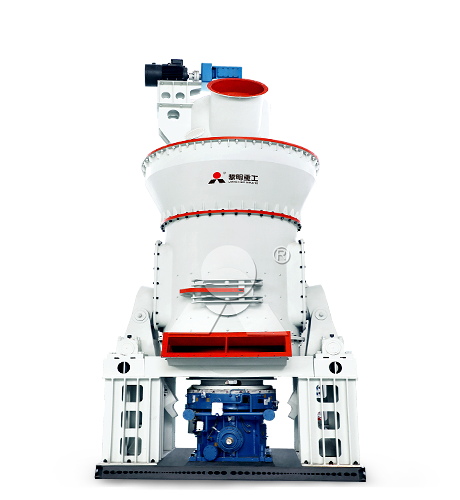
For LM Vertical Roller Mill
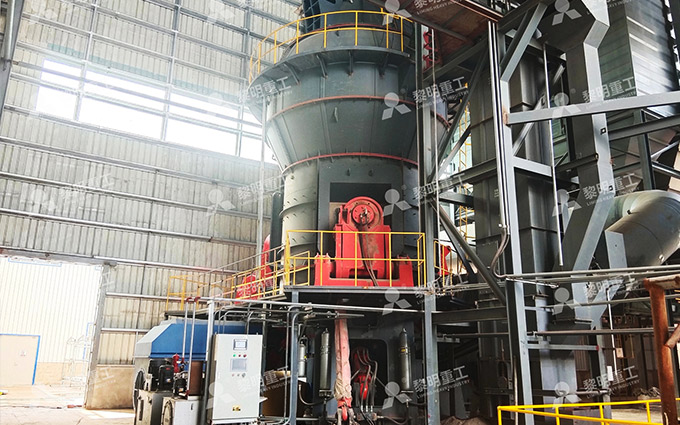
LM Vertical Roller Mill efficiency depends on the interaction among feed rate, grinding pressure, grinding bed condition, classifier speed, airflow and hot-gas temperature. If one variable changes significantly, the others often need adjustment.
Vertical-mill guidance emphasizes maintaining a stable grinding bed, properly balancing grinding pressure, classifier speed and feed rate, and avoiding over-grinding. It also identifies air flow, nozzle-ring condition, pressure profile, grinding-element condition and maintenance planning as important performance factors.
For LM Vertical Roller Mill operation, monitor:
Feed rate and feed moisture
Grinding pressure and hydraulic stability
Grinding-table material bed
Classifier speed and actual product fineness
Hot-gas temperature and outlet temperature
Mill differential pressure
Fan load and airflow balance
Vibration trend and mechanical condition
5. Set the Classifier for the Required Product
The classifier determines the final powder size. It should be set to achieve the customer’s required particle-size distribution, not to produce the finest powder the mill can make.
Over-classification creates excessive recirculation. More material returns to the grinding zone, mill load rises, energy consumption increases and finished-powder output can fall. Under-classification may increase output temporarily but can allow coarse particles into the product.
Use actual powder measurements to optimize classification:
Measure sieve residue or laser particle-size distribution regularly.
Track D10, D50 and D90 where applicable.
Compare fineness with classifier speed, airflow and mill feed rate.
Adjust one parameter at a time and record the result.
Use the minimum classifier setting needed to meet the product specification.
Classifier speed does not have a simple linear relationship with fineness. Feed condition, airflow, grinding pressure and classifier condition all influence the final result.
6. Balance Airflow and Dust Collection
Airflow is part of the grinding process, not only an environmental-control function. It transports fine powder, supports classification, removes moisture in integrated drying systems and carries product to the collector.
Insufficient airflow can cause powder buildup, poor conveying, unstable classification and low throughput. Excessive airflow can overload the filter, increase fan power, carry coarse particles into the finished product or create unnecessary heat loss.
Improve airflow efficiency by:
Checking fan performance against design conditions.
Inspecting ducts for buildup, leaks, damaged insulation and unnecessary pressure loss.
Monitoring filter differential pressure and cleaning-system performance.
Checking airlocks, rotary valves and seals for false-air entry.
Balancing hot-gas flow, mill airflow and classifier operation.
Maintaining proper negative pressure to reduce dust leakage without drawing excessive false air.
Vertical-mill optimization references identify fan efficiency, dust load, gas temperature, airflow, duct and seal integrity, nozzle-ring condition and pressure profile as important operating variables.
7. Reduce Material Loss and Rework
Plant efficiency improves when more of the incoming gypsum becomes saleable powder. Track where material is lost or reprocessed:
Dust collected from leakage points rather than recovered through the main system.
Off-spec coarse powder that must be reground.
Wet powder that cakes and cannot be dispatched.
Material spilled at transfer points.
Product rejected because of moisture, fineness or contamination.
Material left in hoppers, ducts or equipment during shutdowns.
Use sealed transfer chutes, correctly sized airlocks, reliable conveyors, moisture-protected silos and routine housekeeping. Small recurring losses at feeders, filters and loading points can become significant over a full year of operation.
8. Maintain Grinding and Classification Components
Gypsum is relatively soft, but industrial by-product gypsum may contain silica, ash, iron-bearing material or other abrasive impurities. Wear in rollers, rings, grinding tables, blades, classifiers, ducts and filters can reduce capacity before an obvious failure occurs.
A preventive maintenance program should include:
Regular inspection of grinding rollers, rings, table liners and wear surfaces.
Measurement of roller or ring wear and replacement planning.
Classifier inspection for wear, buildup and imbalance.
Fan inspection for wear, vibration and efficiency loss.
Filter bag inspection, cleaning-system checks and differential-pressure monitoring.
Lubrication, bearing-temperature and gearbox monitoring.
Inspection of conveyors, feeders, rotary valves and airlocks.
Spare-parts planning for high-wear and critical components.
Analyze every unplanned stop. Group downtime by cause—feeding, moisture, mill vibration, filter blockage, fan failure, electrical trip, classifier fault or finished-product handling—and address the highest-frequency cause first.
9. Protect Finished Powder from Moisture
Efficiency is lost when properly ground powder cakes in storage or cannot be loaded consistently. Finished powder should be stored in dry, sealed silos or protected packaging.
Improve finished-product handling by:
Controlling final powder moisture before the powder enters storage.
Preventing humid-air entry through silo vents, leaks and open transfer points.
Using suitable silo geometry and discharge aids where powder flow requires them.
Monitoring powder temperature to reduce condensation risk.
Maintaining bagging, big-bag filling and bulk-loading equipment.
Checking powder flowability after realistic storage periods.
Good powder storage protects product quality and prevents rework, silo-cleaning downtime and customer complaints.
10. Improve Process Control and Operator Practice
Efficient plants use routine data rather than relying only on operator judgment. A basic process-control system should record feed rate, moisture, mill power, fan power, pressure, temperature, classifier setting, product fineness, final moisture and downtime.
Use a simple optimization routine:
Define the required product fineness, moisture and hourly output.
Record a stable baseline for feed condition, power, airflow, pressure and product quality.
Identify the largest loss, such as wet feed, low output, high power, coarse product, frequent stops or powder caking.
Change one operating parameter or process condition at a time.
Run long enough to capture stable operation.
Compare output, specific energy, product quality and downtime with the baseline.
Standardize the improved setting only after it performs consistently.
Do not change feed rate, classifier speed, airflow and grinding pressure simultaneously. If several variables change at once, the plant cannot identify what produced the improvement or the problem.
Efficiency Priorities by Mill Type
| Mill type | Highest-priority efficiency actions |
|---|---|
| MTW European Grinding Mill | Maintain dry and stable feed; control lump size; optimize airflow and classification; inspect rollers, rings and filters; use upstream drying when feed moisture is high. |
| LM Vertical Roller Mill | Balance drying, grinding and classification; stabilize feed moisture and grinding bed; optimize hot-gas flow, classifier speed, grinding pressure and fan operation; maintain seals and grinding components. |
| Raymond Mill | Use dry, consistently sized feed; prevent buildup; maintain roller, ring and blade condition; optimize air classifier and collector performance; avoid over-grinding. |
Common Efficiency Mistakes
Increasing feed rate without correcting moisture
Adding more wet gypsum can overload the dryer, feeder, mill or classifier. This often lowers finished-powder output and creates off-spec material instead of increasing production.
Grinding finer than required
Over-grinding increases power consumption, reduces capacity, raises dust load and can change powder performance. Set the classifier to meet the specification, not to maximize fineness.
Ignoring false air and duct leakage
Air leaks can disrupt drying, reduce temperature control, increase fan load and make classification unstable. Inspect seals, expansion joints, flanges, rotary valves and filter connections regularly.
Using average moisture as the only design value
Industrial gypsum can change significantly after rain, storage or source-process variation. The dryer and operating plan should account for the highest normal moisture condition.
Delaying wear-part replacement
Worn grinding and classification components gradually reduce output and increase power consumption. Replacing them at the correct time is often less costly than operating for months with poor efficiency.
Treating chemical problems as grinding problems
Grinding cannot remove soluble phosphorus, fluoride-related compounds, boron, iron, acidity or other source-specific impurities. If the final product fails chemical or application testing, improve source control, pre-treatment, blending or application selection rather than only changing mill settings.
Practical Improvement Checklist
Measure incoming moisture, not only average monthly moisture.
Cover raw-material storage and control stockpile blending.
Improve dewatering before increasing thermal drying.
Break wet lumps before they enter the mill.
Use stable, measured feeding.
Set classifier speed for the required fineness only.
Balance airflow, drying gas and fan load.
Monitor filter differential pressure and false-air leakage.
Maintain grinding rollers, rings, table liners, classifier components and seals.
Protect finished powder from moisture absorption.
Track kWh per tonne, thermal energy per tonne, availability and off-spec production.
Test one improvement at a time and standardize only proven changes.
Conclusion
The most effective way to improve an industrial gypsum grinding plant is to stabilize the entire process: raw-material moisture, feed size, feeding rate, drying duty, grinding conditions, classifier setting, airflow, dust collection, maintenance and powder storage.
For MTW European Grinding Mill and Raymond mill, the priority is dry, stable and properly prepared feed. For LM Vertical Roller Mill, the priority is balancing integrated drying, grinding, classification and airflow while maintaining a stable grinding bed.
Start with data: measure output, kWh per tonne, moisture, fineness, filter pressure and downtime. Then correct the largest constraint first. In most industrial gypsum plants, moisture variation, unstable feeding, incorrect classifier settings and delayed maintenance create larger efficiency losses than the mill’s basic design capacity.