Oil & Gas Mineral Processing
Large-Scale Drilling Mineral Powder Processing
2026-09-14 17:33:16
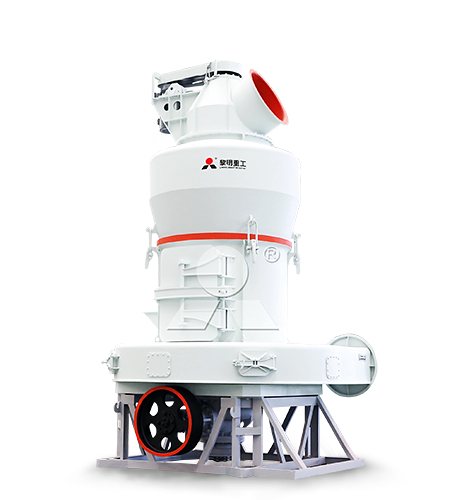
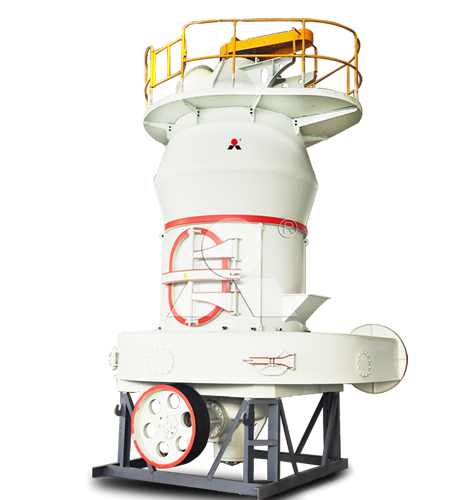
We are Liming Heavy Industry, a manufacturer of various types of industrial crushers, such as Raymond Mill, Trapezoidal Mill, Vertical Mill, Ultrafine Mill, Ball Mill, etc.
Our mills can process the following minerals:
limestone, quicklime, kaolin, talc, barite, bentonite, calcium carbonate, dolomite, coal, gypsum, clay, carbon black, slag, cement raw materials, cement clinker, etc.
If you need a mill to process stone or minerals into powder, please feel free to contact me (WhatsApp: +8615333807511). Thank you.
Large-scale drilling mineral powder processing requires an integrated plant that can receive variable ore, maintain continuous high-capacity operation, control moisture and particle size, recover fine powder efficiently, and verify product quality before bulk dispatch. The central products are usually barite for standard mud weighting, hematite for high-density fluid systems, bentonite for viscosity and filtration control, and calcium carbonate for acid-soluble bridging and loss-control applications.
At large capacity, the main challenge is not simply increasing tonnage. It is maintaining the same mineral quality and particle-size distribution across every hour of operation, every storage silo, and every shipment. Drilling-fluid materials are covered by defined physical-property and test-procedure requirements, so the line should be designed around traceable quality control from incoming ore to finished powder.
Large-Scale Processing Objectives
A centralized drilling-mineral plant may supply bulk powder to mud-service companies, offshore supply bases, oilfield distributors, drilling contractors, and regional storage terminals. These operations need high availability, stable output, reliable loading capacity, and sufficient finished-product inventory to continue delivery during mill maintenance, weather interruptions, or fluctuations in mine supply.
| Production Objective | Why It Matters | Plant Design Response |
|---|---|---|
| Continuous high output | Large customers often require regular bulk deliveries with limited tolerance for supply interruption. | Use adequately sized crushing, grinding, conveying, collection, storage, and loading equipment with planned maintenance access. |
| Stable powder quality | Variation in density, fineness, moisture, or mineral composition can affect drilling-fluid performance. | Use raw-material grade separation, controlled blending, automatic feeding, online monitoring, and routine laboratory testing. |
| Moisture control | Wet feed reduces grinding efficiency and can block conveying, classification, and storage equipment. | Provide covered stockpiles, material drainage, hot-air drying capacity, and finished-powder silo protection. |
| Bulk dispatch capability | High-volume drilling mineral supply commonly depends on tanker loading and rapid truck turnaround. | Install sufficient silo capacity, weighing systems, loading stations, vent filtration, and traffic flow space. |
| Low product loss | Fine mineral powder has commercial value and can create dust if handling is not enclosed. | Use enclosed conveying, negative-pressure operation, pulse dust collection, and controlled collector return. |
| Batch traceability | Customers need reliable documentation for drilling-fluid material quality. | Link raw-material sources, process records, laboratory results, silo locations, and shipping documents. |
Mineral-Specific Processing Routes
The same plant framework can process several drilling minerals, but each mineral needs its own quality targets and operating controls. A large-scale facility should avoid treating all minerals as identical powder products.
| Mineral | Main Drilling Function | Large-Scale Processing Priority |
|---|---|---|
| Barite | Raises drilling-fluid density and supports formation-pressure control. | Maintain high specific gravity, control particles above 75 μm, limit excess particles below 6 μm, and keep moisture low. |
| Hematite | Provides high-density weighting for high-pressure and high-temperature applications. | Control Fe2O3 grade, manage abrasion, maintain tight particle-size distribution, and use wear-resistant equipment. |
| Bentonite | Develops viscosity, gel strength, suspension, and filtration control. | Protect hydration performance, stabilize moisture, limit coarse residue, and verify rheology and filtration performance. |
| Calcium carbonate | Provides acid-soluble bridging and lost-circulation control. | Produce separate fine, medium, and coarse grades; maintain acid solubility; and prevent cross-contamination between size fractions. |
Barite and hematite are high-specific-gravity weighting minerals. Bentonite is a clay mineral selected for fluid-building properties. Calcium carbonate is usually processed as a set of bridging grades rather than as one uniform fine powder. Large plants should therefore use dedicated storage bins, process routes, and laboratory release procedures for each finished product.
Barite Quality at High Capacity
Barite is often the main product in a large drilling-mineral powder facility. Standard drilling-grade barite must combine suitable density with controlled particle-size distribution. For 4.2-grade barite, commonly referenced requirements include a minimum specific gravity of 4.20 g/cm3, at least 97% passing through a 75 μm screen, no more than 30% below 6 μm, and no more than 250 mg/kg of water-soluble alkaline-earth metals expressed as calcium.
At high output, raw ore variability becomes a major risk. Material from different mine benches may have different barium sulfate content, density, moisture, hardness, and impurity levels. A large plant should use separate ore stockpiles, controlled blending, and regular raw-material testing before feed enters the grinding circuit.
For barite, the target is not maximum fineness. If the mill produces too much material below 6 μm, drilling-fluid plastic viscosity can rise. If the product contains too much material above 75 μm, settling behavior and mud-density consistency may be affected. The grinding and classification system must therefore balance feed rate, grinding force, air volume, separator operation, and coarse-powder recirculation.
LM Vertical Roller Mill for Large Plants
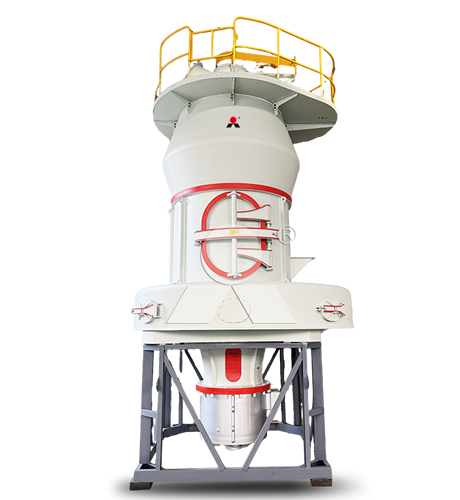
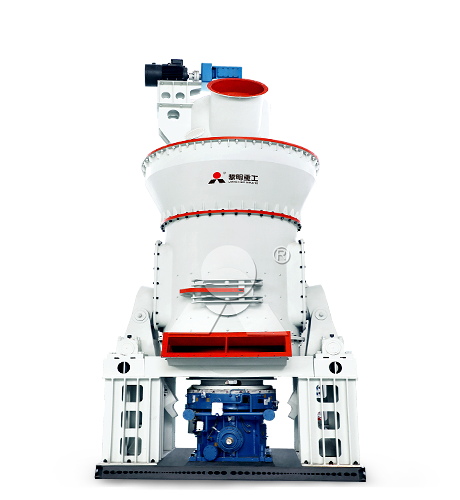
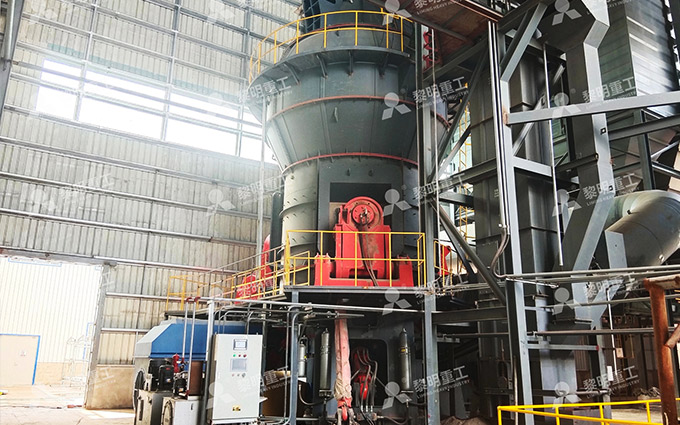
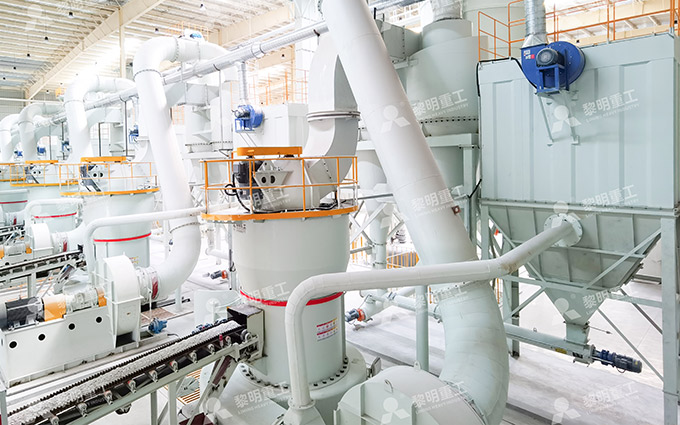
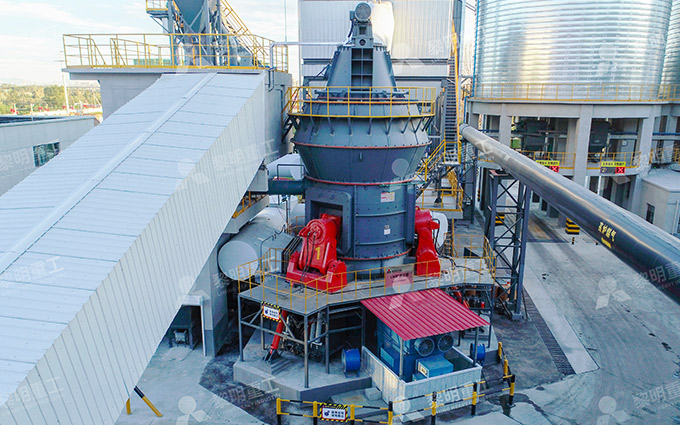
The LM Vertical Roller Mill is suitable for large-scale drilling mineral powder processing because it integrates crushing, drying, grinding, classification, and pneumatic conveying in one system. This integrated arrangement can reduce intermediate transfer points, simplify the overall process flow, and support continuous high-output operation.
For drilling minerals, crushed and prepared feed enters the mill through a controlled feeding system. The material is ground on the vertical table by rollers. Hot air can be introduced to dry moisture-bearing feed during milling. The air stream carries fine particles toward the classifier, where qualified powder proceeds to the collection system and coarse material falls back to the grinding table for further processing.
Liming Heavy Industry lists the LM Vertical Roller Mill with feed size below 50 mm and a capacity range of 4–100 t/h, depending on the selected model, material characteristics, target fineness, moisture, and operating conditions. The system is described as capable of drying and grinding simultaneously and as integrating crushing, drying, grinding, powder selection, and conveying in a compact arrangement.
| LM Vertical Roller Mill Feature | Benefit for Large Drilling Mineral Plants |
|---|---|
| Integrated drying and grinding | Helps process moisture-bearing barite, bentonite, and other mineral feed without separate transfer between main operations. |
| Internal air classification | Allows continuous separation of qualified powder and coarse material returned for regrinding. |
| Pneumatic powder conveying | Transfers fine powder efficiently from the mill to the collection and storage system. |
| Compact process flow | Reduces handling stages and can lower the space required for a high-capacity grinding section. |
| Automatic control capability | Supports stable management of feed rate, mill loading, temperature, airflow, and product fineness. |
| High-capacity range | Suitable for centralized drilling-mineral supply operations requiring sustained output. |
For feed with variable moisture, the hot-air system must be designed around the actual material condition. Liming Heavy Industry states that the LM Vertical Roller Mill can process material with in-mill moisture up to 15% and achieve an outlet moisture level below 1% under suitable process conditions.
Plant Layout and Storage
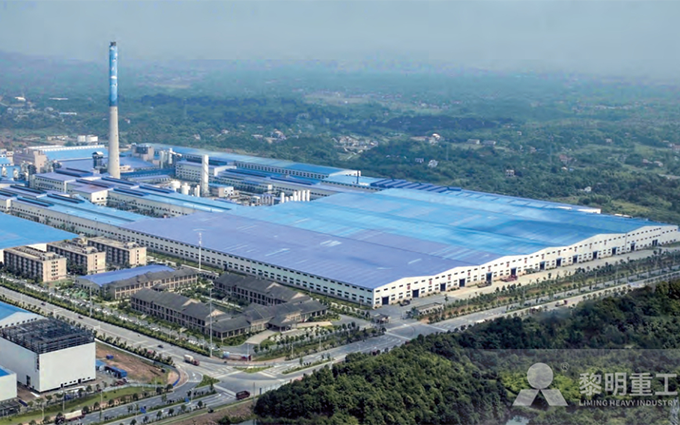
Large-scale production requires enough buffer capacity to separate the operating rhythm of mining, crushing, grinding, laboratory testing, packing, and shipping. Without sufficient storage, every short interruption in one process section can stop the entire line.
| Plant Section | Large-Scale Design Requirement | Operational Value |
|---|---|---|
| Raw-material yard | Covered stockpiles or storage sheds with separated grades and reliable loader access. | Reduces weather-related moisture variation and prevents uncontrolled mixing of ore grades. |
| Crushed-material buffer | Surge hopper or silo between crushing and grinding. | Allows the grinding circuit to operate steadily during short interruptions in crushing. |
| Grinding circuit | Stable feeder, mill, classifier, fan, collector, and coarse-return path designed as one pressure-balanced system. | Maintains controlled fineness and reduces fluctuations in output. |
| Finished-product silos | Multiple sealed silos with adequate storage days, level monitoring, aeration, and independent discharge systems. | Allows product testing, grade separation, and continuous loading while production continues. |
| Bulk-loading station | High-capacity screw conveyor or pneumatic loading system, truck scale, vent filtration, and dust-tight connection. | Supports fast, accurate tanker loading with less powder loss. |
| Bagging section | Separate packaging line for valve bags or big bags, with local dust extraction. | Supports customers requiring packaged products without interrupting bulk delivery. |
| Laboratory | Sampling point, rapid-release testing equipment, retained-sample storage, and digital batch records. | Prevents nonconforming material from entering the shipping system. |
Finished-product storage should be designed for the density and flow behavior of the mineral. Barite and hematite are dense powders, so silo cones, discharge valves, rotary feeders, screw conveyors, and truck-loading equipment must be sized for their bulk density. Bentonite requires careful moisture control because damp clay can bridge or adhere inside silos and hoppers. Calcium carbonate grades should remain in dedicated storage so that fine dust does not contaminate medium and coarse bridging products.
Automation and Quality Control
Large plants need automatic monitoring because manual observation alone cannot maintain stable quality over long production cycles. The control system should record material feed rate, mill load, grinding pressure, separator setting, fan current, airflow, system pressure, inlet and outlet temperatures, dust-collector differential pressure, silo level, and loading weight.
For barite production, quality-control equipment should include specific-gravity testing, moisture analysis, wet-screen testing, particle-size analysis, and chemical analysis for relevant soluble components. Online particle-size analyzers, automated sampling stations, and X-ray fluorescence equipment can strengthen control where production volume and product requirements justify the investment.
Incoming ore inspection: Verify mineral grade, density, moisture, hardness, and impurity level before the material is added to the main stockpile.
Controlled blending: Use recorded blending ratios where multiple ore sources are combined to maintain stable product density and composition.
Continuous process monitoring: Track feed, mill loading, airflow, separator performance, temperature, and dust-collector condition throughout the shift.
Finished-powder sampling: Collect representative samples from the product stream or finished silo at defined intervals.
Batch-release testing: Confirm density, moisture, particle-size distribution, coarse residue, ultrafine content, and mineral-specific functional properties.
Separate product storage: Keep different density grades, particle-size grades, and mineral types in dedicated, clearly identified silos.
Dispatch traceability: Record the batch number, silo number, test result, loading date, truck or container identification, and shipment quantity.
Reliable Production at Scale
Large-scale drilling mineral powder processing succeeds when capacity and quality are designed together. A high-output mill is only one part of the solution. Stable ore supply, protected stockpiles, accurate feeding, integrated drying, controlled grinding, efficient classification, high-recovery dust collection, sufficient silo capacity, and verified batch release are all required to deliver dependable drilling-fluid minerals.
For high-capacity fine-powder production, the LM Vertical Roller Mill provides an integrated route for drying, grinding, classification, and conveying. It is particularly suitable for centralized barite, hematite, bentonite, and fine calcium carbonate operations where consistent output and process integration are required. Medium and coarse calcium carbonate bridging grades should remain in dedicated crushing and screening circuits to preserve the particle sizes needed for loss-control performance.
The final line should be configured using representative material tests, actual moisture and hardness data, target product specifications, planned annual capacity, local utilities, and the intended dispatch method. This approach creates a production system that can supply drilling mineral powders consistently through long operating cycles and changing field demand.