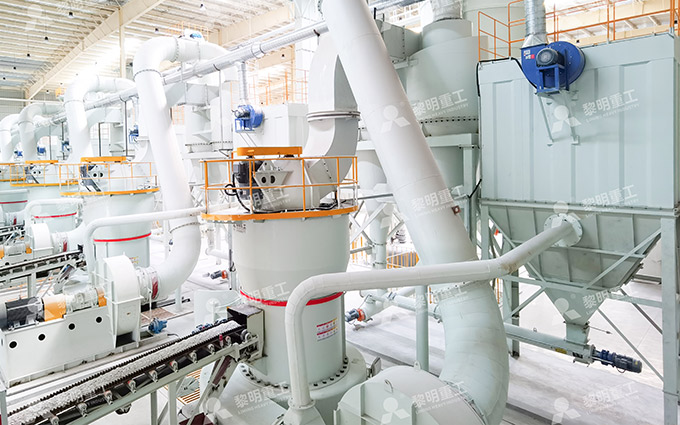
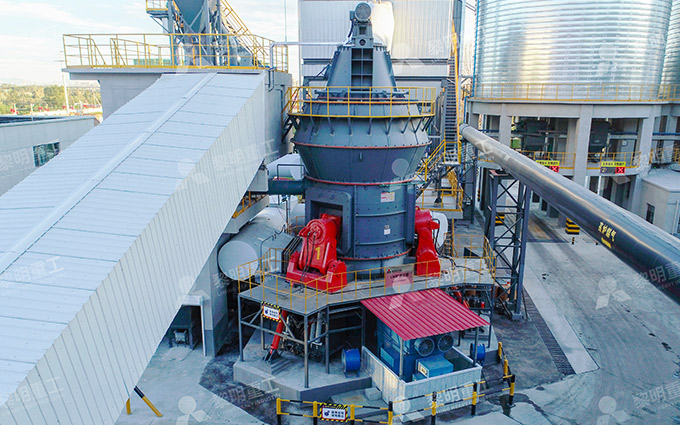
Industrial By-product Gypsum Solutions
How to Grind FGD Gypsum into Powder for Industrial Applications?
2026-09-08 16:00:47
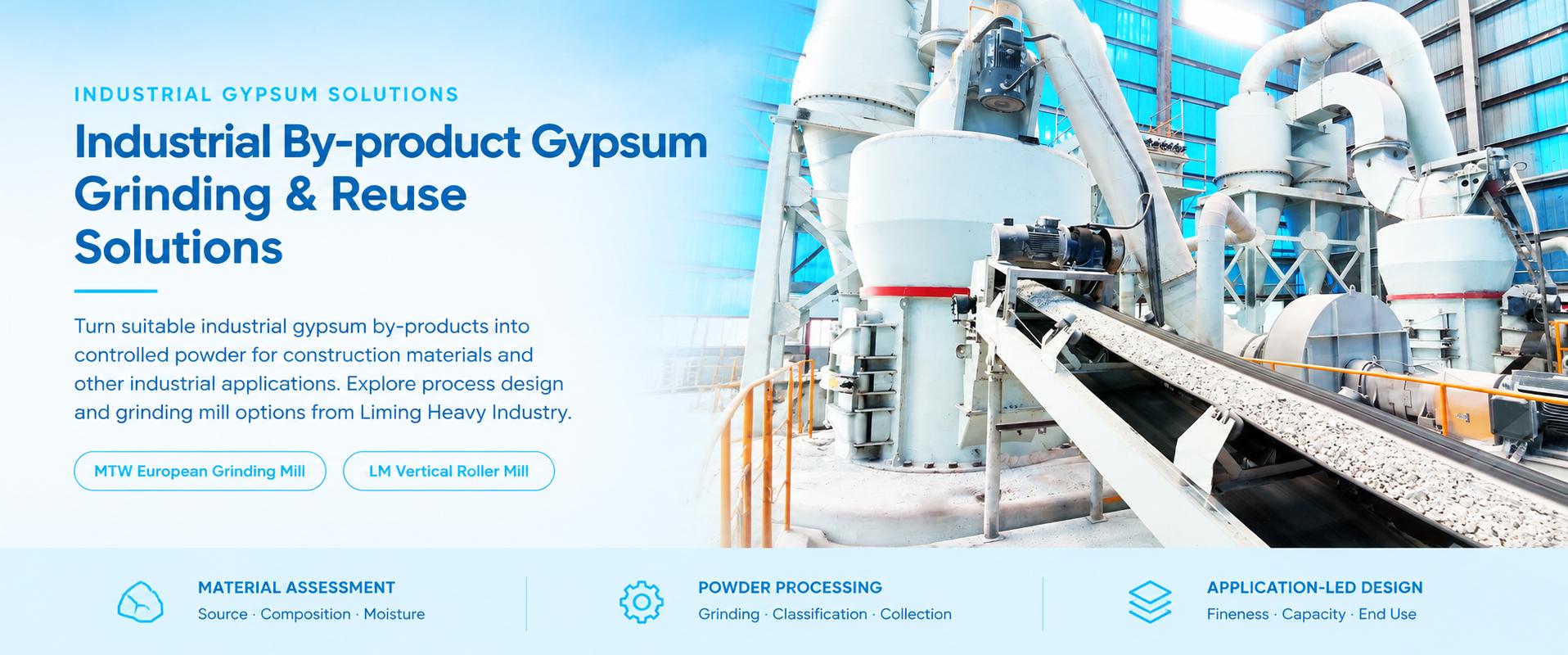
FGD gypsum can be ground into controlled powder for cement, gypsum-based building materials and other industrial applications when the material quality, moisture level and final product requirements are properly evaluated. A reliable process usually includes material testing, dewatering or drying when necessary, stable feeding, grinding, classification, powder collection and controlled storage.
FGD gypsum, also called flue gas desulfurization gypsum or synthetic gypsum, is produced during the removal of sulfur dioxide from industrial flue gas. In wet limestone-based desulfurization systems with forced oxidation, calcium sulfite is converted into calcium sulfate dihydrate. The resulting material is commonly discharged as a moist gypsum filter cake or slurry-derived solid rather than as a dry, finished powder.
The main question is not simply how to grind FGD gypsum. The more important question is how to prepare the material so that the final powder meets the needs of the intended application. Moisture, purity, soluble salts, residual carbonate, ash-related particles, particle-size distribution and storage conditions can all influence the design of the grinding system and the suitability of the final product.
Understand the Characteristics of FGD Gypsum Before Grinding
FGD gypsum is generally dominated by calcium sulfate dihydrate, but its actual quality depends on the flue-gas treatment process, fuel source, absorbent quality, oxidation efficiency, washing performance, filtration equipment and handling practices. Two sources described as FGD gypsum may behave differently in a grinding plant.
In many cases, FGD gypsum has a relatively fine original particle size. It may contain crystals in the approximate range of 20 to 75 micrometers, although the actual distribution varies by plant and process conditions. This means the raw material may already be finer than crushed natural gypsum, but it can still require grinding or deagglomeration to achieve a consistent powder specification for downstream use.
Before selecting a mill, collect representative samples and confirm the following information:
Calcium sulfate dihydrate content and overall gypsum quality
Free moisture content and seasonal moisture variation
Feed form, including filter cake, loose powder, compacted lumps or stored material
Particle-size distribution and presence of agglomerates
Chloride, soluble salt, residual carbonate and sulfite-related content where relevant
Fly ash, silica, unreacted limestone or other non-gypsum components
Required final powder fineness
Required production capacity in tonnes per hour
Final application, such as cement, gypsum board, plaster, mortar or another industrial use
Material testing should be completed before final process design. Grinding can control particle size, but it does not automatically remove unsuitable impurities, reduce excessive soluble salts or make an unqualified material acceptable for a specific product.
Define the Target Industrial Application
The final application determines the required powder quality. A grinding system for cement use may be configured differently from a system supplying material for gypsum board or gypsum-based dry mixes. The project should therefore begin with a product specification rather than with a preferred mill model.
FGD gypsum for cement production
Gypsum is commonly added during cement grinding to help control cement setting time. For this application, the material must be compatible with the cement plant’s chemical and operational requirements. Stable feeding, controlled moisture and suitable fineness are important because they influence dosing accuracy, storage behavior and grinding performance.
FGD gypsum may be used as a substitute for natural gypsum in cement applications when its quality meets the cement producer’s requirements. The material should be evaluated for gypsum content, moisture, soluble salts and other constituents that may affect clinker grinding or final cement performance.
FGD gypsum for gypsum board
Gypsum board manufacturing requires consistent raw material quality. The gypsum must meet the board producer’s specifications for purity, moisture, particle characteristics and process behavior. FGD gypsum can be used in gypsum panel production where it is properly washed, filtered and prepared.
Published technical reviews have identified common wallboard-related quality considerations, including high calcium sulfate dihydrate content and controlled moisture. However, exact acceptance requirements vary by board plant, product formulation and local standards, so the receiving manufacturer’s specification should always take priority.
FGD gypsum for plaster, mortar and other building materials
FGD gypsum may also be considered for selected plaster, mortar and gypsum-based material applications. The final powder should have controlled fineness, low enough moisture for handling and a chemical profile compatible with the formulation. Product trials are especially important because different gypsum-based materials can respond differently to impurities, particle shape and water demand.
Typical FGD Gypsum Grinding Process
A typical FGD gypsum powder line is designed around the condition of the incoming material. The process may include receiving and storage, feeding, deagglomeration or crushing, drying when needed, grinding, classification, powder collection and finished-product storage.
1. Material receiving and storage
FGD gypsum is often delivered as a moist filter cake. It may compact during transport or storage, especially when free moisture is high. The receiving area should be designed to prevent excessive material buildup, moisture absorption from rain or humidity, and uncontrolled variations in feed condition.
If the gypsum is stored for a long time, the project team should check whether it develops hard lumps, uneven moisture zones or changes in flowability. These conditions affect feeder selection and may require a material-conditioning stage before grinding.
2. Feeding and deagglomeration
Stable feeding is essential for consistent mill operation. A feeder should deliver the gypsum at a controlled rate while avoiding large moisture and flow fluctuations. When filter cake or compacted material contains lumps, a crusher, lump breaker or other pre-treatment equipment may be used to create a more uniform feed.
The objective at this stage is not always to reduce the material to final powder size. It is to create a feed that can enter the drying and grinding system continuously without blockage or major load variation.
3. Drying when required
Moisture is often the central processing issue for FGD gypsum. High free moisture can cause sticky feed, poor powder flow, accumulation inside equipment, reduced grinding efficiency and unstable classification. The appropriate drying requirement depends on the incoming moisture, target application, mill configuration and local operating conditions.
For some applications, FGD gypsum is washed and filtered to remove surface salts and excess moisture before downstream processing. Industry descriptions of panel-grade FGD gypsum production emphasize washing and vacuum filtration to reduce chlorides, salts and surface moisture before the material is transported for gypsum panel manufacturing.
A separate dryer may be appropriate when the incoming material is too wet for stable grinding. In other projects, drying can be integrated with the milling system if the selected equipment and heat source are suitable. The drying target should be based on the requirements of the mill and the finished product, not on a single universal moisture number.
4. Grinding
Grinding reduces agglomerates and controls the final particle size of the gypsum powder. Although FGD gypsum can be naturally fine, grinding may still be needed to improve powder uniformity, support stable blending, meet a target fineness or prepare the material for a specific downstream process.
The selected mill should match the actual feed condition. Dry, stable FGD gypsum may be processed in a conventional grinding system, while moist material may require a system with stronger drying capability and more careful airflow control.
5. Classification
Classification separates finished fine powder from oversized particles. This stage is important because product performance often depends not only on average fineness, but also on the full particle-size distribution. A properly configured classifier helps maintain consistent powder quality and returns coarse material for further grinding where necessary.
For cement and building-material applications, the required fineness should be agreed with the end user. Over-grinding can increase energy consumption and may change powder behavior, while insufficient grinding can lead to poor uniformity or difficulty in downstream blending.
6. Powder collection and storage
After classification, the finished powder is collected through a dust-collection system and conveyed to a storage silo, packing unit or bulk-loading station. The collection system should maintain stable airflow while reducing powder loss and dust emissions.
Finished FGD gypsum powder should be protected from moisture during storage. If the powder absorbs water after grinding, it may cake, lose flowability or create difficulties during conveying and dosing.
Choosing a Mill for FGD Gypsum Grinding
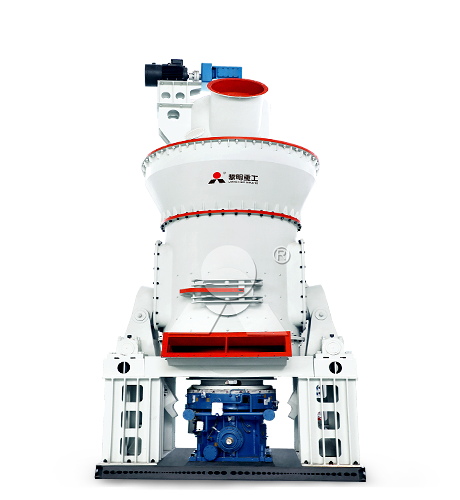
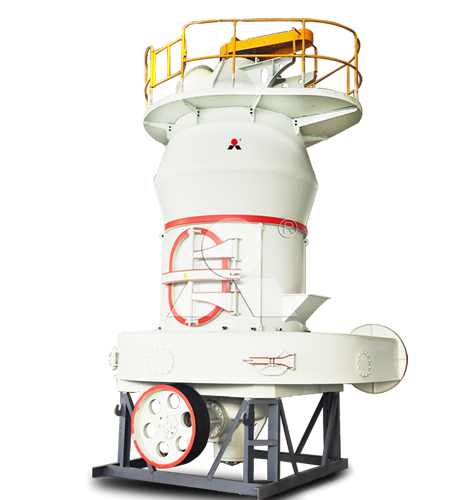
For conventional FGD gypsum powder production, MTW European Grinding Mill, LM Vertical Roller Mill and Raymond mill can be evaluated according to throughput, moisture, feed condition, target fineness and plant layout.
MTW European Grinding Mill for FGD gypsum
MTW European Grinding Mill is suitable for small-to-medium capacity FGD gypsum powder projects that require controlled fineness and stable classification. It can be a practical solution when the material has been adequately prepared and the feed moisture is within the operating range of the selected system.
For FGD gypsum with elevated moisture, the project should evaluate whether upstream drying is required. Good feed preparation is especially important because wet or sticky filter cake can reduce system stability and lead to buildup in feeding and conveying equipment.
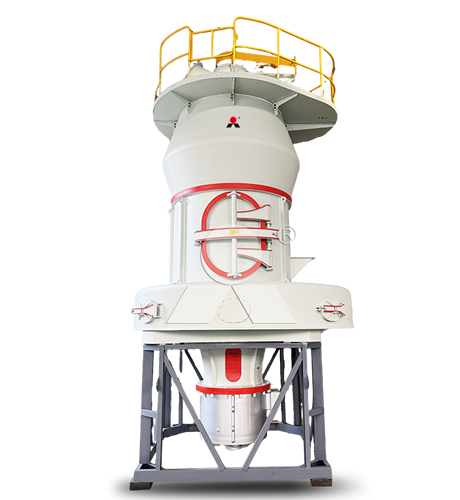
LM Vertical Roller Mill for FGD gypsum
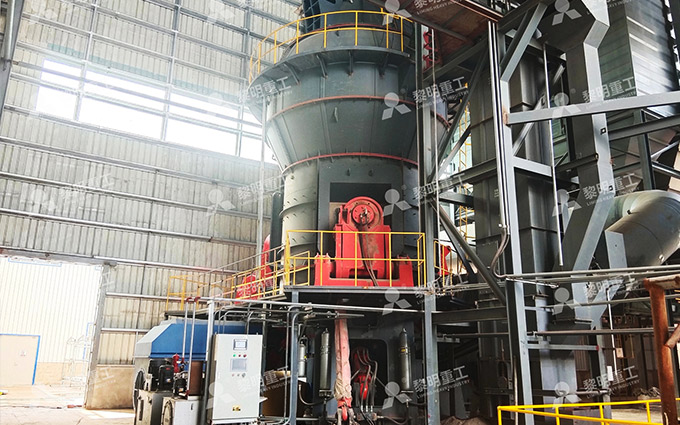
LM Vertical Roller Mill is suitable for large-capacity FGD gypsum grinding projects. Its process arrangement can support grinding, classification and, where conditions are suitable, drying integration. This makes it a strong option for continuous, higher-output projects or for materials that need more active moisture control.
The final LM Vertical Roller Mill configuration should be based on the actual moisture level, required evaporation capacity, available heat source, target fineness and production rate. It is important to distinguish between the total moisture in the material and the free moisture that affects handling and drying performance.
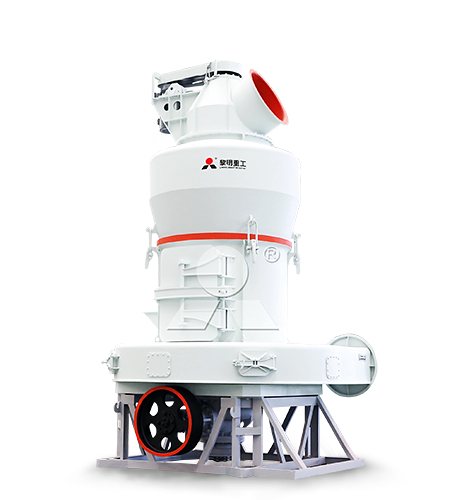
Raymond mill for FGD gypsum
Raymond mill can be considered for conventional FGD gypsum powder production where output requirements are moderate and the feed condition is relatively stable. It is generally more suitable for prepared gypsum feed with controlled moisture than for highly wet filter cake requiring major drying duty.
Before selecting a Raymond mill, confirm the feed size, moisture level, required product fineness, hourly capacity and powder collection arrangement. A stable and properly conditioned feed will improve operating reliability.
How to Control Moisture During FGD Gypsum Grinding
Moisture control begins before the gypsum reaches the grinding mill. The source plant’s filtration performance, transport method, storage arrangement and feeding system all influence the actual moisture seen by the processing line.
The following practices can help improve moisture management:
Use representative moisture testing rather than relying on a single sample.
Separate fresh material from long-stored material when their moisture conditions differ significantly.
Protect outdoor stockpiles from rain and uncontrolled surface-water exposure.
Use suitable feeding equipment for moist, cohesive or compacted gypsum.
Install pre-treatment when lumps or agglomerates prevent stable feeding.
Match drying capacity to the highest expected operating moisture, not only the average value.
Control system airflow and collection performance to maintain stable grinding and classification.
Store finished powder in dry, sealed conditions to reduce caking after grinding.
Common Problems in FGD Gypsum Powder Processing
Unstable feed caused by wet filter cake
FGD gypsum filter cake can bridge, compact or adhere to hoppers and conveyors when moisture is high. The solution may involve improved hopper design, controlled feeding, lump breaking, drying or changes in storage and handling practice.
Powder caking after collection
Even if the mill operates normally, finished powder can cake in storage if residual moisture is too high or if it absorbs moisture from the surrounding environment. The project should check drying performance, silo sealing, powder temperature and storage time.
Inconsistent fineness
Inconsistent fineness may result from fluctuating feed rate, variable feed moisture, worn grinding components, incorrect classifier settings or unstable airflow. Process control should focus on the entire system rather than only on the mill.
Unexpected impurities
Residual carbonate, sulfite, chlorides, fly ash, silica and other source-related materials can affect suitability for downstream use. If the final product fails customer testing, the solution may require improved source-material control, washing, blending, process adjustment or selection of a different reuse route rather than finer grinding alone.
Recommended Process-Design Information
To design an FGD gypsum grinding line, provide the following information for preliminary evaluation:
FGD gypsum source and desulfurization process description
Recent chemical analysis and gypsum content
Free moisture and moisture variation range
Feed form, feed size and degree of agglomeration
Required final powder fineness
Required production capacity
Planned final application
Available heat source, if drying is required
Installation location, plant layout and environmental-control requirements
Finished powder storage, packing and bulk-dispatch requirements
Conclusion
Grinding FGD gypsum into industrial powder is a material-preparation process rather than a simple size-reduction step. The most reliable route begins with chemical and physical testing, followed by moisture control, stable feeding, suitable grinding, precise classification and protected powder storage.
MTW European Grinding Mill can be considered for prepared small-to-medium capacity FGD gypsum powder projects. LM Vertical Roller Mill is suitable for larger-capacity systems and projects where integrated drying and grinding may be beneficial. Raymond mill can be a practical choice for conventional powder production with stable and adequately conditioned feed.
Final equipment selection should be based on real FGD gypsum data, including moisture, impurities, feed condition, target fineness, output requirement and final application. When the process is matched to the material, FGD gypsum can be converted into a controlled powder feedstock for cement, gypsum-based materials and other qualified industrial uses.