Oil & Gas Mineral Processing
Drilling Fluid Mineral Powder Processing
2026-09-14 17:19:32
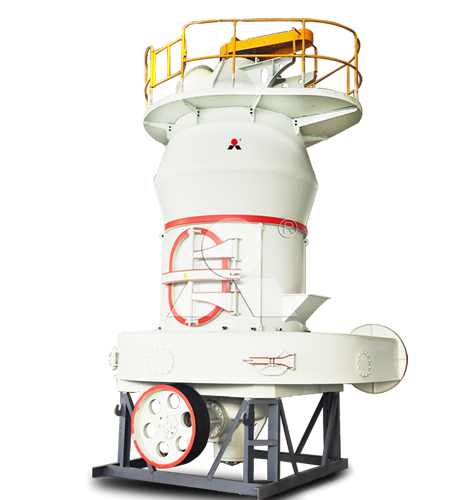
We are Liming Heavy Industry, a manufacturer of various types of industrial crushers, such as Raymond Mill, Trapezoidal Mill, Vertical Mill, Ultrafine Mill, Ball Mill, etc.
Our mills can process the following minerals:
limestone, quicklime, kaolin, talc, barite, bentonite, calcium carbonate, dolomite, coal, gypsum, clay, carbon black, slag, cement raw materials, cement clinker, etc.
If you need a mill to process stone or minerals into powder, please feel free to contact me (WhatsApp: +8615333807511). Thank you.
Drilling-fluid mineral powder processing converts selected industrial minerals into controlled powders used to build, weight, stabilize, and condition drilling fluids for oil and gas wells. The finished material must do more than reach a nominal mesh size: it must have consistent density, moisture, purity, and particle-size distribution so that the drilling-fluid system performs predictably in the wellbore.
Among the minerals used in drilling fluids, barite is the principal weighting material. Bentonite, attapulgite, sepiolite, hematite, calcium carbonate, and other materials may also be selected according to the drilling environment and fluid formulation. Each mineral has a different function, so the processing route must begin with the required end use rather than with grinding fineness alone. API Specification 13A covers physical properties and testing procedures for a range of materials used in oil- and gas-well drilling fluids, including barite, hematite, bentonite, attapulgite, and sepiolite.
Mineral Powders and Their Functions
A drilling fluid is a carefully balanced system. It must transport cuttings, cool and lubricate the bit, maintain wellbore stability, transmit hydraulic energy, and manage formation pressure. Mineral powders contribute to these functions through their density, particle shape, surface area, hydration behavior, and chemical composition.
| Mineral Material | Primary Function | Processing Focus |
|---|---|---|
| Barite | Increasing drilling-fluid density | Controlled particle-size distribution, high specific gravity, low moisture, and clean powder handling. |
| Hematite | High-density weighting in selected fluid systems | Stable grinding, wear-resistant process design, and close density control. |
| Bentonite | Viscosity development, suspension, filtration control, and borehole support | Moisture management, fine grinding, preservation of swelling performance, and avoidance of contamination. |
| Attapulgite or sepiolite | Suspension and rheology support, particularly in saltwater environments | Gentle handling of fibrous minerals and consistent powder fineness. |
| Calcium carbonate | Bridging and seepage-loss control in selected drilling applications | Production of defined coarse, medium, or fine particle grades with narrow size ranges. |
Barite remains the most widely used drilling-fluid weighting agent because barium sulfate has high density and good chemical stability. Conventional drilling-grade barite is commonly supplied in 4.1 g/mL and 4.2 g/mL density grades. For the 4.2 grade, the minimum density is 4.20 g/mL; both grades have the same specified limits for other principal particle-size and soluble-salt parameters.
What Makes Drilling Mineral Processing Different
Ordinary mineral powder production may focus mainly on throughput and average fineness. Drilling-fluid minerals require tighter process discipline because the powder is used in a circulating fluid system where small changes in particle distribution can affect settling behavior, viscosity, filtration performance, and mud density.
For barite, the finished product must be sufficiently fine to disperse in the drilling fluid, but it cannot contain an uncontrolled amount of ultrafine powder. Large particles can settle more readily, particularly when circulation slows or when the well path includes highly deviated sections. Excessively fine particles can increase surface area, consume more liquid, and alter drilling-fluid rheology.
API 13A requirements for barite illustrate this balance. The specification identifies a maximum 3.0% mass fraction of material retained above 75 μm and a maximum 30% mass fraction of particles below 6 μm in equivalent spherical diameter. It also limits water-soluble alkaline-earth metals, expressed as calcium, to 250 mg/kg.
These requirements mean that a drilling mineral powder plant needs stable feed preparation, controlled grinding, efficient classification, enclosed material transfer, and routine laboratory inspection. A mill should be selected not only for its ability to generate fine powder, but also for its ability to maintain a repeatable product profile over extended production campaigns.
Typical Processing Route
The exact flow sheet changes with mineral type, mine condition, moisture level, and finished-product requirement. However, a practical dry-process line for drilling-fluid mineral powders usually follows the sequence below.
Raw material receiving and inspection. Incoming ore is checked for mineral composition, density, moisture, contaminants, and size distribution. For barite, raw material quality has a direct effect on the density and purity of the finished powder. Grinding cannot compensate for an ore body that does not have sufficient specific gravity or contains unsuitable impurities.
Crushing and controlled feeding. Large mineral lumps are reduced to the feed size required by the grinding mill. A vibrating feeder or equivalent dosing system maintains a steady material flow. Stable feed is important because sudden changes in feed rate can cause fluctuations in mill pressure, circulating load, and finished-powder fineness.
Drying and moisture control. Moisture can reduce grinding efficiency and create flow problems in elevators, classifiers, filters, silos, and packing systems. When raw material moisture is high or variable, the process should include sufficient drying capacity. The drying arrangement should be matched to the mineral’s heat sensitivity and the capacity of the entire line.
Grinding and classification. The mineral is ground and separated in a closed circuit. Fine qualified powder is collected, while coarse particles return to the grinding zone. This circulation is essential for controlling the upper particle-size limit without unnecessarily overgrinding the entire material stream.
Collection, storage, and packaging. High-efficiency dust collection recovers fine powder from the air stream and supports a cleaner working environment. The final product can then be conveyed to storage silos, bulk-loading systems, big-bag stations, or valve-bag packing lines, depending on customer logistics and local transportation conditions.
Batch verification. Samples should be collected according to a defined production schedule and tested before release. For drilling-grade barite, manufacturers commonly verify density, moisture, screen residue, fine-particle content, and soluble components. The standard specifies that a composite sample representing no more than one day of production should conform to the relevant chemical and physical requirements.
LM Vertical Roller Mill in Large Powder Plants
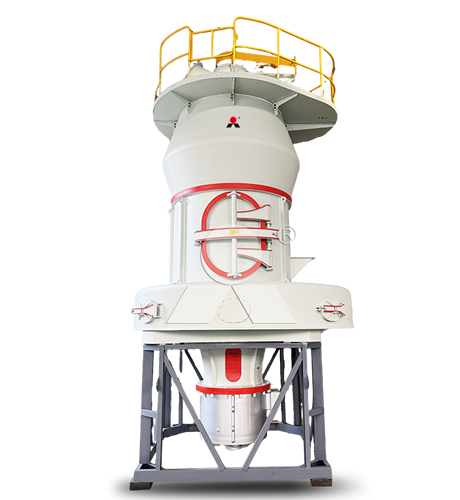
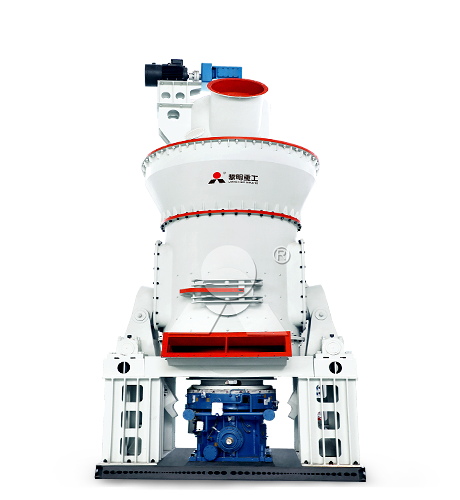
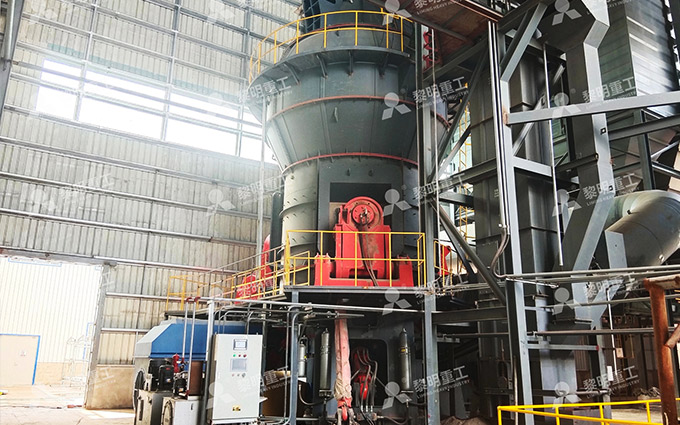
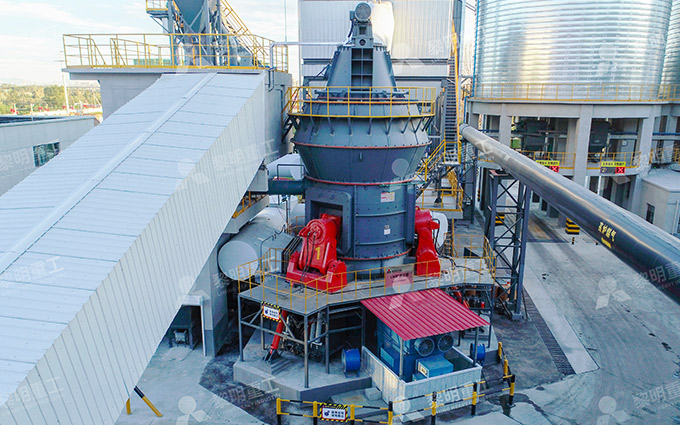
The LM Vertical Roller Mill can be configured for large-scale dry grinding of drilling-fluid mineral feed, especially where high production capacity, integrated drying, and continuous operation are required. Its vertical arrangement combines grinding, drying, classifying, and pneumatic conveying within one main system, making it suitable for centralized barite processing facilities supplying multiple drilling-fluid customers or bulk distribution terminals.
Inside the mill, material is fed onto the grinding table and ground between the table and rollers. Hot gas can assist with moisture removal when required. The air stream carries ground material toward the classifier, where the qualified fraction continues to the collection system and coarse particles return for further grinding. This internal circulation supports stable operation and helps maintain consistent product fineness.
For drilling-fluid barite, the operating target should be established through raw-material testing and product trials. The best setting is not necessarily the finest possible setting. A suitable setting is one that consistently controls particles above the specified coarse limit while preventing an excessive fraction of material below 6 μm.
The LM Vertical Roller Mill is particularly appropriate when a project requires high output, a compact process layout, centralized control, and the ability to manage feed moisture within the grinding system. Its process integration can simplify the overall plant arrangement by reducing the number of separate handling stages between drying, milling, classification, and powder conveying.
MTW European Trapezium Grinding Mill for Flexible Capacity
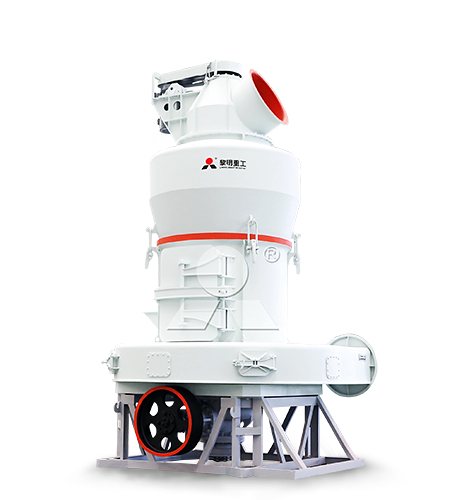
The MTW European Trapezium Grinding Mill is suited to drilling-fluid mineral powder projects that require dependable fine grinding with flexible production capacity. It can be applied to barite processing lines where the plant serves regional mud-service companies, drilling contractors, mineral distributors, or industrial customers with multiple powder-grade requirements.
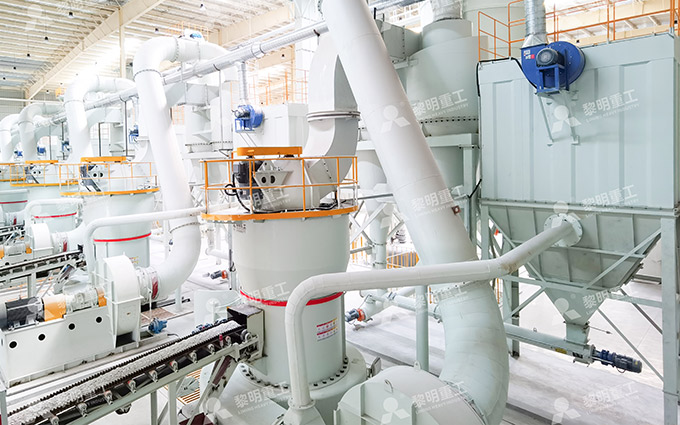
The mill grinds material through the interaction of rollers and the grinding ring. An air-flow and separator system carries fine powder toward collection equipment while returning unqualified coarse material for additional grinding. With stable feed control and correctly adjusted classification, the MTW European Trapezium Grinding Mill can support barite powder production with controlled fineness and repeatable output.
A complete MTW-based line may include a crusher, bucket elevator, feeder, grinding mill, classifier, pulse dust collector, blower, finished-product silo, and packing or bulk-loading equipment. A closed-circuit arrangement is commonly used for barite processing so that oversize particles are returned to the mill instead of entering the finished-product stream.
The MTW European Trapezium Grinding Mill is a practical choice when the plant needs an efficient, organized process route without the production scale of a large centralized vertical-mill installation. It can also support phased project development, allowing producers to match installed capacity with confirmed market demand and available barite reserves.
Quality Control Begins Before Grinding
The most dependable drilling-fluid powder lines treat quality control as a continuous activity, not as a final inspection step. Ore selection, stockpile segregation, feed blending, mill operation, classifier adjustment, dust collection, and packaging all influence the final product.
For a barite operation, the first check should be the raw ore’s specific gravity and mineral composition. A powder plant may operate perfectly, but it cannot produce 4.2-grade barite from feed that does not contain enough high-density barium sulfate. Producers should therefore establish acceptance criteria for each mine source and keep different ore grades separated whenever practical.
During production, operators should monitor feed rate, mill current, pressure or loading condition, air volume, classifier setting, outlet temperature, and dust-collector performance. These operating values provide early warning when product fineness begins to drift. Routine sieve analysis and particle-size measurement then confirm whether the powder continues to meet the required distribution.
Finished material should be stored in dry, clean silos that protect it from moisture pickup and cross-contamination. This is particularly important for barite because a change in moisture affects handling weight and can complicate customer blending calculations. Product identification, batch records, and retained samples help maintain traceability from the loaded truck or bag back to the production date and raw-material source.
Building a Reliable Drilling Mineral Powder Line
A successful drilling-fluid mineral powder project starts with the application requirement: the drilling-fluid formulation, target density, particle-size specification, delivery format, and expected annual consumption. These factors determine the grinding capacity, classification arrangement, storage volume, and quality-control equipment needed for the plant.
For barite, a properly designed LM Vertical Roller Mill or MTW European Trapezium Grinding Mill system can provide the controlled grinding and classification needed for drilling-fluid powder production. The final configuration should be based on representative material testing, including raw ore moisture, hardness, specific gravity, feed size, required finished-powder distribution, and planned hourly output.
When the process is designed around actual mineral characteristics rather than only nominal capacity, the result is a more stable powder supply, more consistent drilling-fluid performance, and a production line that can operate efficiently over the long term.