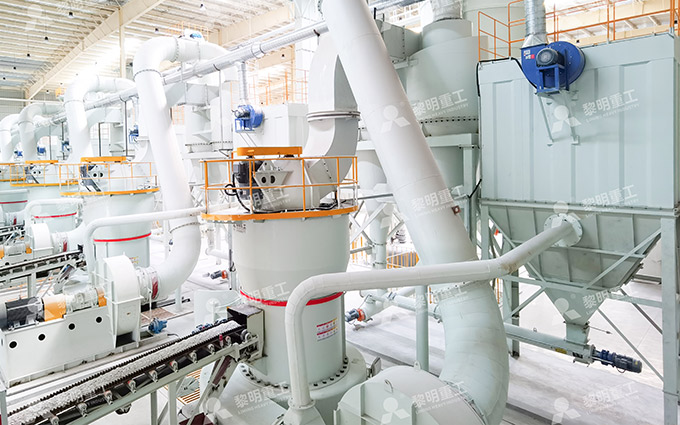
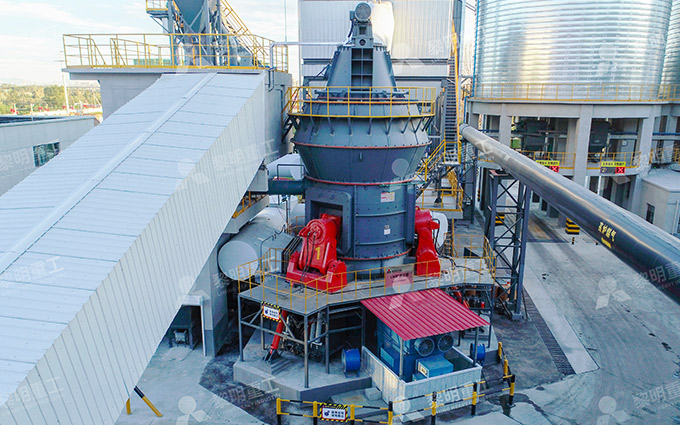
Industrial By-product Gypsum Solutions
What Information Is Needed to Design a Gypsum Grinding Plant?
2026-09-08 16:09:03
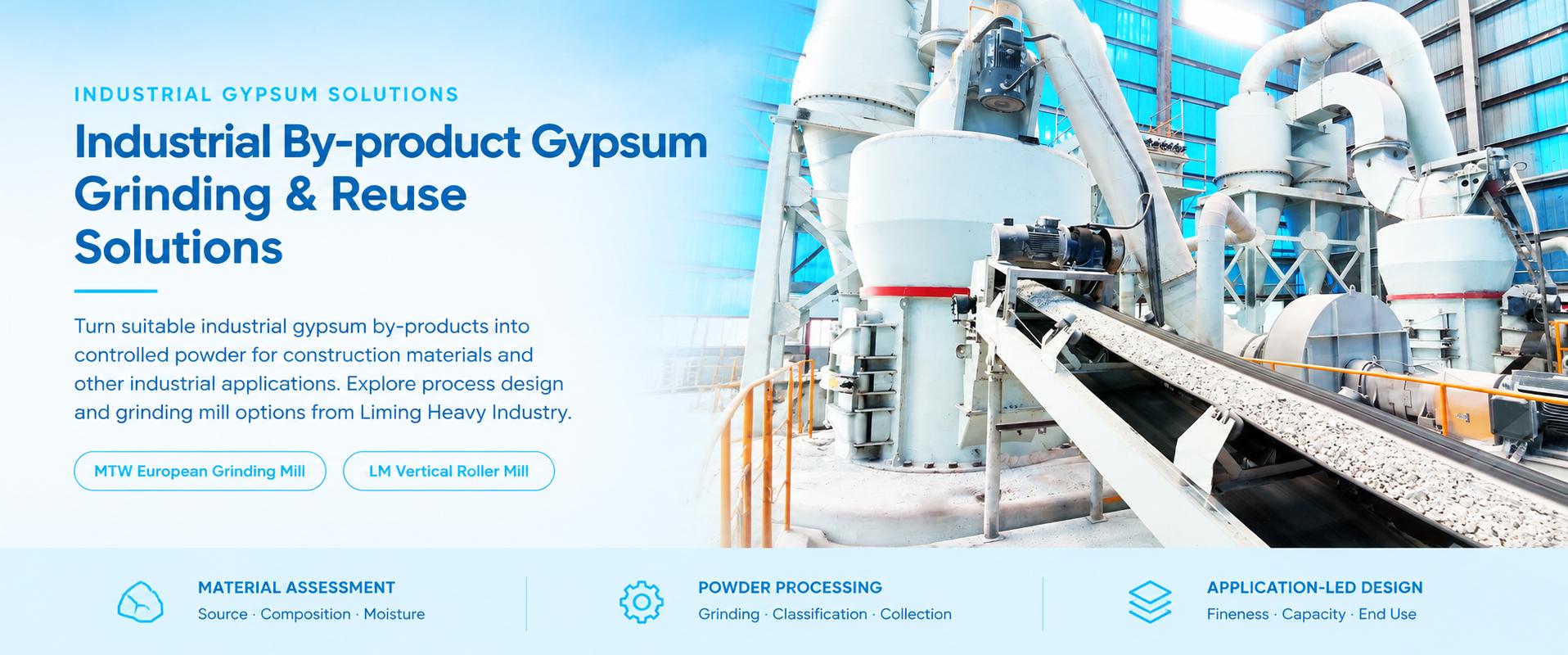
A gypsum grinding plant should be designed from measured material data and a defined finished-powder specification. The most important inputs are gypsum source, chemical composition, moisture, feed size, target fineness, required capacity, final application, drying requirement, available heat source, site conditions and product-handling method.
For industrial by-product gypsum, this information is especially important because FGD gypsum, phosphogypsum, citrogypsum, titanogypsum, fluorogypsum and borogypsum can differ greatly in moisture, impurity profile, particle size, flowability and end-use suitability. A mill cannot compensate for incomplete raw-material information. The correct process starts with representative samples and a practical product target.
Start with the Final Product
Before selecting any equipment, define what the finished gypsum powder will be used for. The final application determines the required fineness, moisture level, chemical quality, storage method and process route.
Possible industrial gypsum powder applications include:
Cement production and setting-time control
Gypsum board and wallboard raw-material preparation
Gypsum plaster and gypsum-based building materials
Dry mortar and construction-material formulations
Industrial filler or chemical-process applications
Other qualified applications based on local standards and material quality
A cement plant may require controlled sulfate contribution and stable dosing. A gypsum board plant may require strict control of purity, moisture, particle characteristics and calcination behavior. A dry-mortar producer may focus on powder fineness, flowability and consistency. These are different products, so they should not use the same plant design without confirming requirements.
1. Gypsum Type and Source Process
The first design input is the gypsum source. The plant designer should know not only the material name, but also how it was generated, recovered, stored and transported.
Common gypsum sources include:
Natural gypsum from a quarry or mine
FGD gypsum from wet flue-gas desulfurization
Phosphogypsum from phosphoric acid production
Citrogypsum from citric acid production
Titanogypsum from titanium dioxide production
Fluorogypsum from fluorine-related chemical processes
Borogypsum from borate or boric acid processing
Recycled gypsum or mixed gypsum-containing material
The source process affects moisture, gypsum form, soluble salts, residual chemicals, particle size and storage behavior. FGD gypsum is commonly produced as a wet slurry and then dewatered through hydrocyclones and filtration. One published FGD process example produces gypsum at about 90% solids after washing and vacuum-belt dewatering, but actual moisture and material quality must be confirmed for each supply source.
For industrial by-product gypsum, the design team should request a brief source-process description together with laboratory data. This helps identify whether the plant needs only grinding or a more complete route involving deagglomeration, washing, dewatering, drying, blending or other pre-treatment.
2. Chemical Analysis and Gypsum Content
Gypsum content and chemical composition determine whether the material is suitable for the intended application. The analysis should represent actual normal production, not only a best-case sample.
Useful chemical information may include:
Calcium sulfate dihydrate content
Total sulfate and SO3 contribution
Calcium oxide and sulfur trioxide content
Free moisture and total moisture
Chloride and soluble-salt content where relevant
Residual carbonate, sulfite, fly ash or other non-gypsum components
Soluble phosphorus and fluoride-related compounds for phosphogypsum
pH and acidity where relevant
Organic matter, trace elements and source-specific impurities
Radiological characteristics where required for phosphogypsum or other sensitive sources
Grinding controls particle size. It does not remove unsuitable impurities or make an unqualified industrial gypsum source acceptable for gypsum board, cement or another regulated application. If the material needs washing, neutralization, separation or other treatment, these stages must be included in the plant design before the grinding system is finalized.
3. Moisture Data and Drying Requirement
Moisture is one of the most important inputs for a gypsum grinding plant. It affects raw-material storage, feeder selection, conveyor type, lump formation, drying duty, mill selection, classifier stability, dust collection and finished-powder storage.
Do not provide only one average moisture value. The design should include:
Minimum free moisture
Average free moisture
Maximum free moisture
Seasonal moisture variation
Moisture after filtration, transport and storage
Required finished-powder moisture
High free moisture can cause industrial gypsum to bridge in hoppers, stick to conveyors, form compacted lumps and reduce grinding efficiency. It may also lead to caking in finished-powder storage.
The plant designer must determine whether the material needs:
Only covered storage and controlled feeding
Mechanical dewatering
A separate thermal dryer before grinding
Integrated drying during grinding
Drying followed by a separate calcination stage
For a gypsum grinding-drying process, surface moisture must be removed without unintentionally changing the gypsum into a calcined product when the target is dihydrate gypsum powder. Gypsum-process references distinguish grinding-drying from calcination by controlling gas temperature and process conditions; the correct condition depends on material, mill arrangement and required final product.
4. Feed Size and Physical Condition
The grinding plant must be designed for the real feed condition, not only for the size of individual gypsum crystals. Industrial gypsum can have fine primary particles but still arrive as wet filter cake, compacted lumps, weathered stockpile material or cohesive agglomerates.
The following information is needed:
Maximum feed size and typical feed-size range
Largest lump size after storage or transport
Particle-size distribution of the raw material
Degree of agglomeration
Bulk density
Flowability and tendency to bridge
Stickiness and tendency to coat equipment
Presence of foreign materials, oversize particles or contamination
This information determines whether the plant needs receiving hoppers, covered storage, screens, lump breakers, crushers, feeders, conveyors and blending equipment before the mill.
A vertical grinding system can handle certain moisture levels and feed conditions, but oversized hard lumps, foreign materials and severe wet agglomeration should be managed before they enter the mill. Published gypsum-mill references commonly show that feed size, feed moisture and target fineness must be specified together when designing a grinding-drying system.
5. Required Powder Fineness
Fineness must be defined using a measurable product specification. Terms such as “fine gypsum powder” or “325 mesh” are not sufficient unless the project also states the test method and acceptance range.
The customer should provide one or more of the following:
Mesh size and sieve residue
Laser particle-size distribution
D10, D50 and D90 values
Specific surface area
Maximum coarse-particle limit
Required powder consistency over time
Target fineness directly affects mill capacity. A mill normally produces more tonnes per hour at a coarser powder specification than at a finer specification. Higher fineness increases grinding work, classifier demand, airflow requirements and energy consumption.
For gypsum grinding and drying, published mill references show target fineness ranges that can vary from approximately 60 to 500 micrometers depending on the process and product. The final target should always be based on the end user’s product requirement rather than on a generic equipment range.
6. Required Production Capacity
Capacity should be defined as tonnes per hour of finished powder at the specified fineness and final moisture level. Wet-feed capacity alone is not enough because moisture removal changes the mass balance.
For example, assume a plant receives 25 tonnes per hour of industrial gypsum at 16% free moisture and produces powder at 2% moisture:
Wet feed: 25 tonnes per hour
Dry solids in feed: 25 × 84% = 21 tonnes per hour
Finished powder at 2% moisture: 21 ÷ 98% = approximately 21.4 tonnes per hour
Water removed during drying: 25 − 21.4 = approximately 3.6 tonnes per hour
The system must therefore produce approximately 21.4 tonnes per hour of finished powder and remove approximately 3.6 tonnes of water per hour under this feed condition. The dryer, hot-gas system, mill, fan, classifier, dust collector, silo and dispatch equipment must all be sized around this actual process duty.
Capacity planning should also include:
Required operating hours per day
Required operating days per year
Expected annual production
Planned maintenance downtime
Required production flexibility
Peak-demand or seasonal production requirements
7. Final Application and Quality Standard
The final application determines the plant’s quality-control plan and may influence the process route. A gypsum grinding plant should not be designed without knowing the final market.
| Final application | Key design focus |
|---|---|
| Cement production | Stable sulfate contribution, controlled moisture, reliable dosing, suitable fineness and consistent cement-setting performance |
| Gypsum board | High and stable gypsum quality, moisture control, calcination behavior, particle characteristics and compatibility with the board process |
| Gypsum plaster | Controlled calcination route, powder fineness, water demand, setting behavior and storage stability |
| Dry mortar | Powder flowability, particle-size distribution, blending consistency, moisture control and formulation compatibility |
| Industrial filler or chemical use | Application-specific chemistry, fineness, purity, bulk density and delivery format |
For industrial by-product gypsum, the plant should also confirm relevant environmental, product-quality, building-material and radiation-protection requirements before investment. This is particularly important for phosphogypsum and other sources with possible source-specific impurities.
8. Mill Selection and Process Route
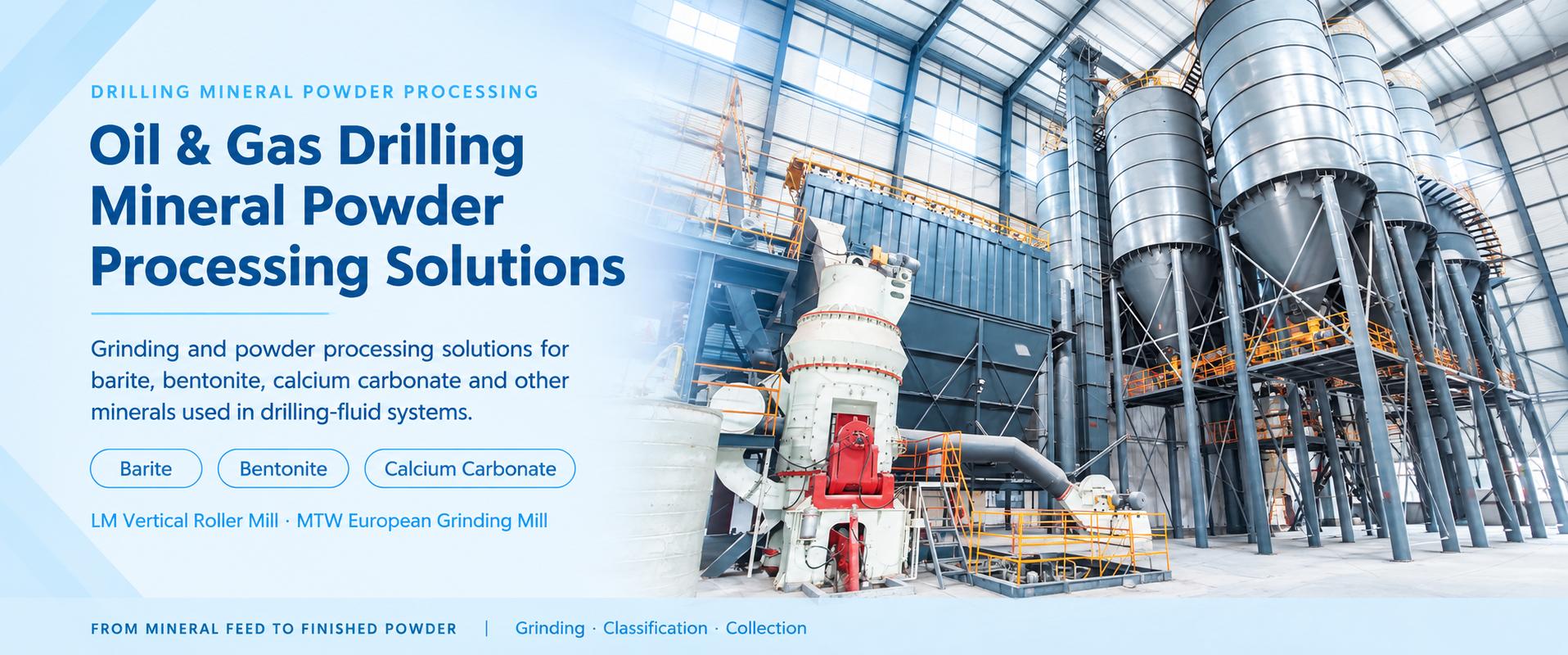
After the material and product requirements are defined, the grinding system can be selected. For industrial gypsum, the choice between MTW European Grinding Mill, LM Vertical Roller Mill and Raymond mill depends mainly on capacity, moisture, feed stability, target fineness and need for integrated drying.
MTW European Grinding Mill
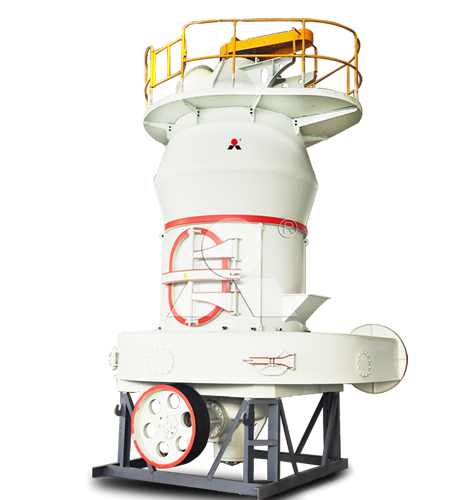
MTW European Grinding Mill is suitable for small-to-medium capacity gypsum powder projects with prepared, relatively dry or conditioned feed. It can provide controlled conventional powder fineness and stable classification. When the incoming gypsum is wet, separate dewatering or drying may be needed before grinding.
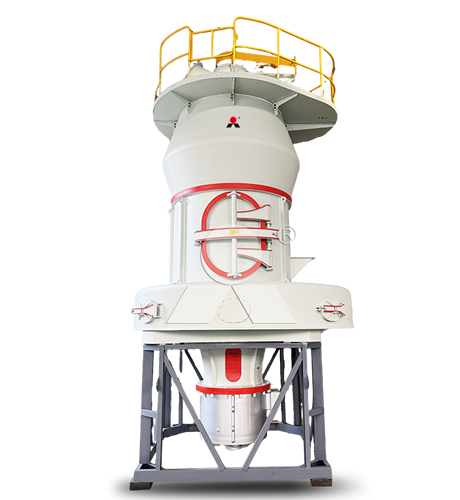
LM Vertical Roller Mill
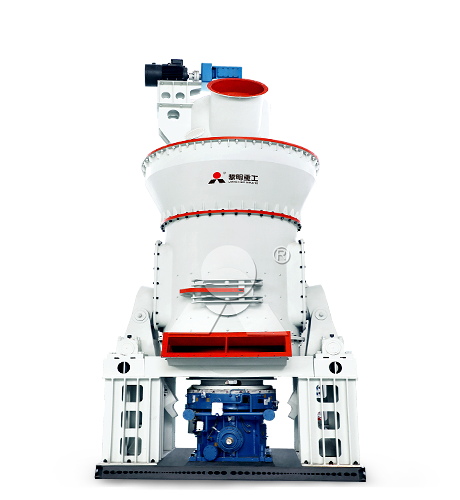
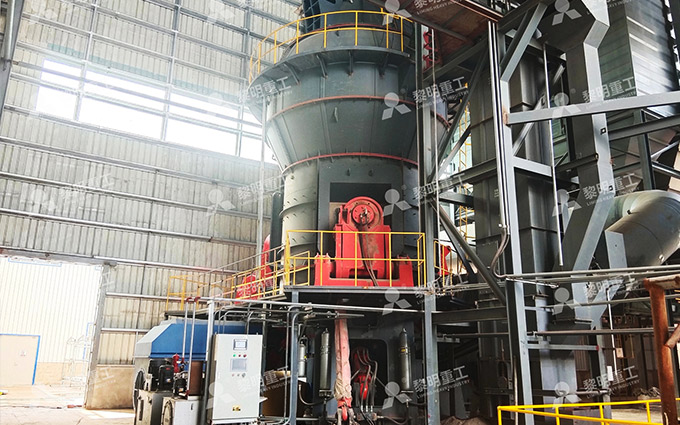
LM Vertical Roller Mill is suitable for medium-to-large and high-capacity gypsum grinding projects. It can integrate drying, grinding and classification when the project has a suitable heat source and the feed moisture creates a meaningful drying requirement.
LM Vertical Roller Mill is often selected for FGD gypsum, phosphogypsum or other industrial gypsum sources that have moderate moisture, high throughput requirements or a need for a compact integrated process. The system must be designed around actual evaporation load, not simply around mill capacity.
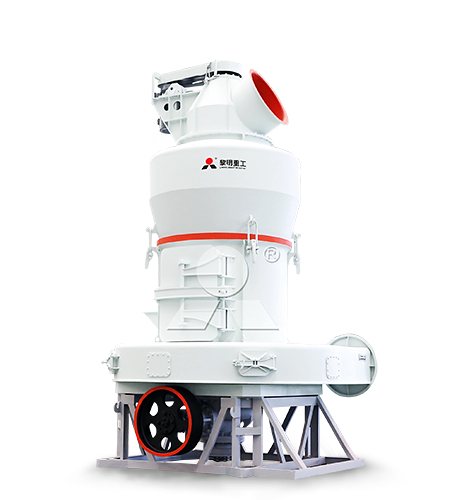
Raymond Mill
Raymond mill can be considered for conventional gypsum powder production with moderate output requirements and stable, dry or pre-dried feed. It is suitable when the project does not require major integrated drying duty and the material can be fed consistently.
9. Heat Source and Energy Conditions
If drying is required, the plant designer needs information about the available heat source. This determines whether integrated drying is feasible and influences operating cost, safety design and environmental-control requirements.
Useful information includes:
Available fuel type, such as natural gas, coal, biomass or another approved source
Available waste heat or hot gas from an existing process
Hot-gas temperature and available flow rate
Fuel cost and energy price
Electrical power supply and voltage
Site emissions requirements
Required temperature-control range
The heat source must be selected to remove free moisture while preventing unintended gypsum dehydration when the final product is required to remain calcium sulfate dihydrate. If the project requires hemihydrate gypsum for plaster or board production, calcination should be designed as a separate controlled stage.
10. Site Conditions and Plant Layout
Plant design also depends on the installation site. Equipment selection should reflect land availability, building height, raw-material transport, finished-product dispatch, environmental requirements and local utilities.
Important site information includes:
Available installation area and building-height limits
Raw-material receiving method, such as truck, rail, belt conveyor, barge or bulk storage
Distance from gypsum source to the grinding plant
Required raw-material storage capacity
Finished-powder storage and loading method
Access for maintenance and replacement of major components
Local electrical supply and backup-power requirements
Water supply and wastewater requirements if washing is included
Dust-emission, noise and environmental-control requirements
Local climate, humidity and rain exposure conditions
For FGD gypsum projects, locating the plant close to the source and the final market can reduce transport cost and limit repeated moisture exposure. Material-handling planning should include covered storage, conveyor design and moisture protection from the beginning.
11. Finished Powder Storage and Dispatch
Finished gypsum powder must remain dry and free-flowing after grinding. The plant should therefore define how the material will be stored and delivered before equipment is selected.
Key questions include:
Will powder be stored in silos, warehouses, bulk bags or small bags?
Will it be loaded into bulk tankers, containers or bags?
How long will it remain in storage before dispatch?
Does the customer require bulk delivery or packaged product?
What moisture protection is needed during storage and transport?
What dust-control measures are required during loading?
Poor storage design can reduce the value of an otherwise well-designed grinding plant. If finished gypsum powder absorbs moisture after collection, it may cake, lose flowability and become difficult to dose or transport.
12. Required Documents for a Preliminary Proposal
For an equipment supplier or engineering team to prepare a reliable preliminary gypsum grinding proposal, provide the following package:
Gypsum type and source-process description
Representative chemical analysis
Free-moisture range and total-moisture data
Raw-material photos and description of physical condition
Feed-size distribution and maximum lump size
Bulk density and flowability information if available
Required final powder fineness and test method
Required finished-powder capacity in tonnes per hour
Required annual production and operating schedule
Final application and customer quality specification
Need for drying, calcination, washing or other pre-treatment
Available heat source and electrical power conditions
Site layout, installation area and height limitations
Raw-material and finished-product storage requirements
Environmental, dust-control and local compliance requirements
Conclusion
A gypsum grinding plant is designed around the material and final product, not around a mill model alone. The essential information includes gypsum source, chemical composition, moisture variation, feed size, physical condition, target fineness, finished-powder capacity, final application, drying requirement, available heat source and site conditions.
MTW European Grinding Mill is suitable for prepared small-to-medium capacity gypsum powder projects. LM Vertical Roller Mill is suitable for high-capacity projects and materials that benefit from integrated drying, grinding and classification. Raymond mill is suitable for conventional powder production with dry, stable and adequately prepared feed.
For industrial by-product gypsum, representative material testing and application-specific quality evaluation should always come before final equipment selection. With complete project data, the grinding plant can be designed to deliver stable capacity, controlled fineness and reliable powder quality.