Industrial By-product Gypsum Solutions
Can Industrial By-product Gypsum Be Used for Gypsum Board?
2026-09-08 16:06:12
Industrial by-product gypsum can be used for gypsum board when the material meets the board manufacturer’s technical, safety and regulatory requirements. FGD gypsum is the most established industrial gypsum source for wallboard production because it can be predominantly calcium sulfate dihydrate after washing, oxidation and dewatering. Other materials, including phosphogypsum, may require more extensive testing, purification and compliance evaluation before they can be considered for gypsum board.
Grinding is only one part of the preparation process. A gypsum board plant needs consistent raw material quality, controlled moisture, suitable particle characteristics and predictable calcination behavior. The final decision should be based on representative material testing and production trials with the receiving board manufacturer.
How Gypsum Board Is Made
Gypsum board, also called plasterboard, drywall or wallboard, is generally manufactured by converting gypsum into a calcined calcium sulfate product, mixing it with water and additives, forming a slurry between paper liners and allowing the gypsum to set again into a solid board.
The core chemical cycle is based on calcium sulfate hydrate:
Calcium sulfate dihydrate + heat → calcium sulfate hemihydrate + water vapor
Calcium sulfate hemihydrate + water → calcium sulfate dihydrate
Natural gypsum and suitable synthetic gypsum can both follow this route. The important requirement is that the raw gypsum must behave consistently during drying, calcination, slurry preparation, board forming, setting and final drying.
Which Industrial Gypsum Is Most Suitable for Gypsum Board?
FGD gypsum
FGD gypsum is generally the most suitable and widely used industrial by-product gypsum source for gypsum board. It is produced in wet flue-gas desulfurization systems where sulfur dioxide is removed from exhaust gas using limestone or lime-based absorbents. With effective forced oxidation, calcium sulfite is converted into calcium sulfate dihydrate.
After washing and dewatering, FGD gypsum can have a chemical composition similar to natural gypsum. This makes it suitable for board production when it meets required specifications for purity, moisture, particle characteristics and contaminants. FGD gypsum is recognized as synthetic gypsum and is used in gypsum panel manufacturing in a number of markets.
However, FGD gypsum usually has higher moisture than mined gypsum because it is recovered from a wet process. It may require additional dewatering, drying or controlled handling before calcination and board manufacture.
Phosphogypsum
Phosphogypsum is produced during phosphoric acid manufacture. Although it contains calcium sulfate dihydrate, it can also contain residual phosphate, fluoride-related compounds, soluble salts, organic matter, trace elements and naturally occurring radionuclides. These factors make phosphogypsum more complex to use in gypsum board than FGD gypsum.
Phosphogypsum may be considered for gypsum-based building materials only after source-specific testing and appropriate treatment. Depending on the material and local requirements, treatment may include washing, neutralization, impurity removal, filtration, drying, calcination or blending.
Radiological evaluation is particularly important for phosphogypsum. Research reviews note that building-material use must account for radionuclide concentrations and the applicable exposure requirements. In the European context, building-material assessment may use a radioactivity concentration index based on radium-226, thorium-232 and potassium-40.
Other industrial by-product gypsum
Citrogypsum, titanogypsum, fluorogypsum, borogypsum and other industrial gypsum sources may be evaluated for gypsum board, but none should be assumed suitable simply because it contains calcium sulfate. Each source can have different impurities, moisture, particle behavior and product-compliance requirements.
For these materials, the project should first define the board product, target market and acceptance criteria. The gypsum source should then be tested against those criteria before process and equipment selection begins.
What Quality Does Gypsum Board Require?
Gypsum board production requires more consistent raw material quality than many bulk gypsum applications. A cement plant may be able to use a gypsum source primarily as a sulfate regulator, but gypsum board production depends on controlled calcination, slurry behavior, setting time, board strength, surface quality and production-line stability.
The exact specification is set by the board manufacturer, but typical evaluation areas include:
Calcium sulfate dihydrate content and gypsum purity
Free moisture and total moisture
Particle-size distribution and particle morphology
Soluble salts, especially chloride where relevant
Residual carbonate, sulfite or other non-gypsum material
Phosphate, fluoride and acidity where relevant
Organic matter and color-related impurities
Trace elements and radiological characteristics where required
Calcination behavior and hemihydrate quality
Setting behavior after water and additives are introduced
Compatibility with paper liners, foaming agents, starch, retarders and accelerators
FGD gypsum can have high bulk density because of its crystal characteristics. This can affect storage, feeding, conveying and the amount of water needed in gypsum board slurry preparation. Board producers should therefore evaluate bulk density and water demand in addition to chemical composition.
Why Moisture Control Is Important
Moisture is one of the most important process variables when industrial gypsum is used for gypsum board. FGD gypsum is commonly obtained as wet filter cake, while phosphogypsum and other industrial gypsum sources may also arrive with high or variable free moisture.
Excess moisture can create several problems:
Material can compact or bridge in hoppers and feeders.
Wet gypsum can form lumps during storage and transport.
Drying energy demand can increase significantly.
Feed-rate control to the calciner can become unstable.
Inconsistent moisture can affect calcination and finished stucco quality.
Powder can cake during storage after grinding.
The material should be dewatered and dried to the moisture range required by the calcination and board-forming process. The target is not a universal moisture number. It depends on the source material, calciner design, plant layout, powder-handling system and the board manufacturer’s operating requirements.
Typical Process: Industrial Gypsum to Gypsum Board Raw Material
The exact process varies by gypsum source and board plant, but the general route includes material preparation, moisture control, grinding, calcination and finished-stucco handling.
Receive industrial gypsum and store it under controlled conditions.
Collect representative samples and confirm material quality.
Remove foreign materials and break compacted lumps if needed.
Wash, neutralize or treat impurities when required by the gypsum source.
Dewater and dry the material to a suitable feed condition.
Grind and classify the gypsum to achieve consistent feed for calcination.
Calcine calcium sulfate dihydrate to produce calcium sulfate hemihydrate.
Cool, store and dose the calcined gypsum powder.
Mix stucco with water and additives, then form the board between paper liners.
Allow the board core to set, cut the board and complete final drying.
Grinding and calcination are separate functions. Grinding controls particle size and feed consistency. Calcination changes calcium sulfate dihydrate into hemihydrate through controlled heating. A board project should define both requirements before selecting the gypsum preparation system.
Role of Grinding in Gypsum Board Production
Grinding helps produce a consistent feed for calcination and board manufacture. It can break agglomerates, control particle-size distribution and improve powder uniformity. The right fineness supports stable calcination, predictable water demand and consistent slurry behavior during board forming.
Grinding should not be excessive. Finer powder can increase surface area and may change water demand, calcination response and handling behavior. The target particle-size distribution should be established through board-production trials, not by assuming that the finest possible gypsum powder will produce the best board.
The required grinding route depends on whether the material is ground before calcination, after calcination or as part of an integrated processing arrangement. The board manufacturer’s process and quality specification should determine the final configuration.
Grinding Equipment for Industrial Gypsum Board Feed
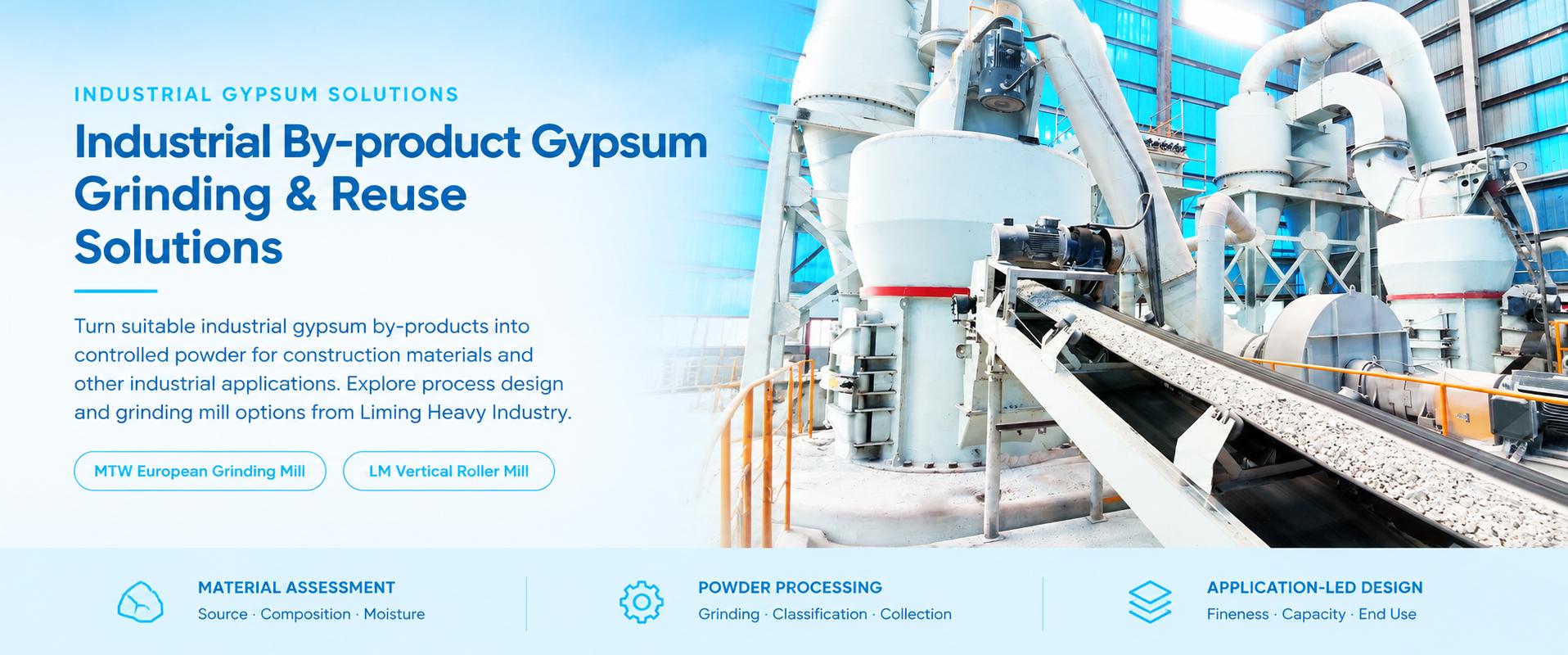
For suitable industrial gypsum feed, MTW European Grinding Mill, LM Vertical Roller Mill and Raymond mill can be considered according to moisture, capacity, target fineness and the need for drying integration.
MTW European Grinding Mill
MTW European Grinding Mill is suitable for small-to-medium capacity industrial gypsum powder production where the feed has been properly prepared. It can be used when moisture is controlled, material flow is stable and the process requires consistent conventional powder fineness before a separate calcination or board-production stage.
For FGD gypsum, upstream dewatering and drying may be required before MTW European Grinding Mill if the filter cake has excessive free moisture. For phosphogypsum, any required impurity treatment and compliance evaluation should be completed before the material enters the grinding line.
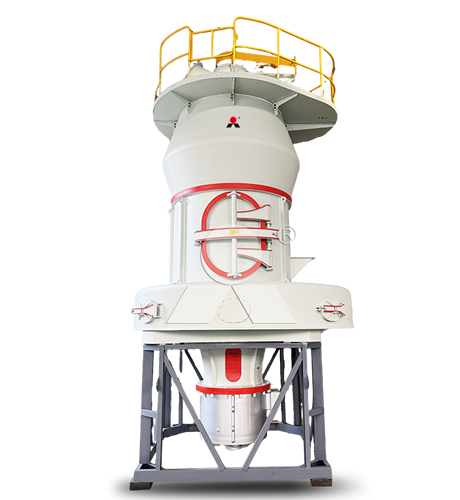
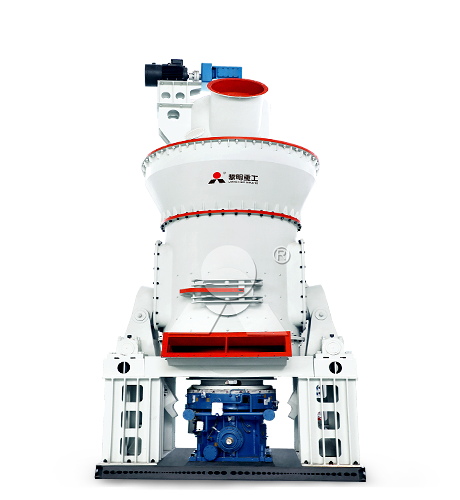
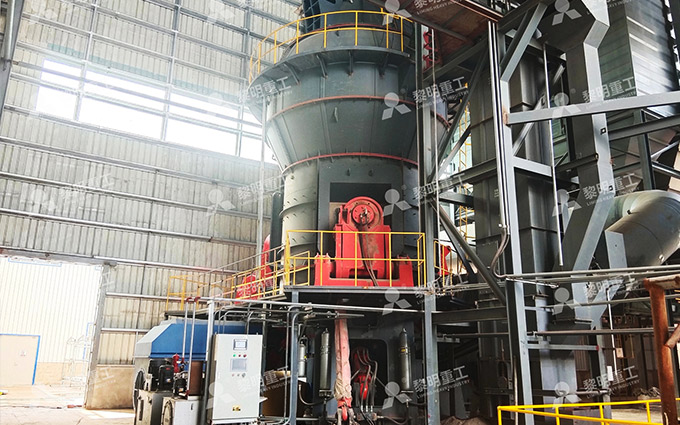
LM Vertical Roller Mill
LM Vertical Roller Mill is suitable for larger-capacity industrial gypsum processing systems. It can integrate drying, grinding and classification when the source material, available heat source and overall process design support this arrangement.
This makes LM Vertical Roller Mill particularly relevant for FGD gypsum or other industrial gypsum with moderate-to-high moisture. The final configuration should consider actual evaporation duty, moisture variation, target fineness, throughput, calcination route and required powder-storage conditions.
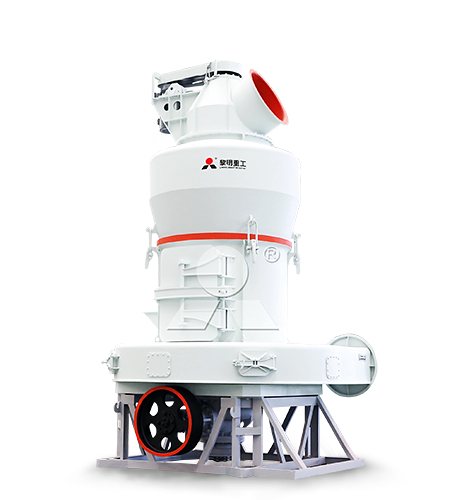
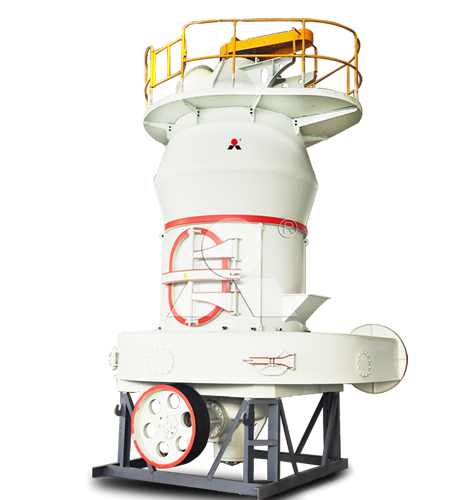
Raymond Mill
Raymond mill can be considered for conventional gypsum powder production with moderate output requirements and dry, stable, pre-treated feed. It is generally better suited to material that has already been dewatered and dried rather than wet filter cake or sticky gypsum with large moisture variation.
Before using a Raymond mill for board-feed preparation, confirm feed size, moisture, powder fineness, production capacity and the board plant’s calcination requirements. Stable feed preparation is essential for reliable mill operation.
FGD Gypsum vs. Phosphogypsum for Gypsum Board
| Factor | FGD Gypsum | Phosphogypsum |
|---|---|---|
| Typical source | Wet flue-gas desulfurization systems | Wet-process phosphoric acid production |
| Main gypsum component | Usually calcium sulfate dihydrate after oxidation | Usually calcium sulfate dihydrate with source-specific impurities |
| Common preparation need | Washing, dewatering, drying and particle-size control | Detailed analysis, possible washing, neutralization, impurity treatment, drying and compliance evaluation |
| Moisture condition | Often supplied as moist filter cake | Can be wet, variable and influenced by storage conditions |
| Impurity concern | Residual salts, chlorides, sulfite, carbonate and ash-related components | Phosphate, fluoride, acidity, soluble salts, trace elements and radionuclides |
| Gypsum board suitability | Established route when board-grade specifications are met | Requires source-specific technical, safety and regulatory confirmation |
Common Challenges When Using Industrial Gypsum for Board
Variable material quality
Material variation can affect calcination response, water demand, setting time and board strength. The processing plant should use regular sampling and define acceptance limits for each important quality parameter.
High free moisture
Wet filter cake can create feed instability, increased drying cost and material buildup. Dewatering, covered storage, controlled feeding and adequate drying capacity are important for stable board-feed preparation.
Impurity-related production problems
Soluble salts, phosphates, fluorides, acidity, organic matter and other impurities can affect gypsum crystal growth, setting behavior, paper adhesion, board appearance or final product performance. If the material is outside the board plant’s acceptable range, grinding alone cannot solve the problem.
Inadequate particle-size control
Large variations in particle size can affect calcination uniformity and slurry behavior. The grinding and classification system should maintain a stable particle-size distribution that matches the board plant’s process requirements.
Regulatory and safety requirements
For phosphogypsum and other sensitive industrial gypsum sources, compliance evaluation should be completed before a board project is approved. The required review may involve building-material standards, environmental requirements, workplace controls and radiological assessment, depending on the source material and country of use.
Recommended Evaluation Procedure
Identify the industrial gypsum source and the original production process.
Collect representative samples from normal production and storage conditions.
Test gypsum content, moisture, particle size, impurities and flowability.
Complete radiological, environmental and regulatory evaluation where required.
Define the board manufacturer’s raw-material and calcination requirements.
Determine whether washing, neutralization, dewatering, drying or other pre-treatment is needed.
Set the target feed fineness and moisture for the calcination process.
Select MTW European Grinding Mill, LM Vertical Roller Mill or Raymond mill according to feed condition, capacity and drying requirement.
Conduct calcination, slurry and board-production trials before commercial-scale supply.
Establish routine quality control for incoming gypsum and finished board-feed powder.
Conclusion
Industrial by-product gypsum can be used for gypsum board, but only when it meets the requirements of the board-production process. FGD gypsum is the most established industrial gypsum source for wallboard because its composition can be similar to natural gypsum after suitable processing. Moisture control, washing, dewatering, grinding and calcination are all important steps in preparing FGD gypsum for board manufacture.
Phosphogypsum and other industrial gypsum sources can be more challenging because they may contain impurities and may require additional treatment, safety assessment and regulatory review. Their suitability must be confirmed through source-specific analysis and board-production trials.
For industrial gypsum feed preparation, MTW European Grinding Mill is suitable for prepared small-to-medium capacity projects, LM Vertical Roller Mill is suitable for large-capacity systems and materials requiring drying integration, and Raymond mill is suitable for conventional powder production with dry, stable feed. Final equipment selection should follow material testing, target board quality and the requirements of the receiving manufacturer.